


Xu Gao is the Chief Economist and Assistant President of Bank of China International Co. Ltd., an investment bank, and an adjunct professor at the National School of Development (NSD) at Peking University.
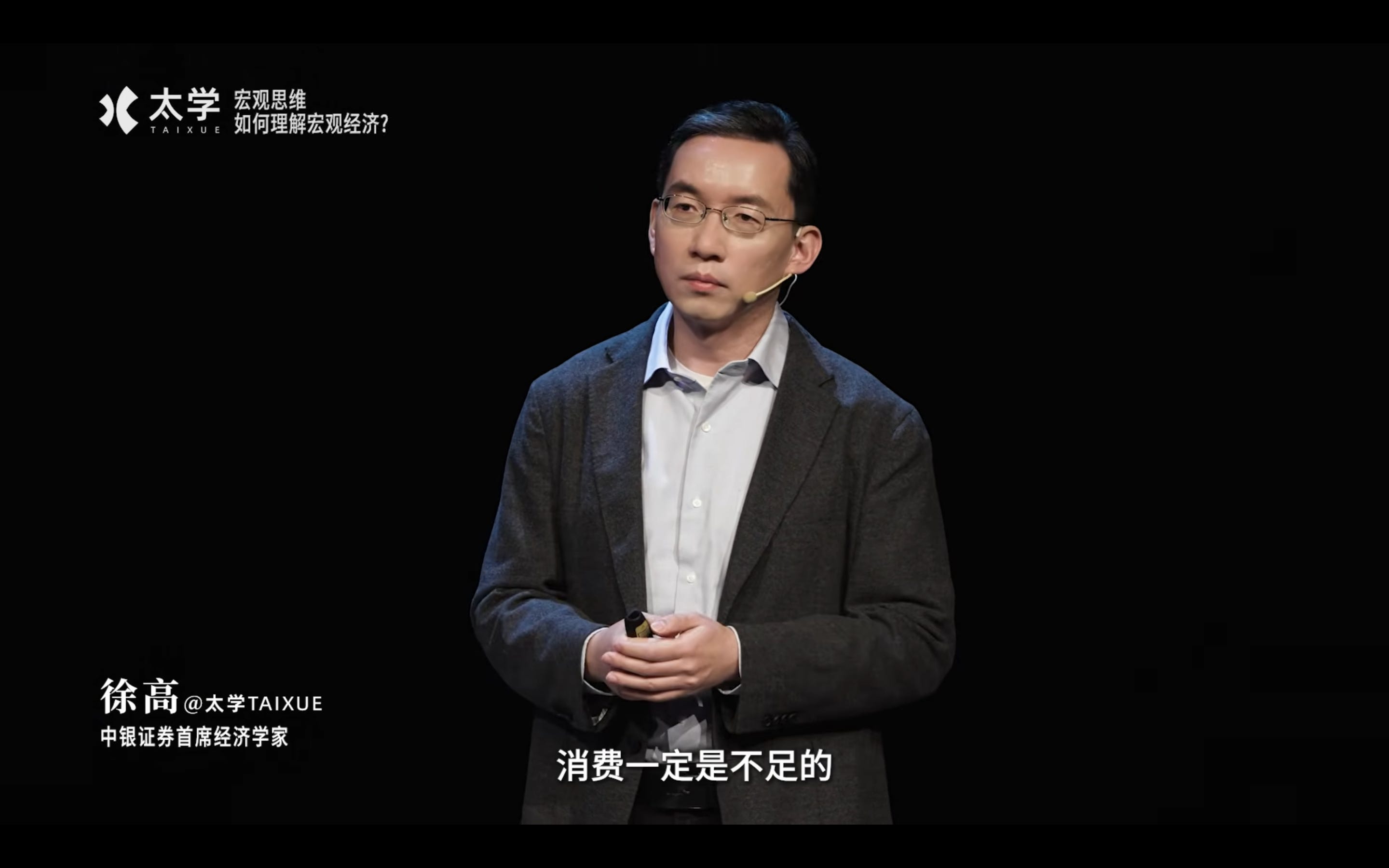
He delivered a TED-style talk on China’s healthcare challenges and proposed reforms at TAIXUE, a programme of the New Economist think tank, on 29 January 2026. A transcript was published on the New Economist’s official WeChat blog on 10 September, and the video recording is available on TAIXUE’s YouTube channel.
Xu has reviewed the following translation before publication.
徐高:宏观思维如何理解宏观经济
Xu Gao: Understanding the Macroeconomy Through Macroeconomic Thinking
Hello, everyone. I am Xu Gao. I am delighted to talk to you today about the macroeconomy — a familiar subject that many people do not really understand. I would like to make five points.
My first point is that the macroeconomy is different from the microeconomy. Understanding the macroeconomy requires macroeconomic thinking.
Everyone is familiar with the idea of the macroeconomy. Everyone is part of it and has their own understanding of it. That can make it seem as though anyone can talk about macroeconomics. Yet for many people, the macroeconomy is actually unfamiliar and even rather strange, because some of the mechanisms and principles at work are rarely encountered in everyday life.
Consider a microeconomic entity such as a company. Every company operates within an external environment that it cannot control and must take as given. Suppose that, because of weak economic conditions, a company suddenly finds that market demand for its products has fallen. It struggles to sell its products, and its revenue declines. How should it respond to this shock? The intuitive answer is to cut costs and improve efficiency: reduce spending to protect profit margins and weather the downturn in demand.
No business owner would say, “Demand is weak, and my revenue has fallen, so I should pay my employees more.” Because even if higher wages gave the employees greater purchasing power and they spent some of that money on the company’s products, the company would still be very small relative to the market in which it operates.
In other words, even if the employees are among the company’s customers, they would make up only a tiny share of its customer base. Raising their income will not reverse the decline in market demand for the company’s products. It will simply increase costs, reduce the profit margin, and make it harder for the company to weather the downturn.
For a microeconomic entity facing a shock from weak external demand, the appropriate response is, of course, to cut costs and improve efficiency. Applying the same logic to the macroeconomy, however, would be a mistake.
Consider macroeconomic policy. When demand is weak across the economy, businesses in many industries struggle to sell their products, and government revenue is consequently low; how should the government respond? Cutting costs and reducing expenditure are not the right answer, because government policy itself has a substantial influence on the macroeconomic environment in which the government operates.
Government expenditure is an important source of private-sector income. If the government cuts spending when economy-wide demand is already insufficient, private-sector income will fall further. Households and businesses will become less willing to spend, aggravating the demand shortfall. Government tax revenue will then decline further as well.
In macroeconomics, the appropriate policy response to insufficient demand is therefore not contraction but expansion. By increasing expenditure, the government can raise private-sector income, support economic activity, and ease the shortfall in demand across the economy. The logic of the macroeconomy is thus the opposite of that of the microeconomy.
Why is that? When analysing macroeconomic policy, it is essential to recognise that government policy changes the macroeconomic environment, which in turn affects the government’s own revenue. A feedback loop can therefore develop between expenditure and revenue: in some circumstances, the more the government spends, the more revenue it ultimately receives; the more it cuts spending, the more its revenue declines. This is difficult to grasp from the perspective of everyday experience. It seems counterintuitive and contrary to common sense.
The macroeconomy is therefore very different from the microeconomy. Everyday experience alone is not enough to understand it. Even so-called common sense can be misleading when applied to macroeconomics. This does not mean that common sense is invariably wrong, but it may sometimes lead to the wrong conclusion.
A genuine understanding of the macroeconomy requires macroeconomic thinking. What does that mean? It means considering the different actors in the economy, the complex causal relationships between them, and the feedback effects they generate, so that the macroeconomy can be understood as a whole.
Without macroeconomic thinking, a small error in economic reasoning can lead to a seriously mistaken conclusion. If macroeconomic policies are designed or implemented without this perspective, they can produce a fallacy of composition: each policy may appear reasonable on its own, yet their combined effect may be entirely different from the desired outcome.
My second point is that the root of insufficient demand lies in income distribution.
Insufficient demand has been a major problem for the Chinese economy for more than two decades. In 2000, the Chinese government was already identifying insufficient effective demand as a problem. By 2025, insufficient demand was still being cited as a prominent challenge. It has therefore been a persistent problem for the Chinese economy.
But where does insufficient demand come from? On closer examination, the idea appears paradoxical. Demand is commonly associated with human wants, which are unlimited, whereas supply — however much it expands — must ultimately remain finite. If unlimited wants confront finite supply, how can demand possibly be insufficient?
This is where a deeper macroeconomic understanding becomes necessary. Demand does not refer simply to what people want. It means the willingness of people or other economic actors to spend, backed by the income needed to make purchases in the market. Economists call this “effective demand.”
The longstanding problem facing the Chinese economy is therefore insufficient effective demand. If human wants are unlimited, the problem would appear to be one of purchasing power. Yet money is a constraint for every individual economic actor.
At the macroeconomic level, however, the quantity of money is not a constraint, because a sovereign government can issue currency. What matters behind a country’s money is its purchasing power, which ultimately comes from what the country produces. A country’s total output is also its total income. Viewed as a macroeconomic whole, China therefore generates enough purchasing power to buy everything it produces. In a monetary economy, this purchasing power takes the form of money, and there is enough of it in aggregate.
That income, however, must be distributed among different economic actors and matched with their willingness to spend before it can become effective demand. If income distribution produces a mismatch — leaving those willing to spend without sufficient purchasing power, while those with purchasing power lack the willingness to spend — aggregate purchasing power cannot readily be converted into effective demand. Money accumulates among those who are unwilling to spend it, becoming excess savings rather than actual purchases. This is how a shortage of aggregate, or effective, demand emerges.
The next question is who might have the money to spend but be unwilling to do so. Or, to put it more bluntly, who has money but doesn’t want to spend it? Consumers do not fit this description because human wants, including the desire to consume, are unlimited. When consumers earn more, they will spend more. Investors may behave differently. Their willingness to invest depends heavily on the expected rate of return. If the return falls to a very low level — if 100 yuan invested this year is expected to become only 90 yuan next year — even someone with plenty of money will be unwilling to invest.
The willingness to invest is therefore not unlimited; it is affected by the rate of return. If too little of an economy’s total income flows to households and consumers, while too much flows to investors, effective demand can easily become insufficient. If consumers receive only a small share of total income, consumption will inevitably be insufficient.
Under such conditions, demand tends to depend more on investment. Yet investment is subject to diminishing marginal returns: as its scale increases, its rate of return declines. As returns fall, investors will eventually become less willing to invest, weakening investment-driven demand. If income is not redirected to consumers in time, investors will hold on to money rather than spend it, resulting in insufficient effective demand, or insufficient domestic demand.
Therefore, the principal reason China has experienced insufficient effective or domestic demand for more than two decades is that the household sector receives too small a share of total income.
China’s economy has long tended to favour investment over consumption. When China was still an economy of scarcity, that tendency played an important positive role: it produced a high investment rate, rapid capital accumulation, and correspondingly rapid economic growth. But conditions have changed over the past two decades. China has moved from an economy of scarcity to one of excess supply. Insufficient demand and consumption have become major constraints on growth. Continuing to prioritise investment over consumption under these circumstances will aggravate both problems.
To tackle weak consumption and domestic demand at their source, income distribution must be improved. Suppose, for example, that state-owned assets transferred to social security funds could be credited to individuals’ social security accounts, so that people could receive annual dividends and withdraw the money to spend immediately. This would provide more direct support for consumer income and consumption and provide a powerful boost to the transition towards consumption-led growth. The fundamental remedy for insufficient demand is therefore to improve the distribution of income and raise the household sector’s share of economy-wide income.
In the long run, there are only four possible scenarios for addressing insufficient domestic demand. Three of them are within China’s control: the optimal, suboptimal, and non-optimal strategies.
In an economy facing insufficient demand, the fundamental problem is that income distribution holds back consumption, leaving domestic demand insufficient. One possible response is to rely on external demand. External demand, however, is beyond China’s control and must largely be taken as given. When it is strong, it can generate an export-led boom. From 2003 until the global financial crisis, for example, strong external demand helped China record consecutive years of double-digit growth, at times even producing economic overheating.
China’s economy is now much larger than it was in 2008 and is also very large relative to other economies. At the same time, global trade protectionism has clearly been on the rise. If external demand comes under increasing pressure, China will need to find domestic solutions to the constraints that insufficient demand places on economic growth.
There are three possible domestic strategies, and the logic is straightforward. To rebalance supply and demand when domestic demand is insufficient, an economy must either add to demand or reduce supply. Domestic demand consists essentially of consumption and investment, so adding to demand means either increasing consumption or stimulating investment. Alongside reducing supply, these amount to the three possible domestic strategies.
The optimal strategy is the approach described earlier: improve income distribution and direct a larger share of income to households, thereby strengthening consumption and addressing insufficient domestic demand at its source. A successful transition towards consumption-led growth would also allow ordinary people to share more fully in the benefits of economic growth.
The purpose of China’s development is to meet the people’s growing needs for a better life, and those needs are reflected to a significant extent in higher consumption. Only by improving income distribution, transitioning towards consumption-led growth, and boosting household spending can China better fulfil the ultimate purpose of economic development. That is why this is the optimal strategy.
But the difficulty is that pursuing this strategy requires changes to income distribution. Such changes are extremely difficult, and the obstacles are not even primarily economic. Although there is now a strong consensus on the need to boost consumption and raise household incomes, it will take time to achieve substantive progress on the necessary policies.
The suboptimal strategy is investment. If it is difficult to add substantially to consumption, investment is the remaining way to increase demand. Ultimately, the choice is whether to continue investing. Continuing to create demand and stabilise growth through investment is often described as returning to the old investment-led model. This is the suboptimal strategy, intended to maintain a stable balance between supply and demand and thereby keep economic growth steady.
However, the suboptimal strategy has a consequence: as investment expands, its rate of return will continue to fall, potentially turning many projects into low-efficiency or ineffective investments. But if these concerns actually bring investment to a halt, consumption, investment, and external demand could all remain weak. With no way to boost demand, the economy would then be forced to adjust through a contraction in supply.
China experienced such an adjustment between 1998 and 2002, five consecutive years of deflation. In 1998, China set a goal of helping struggling state-owned enterprises overcome their difficulties within three years. That was the non-optimal strategy: when demand could not be kept sufficiently strong, the supply side underwent large-scale capacity reduction. Such an adjustment is likely to be the most damaging of the three strategies.
These are the four possible long-term scenarios for addressing insufficient domestic demand and the three strategies available to China. Logically, these four paths cover all the possibilities. External demand is beyond China’s control, and a consumption-led transition will take time. For now, that leaves a choice between the suboptimal strategy of investment-led growth and the non-optimal strategy of cutting capacity.
This brings me to my fourth point: the suboptimal, investment-led strategy is entirely sustainable, but its sustainability can be understood only through macroeconomic thinking.
First, many people will argue that investment-led growth requires investment to keep expanding, eventually weakening the incentive to invest and leading to more inefficient or ineffective investment projects. Are such projects not a waste of resources? That is a valid question, and the answer is yes: inefficient or ineffective investment does waste resources. The next question, however, is whether resources would cease to be wasted if those investments were not made. If abandoning them destabilised demand, the resulting waste would be even greater.
Where does the waste begin? With the distribution of income. When insufficient income is directed to consumers, economic development has already deviated from its ultimate purpose of meeting the people’s needs for a better life. To achieve all these objectives, the best course would be to pursue a transition towards consumption-led growth — the optimal strategy. But if that option is not yet feasible, the suboptimal strategy remains considerably better than the non-optimal one.
Second, many argue that under an investment-led growth model, declining returns will become increasingly unlikely to cover financing costs. Debt financing already dominates China’s financial system, so any expansion in investment will necessarily be accompanied by more debt. China’s debt level is already high. According to the Bank for International Settlements’ measure of total credit to the non-financial sector, China’s debt-to-GDP ratio was close to 300 per cent in the second quarter of 2025. This was above the average for advanced economies, let alone that for developing economies. In 2008, the ratio was below 150 per cent. It has therefore almost doubled.
Whether viewed across countries or over time, the apparent conclusions are that China has too much domestic debt and that its debt is growing rapidly. This naturally raises the question of whether such a large and fast-growing debt burden will trigger a crisis. A widely held view is that China should therefore reduce debt — or at least slow its growth — through deleveraging policies to contain the risk. This line of reasoning is very popular.
However, simply observing that China has a higher debt ratio than other countries does not establish that its debt is excessive or that a crisis is imminent. The methodology is fundamentally flawed. Whether there is too much or too little of something depends not primarily on its absolute quantity, but on the balance between supply and demand. China’s debt must be examined within that supply-and-demand balance before its scale can be judged excessive or insufficient.
China does have a large volume of debt, but it is also an economy with excess savings. Its savings rate has fallen significantly since 2008, when it exceeded 50 per cent. It has declined by roughly 10 percentage points but remains above 40 per cent — around twice the average level in many other countries. China is therefore an excess-savings economy.
Savings constitute the supply of debt, while debt represents demand for those savings. The scale of China’s debt must be assessed in relation to the balance between savings and borrowing, not by examining debt alone.
There is little doubt that China currently has excess savings. Large pools of savings are looking for investment opportunities or other outlets but struggle to find suitable ones. This is clearly visible in the financial markets. One prominent phenomenon in China’s financial system in recent years has been a “shortage of investable assets”: financial institutions hold substantial funds but cannot find suitable projects in which to invest. Behind this financial phenomenon lies large amounts of savings that have nowhere to go. It is the manifestation of an excess of savings over demand for borrowing.
When savings are excessive, even a large volume of debt may still be insufficient. Conversely, if a country has excess domestic demand and insufficient savings, even a small amount of debt may be excessive. Looking at the absolute size of China’s debt alone tells very little. Debt must be considered within the supply-and-demand relationship between borrowing and savings. Given that China has insufficient domestic demand and excess savings, the present problem is not too much debt, but too little.
Some will surely ask: where do these excess savings come from? As explained earlier, insufficient domestic demand arises when income distribution creates a mismatch between purchasing power and the willingness to spend. Some economic actors have purchasing power but little desire to spend it, so their purchasing power is not fully converted into effective demand. This unspent purchasing power accumulates in their hands and becomes the source of excess savings. An economy with insufficient domestic demand, such as China, must therefore also have excess savings. For an economy with excess savings, the size of its debt is not the problem.
These two considerations show that the suboptimal, investment-led strategy is entirely sustainable in China. A declining rate of return need not make the model impossible to maintain. In fact, in his phenomenal The General Theory of Employment, Interest and Money, John Maynard Keynes even put forward a seemingly extraordinary idea: when demand is insufficient, the government could pay people to dig holes, fill them in, and then dig them again. This is commonly known as Keynes’s “digging holes” argument.
But think about it: what is the point of digging holes? What return could such an activity generate, especially if the holes are simply filled in again? The value of digging holes only becomes clear when viewed from a macroeconomic perspective. Although the activity itself appears to create no value, it can be seen as a way of transferring income to unemployed workers — a form of work relief. If money cannot be given directly to the public, paying people to do such work offers an indirect alternative. Its greater value lies in its wider social benefits: stabilising employment, supporting demand, and sustaining economic growth.
Therefore, when assessing the return on investment under this suboptimal strategy, it is not enough to focus solely on the cash flow generated by individual projects. The wider social benefits created by investment must also be considered. Taking those social benefits into account, alongside the broader conditions of insufficient domestic demand and excess savings, shows why this suboptimal strategy is entirely sustainable.
My fifth and final point is that, today, the world is ruled by mere ideas.
In the final paragraph of the last chapter of his great book The General Theory, Keynes made the following famous observation: “…the ideas of economists and political philosophers, both when they are right and when they are wrong, are more powerful than is commonly understood. Indeed the world is ruled by little else. Practical men, who believe themselves to be quite exempt from any intellectual influences, are usually the slaves of some defunct economist.”
The macro and micro levels differ considerably. Many constraints that appear fixed at the micro level are not fixed at the macro level; they are endogenous.
For a company or an individual, money is certainly a constraint. At the macro level, however, the money supply is not fixed, because the government can print it. Demand is also a constraint for an individual company: if market demand for its products is weak, it cannot sell them. But at the macro level, government policies can regulate and create demand, so demand is not a fixed constraint on the macroeconomy. Supply may seem an obvious constraint. Once a company has reached the limits of its production capacity, it cannot simply produce more. At the macro level, however, structural policies can expand the economy’s productive capacity. At least in the long run, supply capacity is not a fixed constraint either.
What, then, is the true constraint on the macroeconomy?
The discussion so far has shown that even if external circulation is weak and external demand comes under severe pressure, China still has three domestic strategies: the optimal, the suboptimal, and the non-optimal. Why, then, has downward pressure on economic growth persisted in recent years? The reason is simple: there is still insufficient understanding of how the macroeconomy actually works. Without recognising the importance of income distribution to stable, long-term economic growth, or the need to improve it to support a transition towards consumption-led growth, the optimal strategy will remain out of reach. Likewise, without recognising that the supposedly “old path” of investment-led growth can be sustained through macroeconomic thinking, policymakers will not dare to keep stimulating investment.
The real constraint, then, is a mistaken understanding of the economy arising from a lack of macroeconomic thinking. In my view, this misreading has much to do with the economics education in China.
The current mainstream Western macroeconomic framework is known academically as the “New Neoclassical Synthesis.” Most people have probably never heard the term. Yet this is precisely the kind of idea Keynes said rules the world. People may never have heard its name, but it still shapes their lives and the world they live in.
In essence, the New Neoclassical Synthesis is a form of microeconomics. The role of effective demand, and the feedback effects between spending and income discussed earlier, are largely absent from this mainstream Western macroeconomic framework. Why is that? This framework matured in the United States, whose circumstances are the opposite of China’s. China faces insufficient demand, whereas the United States faces excess demand and insufficient supply. So a framework developed in the context of the US economy largely reflects the workings of an economy constrained by supply. The logic of a supply-constrained macroeconomy is, to a significant extent, similar to that governing an individual company. In this sense, mainstream Western macroeconomics is essentially microeconomic.
The feedback effects discussed earlier are what make macroeconomics so rich and interesting, yet they are difficult to find in mainstream Western macroeconomics. As a result, many people trained in Western economics see both the world and China through the lens of this mainstream paradigm. This makes it difficult for them to understand China’s economy as it actually operates.
For China’s economy to overcome its current pressures, it is necessary both to learn from the history of economic thought and to draw lessons from real-world experience. Theory must be tested against reality and applied in practice. Only by using macroeconomic thinking to understand how the Chinese economy actually works can China achieve steady and sustainable growth over the long term.
Thank you.

Part II of Xu Gao: Chinese economy at a forking path, leading to three possible futures

On March 13, 2024, the National School of Development (NSD), Peking University, in collaboration with Baidu Economic & Financial News, held the 68th session of the China Economic Observation Report event and launched the 30th-anniversary celebration of the NSD.
Part I of Xu Gao: corporate gains fail to boost household income, leading to over-investment & excessive savings in China

On March 13, 2024, the National School of Development (NSD), Peking University, in collaboration with Baidu Economic & Financial News, held the 68th session of the China Economic Observation Report event and launched the 30th-anniversary celebration of the NSD.
Xu Gao: Why curbing investment can backfire in China

Xu Gao, the Chief Economist and Assistant President of Bank of China International Co. Ltd., and an adjunct professor of the National School of Development (NSD) at Peking University, has been featured on The East is Read several times.
(II) Xu Gao's case for Beijing to spend: stimulus now doesn't hinder structural reforms

This is Part II of Xu Gao's case for stimulus, addressing China's challenges of insufficient demand and excess supply.
China’s consumption problem is an income distribution problem

Last month, Cai Fang, former Vice President—meaning Vice Minister—of the Chinese Academy of Social Sciences (CASS), wrote in the Communist Party of China (CPC)’s flagship journal Qiushi that China should optimise its income distribution structure through institutional development.
Wang Xiaolu’s alternative tally of who gets China’s national income

Wang Xiaolu is Deputy Director and Senior Research Fellow at the National Economic Research Institute, and a former standing Council Member of the China Society of Economic Reform under the National Development and Reform Commission (NDRC).
Li Xunlei: Where to Invest in China

China has no shortage of assets, but too few are worth owning. Li Xunlei, chief economist at Zhongtai Financial International Limited, an investment bank, explains that years of investment-led expansion have increased productive capacity faster than final demand, depressing prices, profits and corporate returns. Meanwhile, China’s vast money supply leav…

