


On July 30, the Politburo met to assess China’s economic conditions and set priorities for the second half of the year. The prevailing market interpretation was that China’s top officials had struck a more supportive tone on the economy but stopped short of announcing major new stimulus. The meeting said macroeconomic policies must “deliver with force and improve effectiveness” and called, among other things, for faster fiscal spending. Investment was an important part of that push.
The following day, the State Council began translating that direction into more concrete measures. Its executive meeting called for faster implementation of major projects under the 15th Five-Year Plan and progress on the “six networks”; heard reports on the construction of new power and logistics networks; and approved four nuclear-power projects.
The renewed emphasis on investment reflects a widely shared diagnosis of China’s recent slowdown. Weak fixed-asset investment, together with slower-than-planned government bond issuance and fiscal spending, has been identified by many market economists as an important reason economic momentum weakened in the first half of the year and domestic demand remained subdued.
In March, Premier Li Qiang’s Government Work Report explicitly called on the government to “fully tap and unleash the potential of effective investment.” Yet the debate is not simply about how much China should invest or how quickly public funds should be spent. In recent years, disagreements over investment have increasingly centred on three more fundamental questions: What is the relationship between investment and consumption? How should the returns on investment be assessed? And how should the debt generated by investment be understood? Different answers to these questions can directly affect the willingness of both governments and businesses to invest.
Xu Gao, Chief Economist of Bank of China International (China) Co., Ltd., interprets the investment agenda set out in the 2026 Government Work Report, including increased central budget investment, ultra-long special treasury bonds for major national projects, larger local-government special bond quotas, and new policy-based financial instruments designed to draw in private capital.

The article appears as Chapter 7 of Understanding the Opening Year of the 15th Five-Year Plan: Chief Experts from Market Research Institutions Interpret the 2026 Government Work Report, published by China Yanshi Press in May 2026. It was published on Xu’s personal WeChat blog on 31 May.
促进有效投资需厘清三个问题
Three Questions That Need to Be Clarified to Promote Effective Investment
This article appears as Chapter 7 of Understanding the Opening Year of the 15th Five-Year Plan: Chief Experts from Market Research Institutions Interpret the 2026 Government Work Report, recently published by China Yanshi Press. The chapter focuses on the sections of the Government Work Report concerning investment. I am grateful to China Yanshi Press for inviting me to contribute.
The 2026 Government Work Report (hereinafter referred to as the “Report”) identifies “building a robust domestic market” as the first major task for the government this year. The world is undergoing profound changes unseen in a century. Unilateralism is on the rise, trade protectionism is becoming more prevalent, and geopolitical risks continue to emerge, creating greater uncertainty for China’s external demand. Against this backdrop, China must, as the Report requires, continue to regard the expansion of domestic demand as a strategic priority and expand internal circulation so that the economy is better able to withstand shocks affecting external circulation.
Enhancing effective investment is an important part of building a robust domestic market. The Report states, “Taking the expansion of domestic demand as our priority, we should make coordinated efforts to boost consumption and expand investment, tap into every potential for growth in domestic demand, and better leverage the strengths of our enormous market.” Investment and consumption are the two principal components of domestic demand and are equally important. The Report therefore explicitly calls for efforts to “fully tap and unleash the potential of effective investment.”
Unlocking that potential requires a clearer understanding of three questions concerning investment. Investment momentum depends to a large extent on the willingness of different entities to invest, and that willingness is shaped by how investment is understood.
In recent years, there has been extensive discussion and disagreement over three key questions: What is the relationship between investment and consumption? How should the returns on investment be assessed? And how should the debt generated by investment be understood?
An incomplete or unbalanced understanding of investment may weaken the willingness to invest and prevent the objectives set by the central authorities from being fully translated into action. This article therefore examines these three questions and sets out personal observations on how they should be understood.
I. What Is the Relationship Between Investment and Consumption?
Within domestic demand, consumption is the objective, while investment is a means to that end. As General Secretary Xi Jinping said, “the ultimate goal for advancing socioeconomic development is to meet people’s increasing needs for a better life.” These needs are expressed to a large extent in the desire to consume more and to enjoy higher-quality goods and services. In this sense, consumption is the objective, and boosting consumption reflects the people-centred orientation of China’s economic development. Policies aimed at expanding domestic demand should therefore give priority to boosting consumption.
Sustained growth in consumption cannot be achieved without investment. Although consumption is the objective, it cannot be sustained in the absence of the capital accumulation and economy-wide income growth generated by investment. New consumer demand must also be met by the new supply created through investment, while new supply can in turn generate additional consumer demand.
The outline of the 15th Five-Year Plan calls for China to “use new demand to guide new supply and new supply to create new demand; promote positive interaction between consumption and investment and between supply and demand; achieve a higher-level dynamic balance between supply and demand; and strengthen the endogenous drivers and resilience of internal circulation.” The Report also states that “we must…invest in both physical assets and people” and calls for government spending this year to be allocated “with priority given to boosting consumption, investing in people, and raising living standards.”
Taken together, these statements by the Party Central Committee underscore the mutually reinforcing relationship between consumption and investment and establish a clear requirement to use investment to boost consumption.
When consumption is insufficient, the investment rate will naturally tend to be higher. Weak consumption means that a larger volume of investment is needed to maintain stable economic activity. As a developing country, China still has considerable scope for investment. The country has a large population, making its economy enormous in aggregate terms. Many of its economic indicators rank among the highest in the world, and some rank first, though per capita levels remain relatively low.
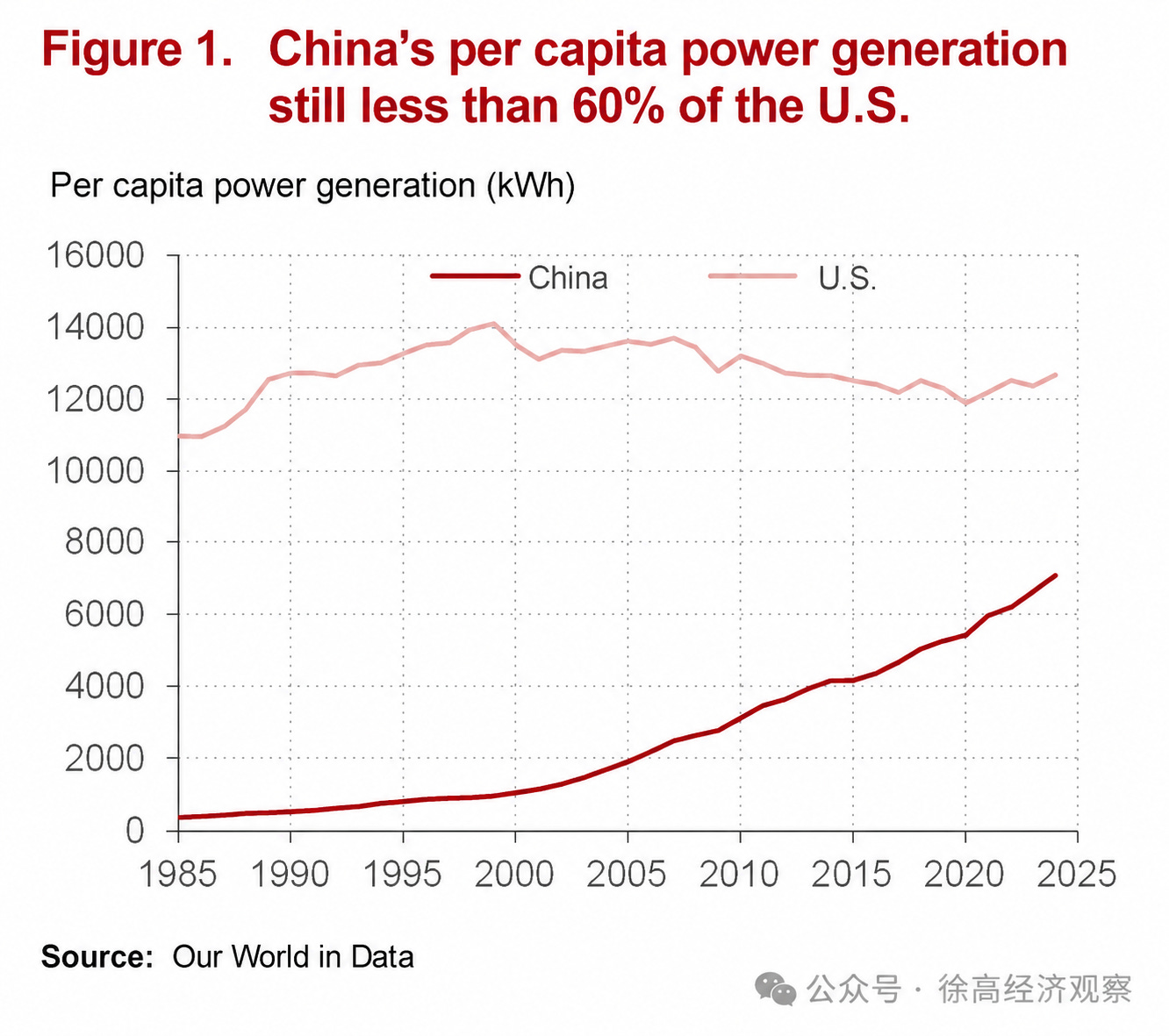
For example, although China has for many years generated more electricity than any other country, its electricity generation per capita is still less than 60 per cent of that of the United States (Figure 1). As the development of artificial intelligence drives a substantial increase in electricity demand, China will need to make major investments in expanding its power supply.
Meanwhile, as uncertainty in the international economy increases and risks to global supply chains continue to grow, China also needs to invest in building more complete industrial chains at home and reducing its vulnerability to critical supply bottlenecks.
Even in the property sector, which has been relatively subdued in recent years, there remains substantial demand for better housing. Meeting that demand will require investment in the construction of more high-quality homes. Many such gaps still need to be filled through investment, creating extensive scope for further investment in China.
The Report’s call for China in 2026 to “make coordinated efforts to boost consumption and expand investment” means that economic development must proceed on both fronts and promote a more balanced relationship between the two. China’s consumption shortfall should be addressed progressively through the special initiatives to increase consumption, structural reforms. This adjustment should take place as the economy continues to expand, thereby achieving a healthy rebalancing. At the same time, China must also continue to promote effective investment and make full use of investment’s role in stabilising demand and economic growth.
II. How Should the Returns on Investment Be Assessed?
Investment decisions necessarily involve an assessment of returns. Yet assessing investment returns, particularly the returns on government investment, is far from straightforward. If the benefits of investment are not understood comprehensively, or if important benefits are omitted from the calculation, the contribution of investment may be underestimated, thereby weakening investment momentum.
1. The Three Ledgers of Investment Returns: Small, Medium and Big
Investment returns should be assessed through three different “ledgers”: the small ledger, the medium ledger, and the big ledger.
The “small ledger” records the project-level financial return on an investment: the direct cash return that a project generates for the investor. Every investment project produces a project-level return, whether high or low. When people discuss investment returns, this is usually what they have in mind.
The “medium ledger” records the broader social benefits that an investment project creates for the locality in which it is situated. Infrastructure investment falls into this category. Public infrastructure projects such as urban roads, metro systems, and parks create value for their cities and contribute to the improvement of the urban environment. These benefits must also be included when assessing the returns on investment.
The “big ledger” records the overall social benefits that an investment project creates for the country as a whole. At the national level, investment can generate higher-order returns by creating demand, stabilising growth and employment, strengthening national competitiveness, and even safeguarding national security.
Transport projects ranging from roads connecting individual villages to railways in Tibet play an important role in promoting rural revitalisation and more coordinated development among different regions. They therefore generate returns that should be recorded in the big ledger.
2. Government Investment Must Take Account of the Medium and Big Ledgers
Different investors should assess returns through different ledgers. Business entities operate according to market principles and will generally focus only on the small ledger. From their perspective, a project is a profitable and effective investment if its direct cash return exceeds its financing costs, and it should therefore proceed. Conversely, if the project’s cash return is lower than its financing costs, it is unprofitable and ineffective and should not proceed.
These market principles are clear and apply to most investment projects. This is why many people instinctively interpret “investment returns” solely as the financial returns recorded in the small ledger.
If every investor considered only the market-based small ledger, however, projects that create substantial social benefits would be undersupplied, and society would lose a significant share of the returns recorded in the medium and big ledgers.
The public services provided by infrastructure are indispensable to economic development. Yet because infrastructure projects serve public purposes, their direct project-level returns are often low, and the projects themselves may not be profitable. If investment were left entirely to the market, most infrastructure projects would struggle to obtain financing and might never begin.
This creates a paradox: an investment that appears ineffective to the market may still be effective for society. If the market is the sole decision-maker, the potential of such investments cannot be fully realised.
China’s remarkable achievements in infrastructure development are attributable in large part to its ability, under the socialist system, to take greater account of the medium and big ledgers when making infrastructure investments. Historically, China’s local-government model of land-based urban development has made an indispensable contribution in this regard. This is an objective fact and one of the institutional strengths behind China’s infrastructure investment.
The central problem with infrastructure investment is that a project may be highly valuable to society while generating little or no profit at the project level. As a result, business entities have little incentive to invest. China’s system of public land ownership is an important advantage in addressing this problem.
Under this system, local governments control urban construction land. Infrastructure investment improves the quality of a city and thereby raises the value of the land controlled by the local government. Through land-based fiscal revenues, local governments have therefore been able, to some extent, to monetise the social benefits created by infrastructure investment and convert some of the returns recorded in the medium ledger into fiscal revenue.
Consequently, although an infrastructure project may not be profitable at the micro level, local governments in many regions — particularly more developed regions — have been able to combine the project’s direct cash returns with land revenues and other medium-ledger benefits, allowing total investment returns to match financing costs.
This created a viable and sustainable operating model for local governments. The ability to use public land ownership to incorporate both the small and medium ledgers into local-government investment decisions is one important reason why China has been able to sustain much stronger infrastructure investment momentum than many other countries and rapidly improve the quality of its infrastructure.
The social benefits of investment arise not only at the regional level but also at the national level. The latter belong in the big ledger.
In some parts of central and western China, the returns on infrastructure investment may not cover financing costs even when land-based fiscal revenues are included. This does not mean that such regions should refrain from investing in infrastructure. The greater purpose of infrastructure investment in these areas is to support less-developed regions and promote more balanced regional development. Excessive disparities between regions would not only impede the achievement of common prosperity but could also weaken national cohesion and social stability.
These returns can be fully appreciated only from a national perspective. The Report calls for China to “narrow disparities between urban and rural areas and between regions.” Achieving this goal requires taking account of investment’s big-ledger returns.
When national consumption is insufficient, investment can also be used to create demand. By stabilising growth and reducing the risk of overproduction, it generates returns that belong in the big ledger. In the current environment of relatively weak consumption, investment needs to be maintained at a larger scale to stabilise economic growth. The demand it creates should be counted in the big ledger for its contribution to national economic stability.
When undertaking public investment, mainly in infrastructure, governments at all levels should take account of both the medium and big ledgers. Projects that are profitable on the small ledger will generally be taken up by the market and should be financed primarily by private investors, with the government playing a supporting and guiding role.
Beyond this, however, governments must participate actively in projects that the market cannot or will not undertake but that are valuable to society and the country. These are projects that may not be profitable according to the small ledger but generate substantial returns in the medium and big ledgers.
The regional and national social benefits created by these projects are needed by society, yet private investors may lack either the willingness or the capacity to provide them. Active government investment in these areas can enable public and private investment to complement and reinforce one another, creating an organic combination of an efficient market and an effective government.
3. A Correct Assessment of Investment Returns and the Expansion of Effective Investment
China currently faces a pronounced imbalance between strong supply and weak demand. Consumption is insufficient overall, and some sectors have experienced excessive investment. Nevertheless, China still needs to maintain a relatively high level of investment. In particular, the returns recorded in the medium and big ledgers remain substantial, leaving considerable scope for effective investment.
The Report emphasises the need to “expand effective investment” and to “fully tap and unleash the potential of effective investment.” This requires investment returns to be assessed from a broader macroeconomic perspective, with greater attention paid to the medium and big ledgers. Doing so will allow investment to play a larger role in stabilising growth in the short term and in strengthening China’s competitiveness and improving public wellbeing over the longer term.
III. How Should the Debt Generated by Investment Be Understood?
Debt is closely connected to investment. Investment has long accounted for a significantly larger share of GDP in China than the global average. Investment necessarily requires financing, and the use of debt financing increases the stock of debt.
China’s financing structure is dominated by debt. Bank lending and bond financing have together accounted for more than 90 per cent of aggregate financing to the real economy for many years. Given this financing structure, a high level of investment naturally results in a large debt stock, raising concerns about debt risk.
Some argue that China needs to reduce its debt stock to lower financial risk. Such views constrain the expansion of debt financing and therefore restrict the investment that this financing supports. It is consequently necessary to develop a clearer understanding of China’s debt risk and remove unnecessary constraints on effective investment.
For a country, debt risk cannot be assessed solely by the size of its debt. More importantly, it must be assessed in light of the supply-and-demand relationship between domestic savings and debt — that is, the balance of supply and demand in the country’s “savings–debt market.”
In this market, savings supply the funds that debt absorbs, while debt represents demand for those savings. If the supply of savings exceeds demand, the risk of default may remain relatively low even when the stock of debt is large. Put differently, when a country’s debt is supported by an even larger pool of savings, a large debt stock does not necessarily imply a high risk of default.
Conversely, if the supply of savings is insufficient relative to the demand for savings created by debt, default risk may be high even when the debt stock is relatively small. When a country’s savings are inadequate to support its debt, its debt risk will inevitably be elevated.
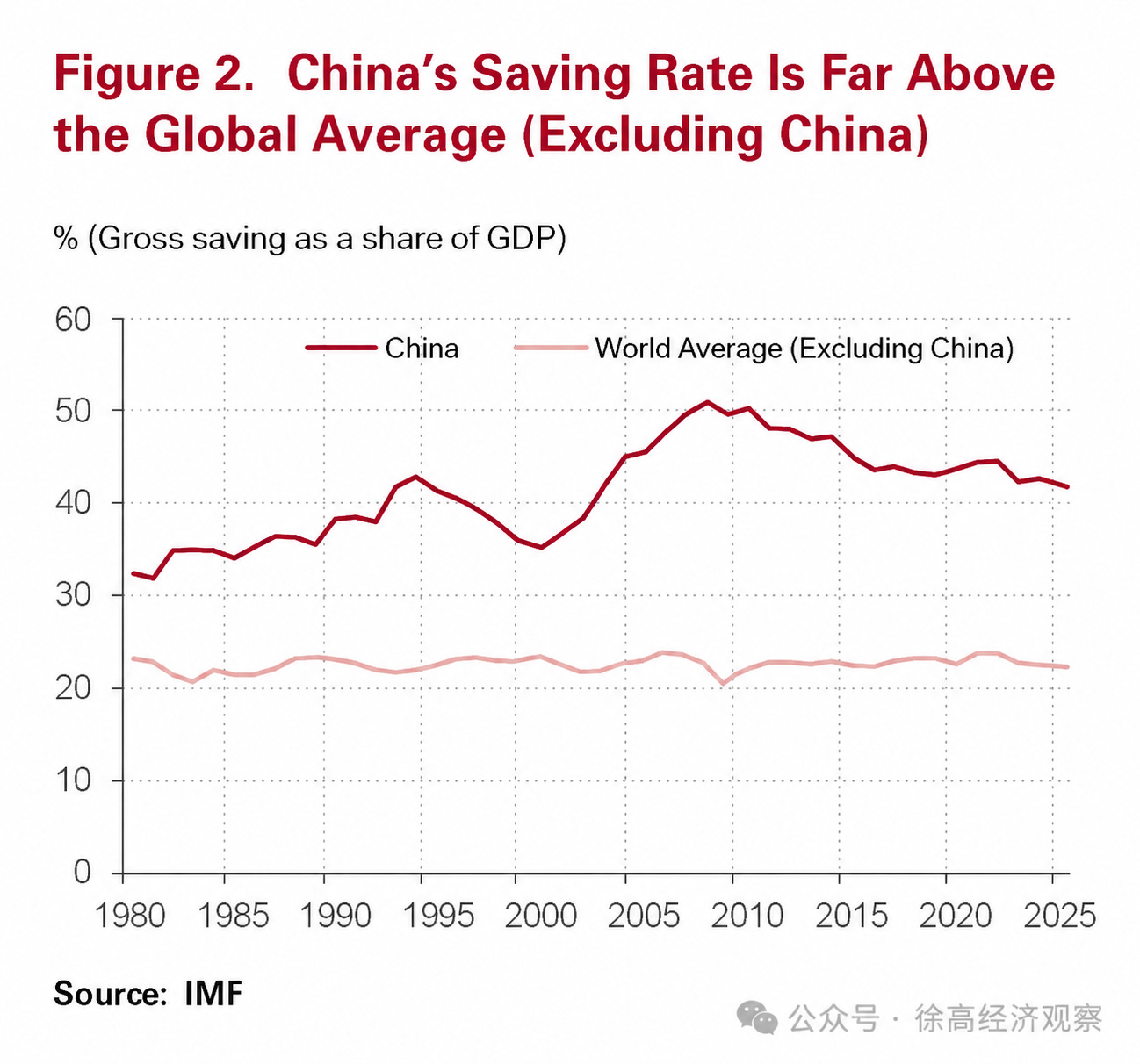
China is a high-saving economy. The domestic supply of savings exceeds demand, and its debt risk is therefore in fact low. According to estimates by the International Monetary Fund, China’s saving rate was 42 per cent in 2025, almost twice the average of 23 per cent for the rest of the world. (Figure 2)
China’s international investment position data also show that its net external assets — the overseas assets held by China minus its external liabilities — exceeded US$4 trillion in 2025. These assets represent Chinese savings invested overseas. Against this backdrop of excess savings, China’s relatively large debt stock does not in itself indicate a high level of debt risk.
Current concerns about local government debt arise partly from insufficient consideration of the medium and big ledgers of investment returns. As discussed above, infrastructure projects are generally unprofitable when assessed solely through the small ledger: their direct project-level cash returns often do not cover their financing costs.
On this basis, some conclude that local government borrowing for infrastructure investment is unsustainable and therefore creates substantial debt risk. A fuller understanding of the returns recorded in all three ledgers, however, produces a more comprehensive and accurate assessment of local government debt risk.
The principal problems with China’s local government debt lie in borrowing practices and liquidity. In the past, some local government borrowing was insufficiently regulated. Hidden debts were accumulated outside formal channels, making their scale opaque and their growth difficult to control, and thereby creating risks.
In recent years, the clean-up of hidden local government debt, together with lower land-sale revenue amid the property-sector adjustment, has put pressure on local government finances and increased debt-servicing burdens. But this is mainly a liquidity problem, and it is gradually being resolved by expanding local governments’ access to transparent and regulated borrowing channels.
The Report notes that in 2025, “We continued to implement a package of measures to address debt risks. As hidden local government debts were replaced in a well-ordered way and the number of financing platforms was further reduced, the structure of local government debts continued to improve.” It also states that in 2026, “quotas for local government special-purpose bonds earmarked for projects will be raised and placed under separate management.” These measures will support the expansion of effective investment.
IV. Making Full Use of Policy Tools to Promote Effective Investment
The Report sets out a range of policy tools for promoting effective investment. These tools must be used fully and effectively to unlock the potential of such investment.
The Report calls for investment to “focus on key areas such as new quality productive forces, new urbanisation, and well-rounded personal development,” identifying the directions for effective investment. It then calls for China to “boost the growth momentum of market-driven effective investment, and increase the share of government investment in public wellbeing initiatives,” indicating that effective investment should be promoted through a combination of market forces and government action.
For private investment, which is guided mainly by the small ledger, the Report calls for policies to reduce frictions in market operations to boost market-led effective investment. It states, “To invigorate private investment, we will implement relevant promotion policies and measures. We will refine the long-term mechanisms for facilitating the participation of private enterprises in major projects and encourage private investment in new arenas such as high technology and modern services.”
The key to such “long-term mechanisms” is to give private enterprises a clear and stable long-term outlook. This would enable them to assess future investment returns more clearly and encourage greater investment today. Government policy guidance can also strengthen private investors’ confidence in emerging sectors such as high-tech industries and modern services, helping to address market failures and lower barriers to entry for private capital.
For government investment in public wellbeing, which must take greater account of the medium and big ledgers, the Report provides governments at all levels with powerful policy tools.
At the central government level, the Report proposes that “A total of 755 billion yuan will be earmarked in this year’s central government budget for investment. We will also allocate 800 billion yuan raised from ultra-long special treasury bonds to implement major national strategies and enhance security capacity in key areas. Central government subsidies for investment will be raised on a per-category basis.”
At the local government level, the Report states, “Quotas for local government special-purpose bonds earmarked for projects will be raised and placed under separate management. We will continue to allocate more quotas to localities where investment projects are well prepared and funds are used effectively.”
These measures expand local governments’ access to formal financing channels and strengthen their capacity for investment in people’s livelihoods. Directing more financing towards localities with well-prepared projects and effective use of funds will also provide stronger incentives for governments across the country to undertake investment.
The Report further introduces policy-backed financing tools designed to leverage private capital. It states, “We will issue new types of policy-backed financial instruments with a total value of 800 billion yuan to stimulate greater private sector investment.”
When used effectively, policy-backed financial instruments can improve a project’s cost–return profile on the small ledger, enabling projects that could not previously get off the ground through the market alone to proceed with policy support. In this way, a relatively small amount of policy funding can leverage much larger amounts of private capital, channel more of it into effective investment, and further expand the scope for effective investment.
V. Conclusion
In the current macroeconomic environment of weak consumption, China still needs to maintain investment at a certain level to ensure stable economic growth.
A full accounting of the small, medium, and big ledgers provides a more comprehensive understanding of investment returns and helps ease constraints on the willingness to invest. A clearer grasp of the nature of debt risk can likewise prevent one-sided perceptions of debt from unduly constraining investment.
This will enable the policy tools set out in the Report to be used more effectively, generate stronger investment momentum, further strengthen the domestic market, and improve China’s ability to withstand external shocks.

Xu Gao: Why curbing investment can backfire in China

Xu Gao, the Chief Economist and Assistant President of Bank of China International Co. Ltd., and an adjunct professor of the National School of Development (NSD) at Peking University, has been featured on The East is Read several times.
Part I of Xu Gao: corporate gains fail to boost household income, leading to over-investment & excessive savings in China

On March 13, 2024, the National School of Development (NSD), Peking University, in collaboration with Baidu Economic & Financial News, held the 68th session of the China Economic Observation Report event and launched the 30th-anniversary celebration of the NSD.
Xu Gao: China's historical, unitary framework implies central govt responsibility for local govt debt

The unitary political framework, a millennia-old legacy in China, obligates the central government to intervene in local government debt, which is a key component of the country's growth model, said Xu Gao, the Chief Economist of Bank of China International (China).
(I) Xu Gao's case for stimulus

Xu Gao, the Chief Economist and Assistant President of Bank of China International Co. Ltd., and an adjunct professor of the National School of Development (NSD) at Peking University, has been featured on The East is Read several times.
Part II of Xu Gao: Chinese economy at a forking path, leading to three possible futures

On March 13, 2024, the National School of Development (NSD), Peking University, in collaboration with Baidu Economic & Financial News, held the 68th session of the China Economic Observation Report event and launched the 30th-anniversary celebration of the NSD.
Xu Gao: The Future of Money, and China’s Choices

This is a very long article, so readers may wish to start with the brief summary below and the author’s own summary at the beginning of the article.


I strongly appreciate and agree with this argument. China does not invest too much; the West and most Global South countries just invest too little.
On a per capita basis, China remains underinvested across a wide range of sectors. In addition to the article’s point that China’s per capita electricity consumption is only about 60% of the US level, China’s railway mileage per capita is only 18% of the US level, despite its leadership in high-speed rail. Its expressway mileage per capita is 43% of the US level; the number of airports per capita is 30%; long-distance natural-gas pipeline mileage per capita is 16%; wastewater-pipeline length per capita is 40%; urban rail-transit mileage per capita is 45%; and university dormitory space per student is only about 60% of the US level.
From a debt perspective, the Chinese government’s balance sheet remains entirely capable of supporting further investment. Many economists overlook the fact that the Chinese government is arguably the wealthiest government in the world by net assets. It owns approximately RMB 400 trillion in assets, compared with around RMB 170 trillion in liabilities, leaving it with net wealth exceeding RMB 200 trillion.
By contrast, the governments of most countries have negative net asset positions. China’s real constraint is therefore not a lack of public wealth or financing capacity, but whether that balance sheet is mobilized effectively, transparently, and productively.