

For years, Yan Xuetong, one of China’s best-known international relations scholars, has advanced a striking argument: changes in world politics cannot be understood through structural forces alone. In his framework of “moral realism,” political leadership is a key variable. Material power and a country’s place in the international system set broad constraints, but leaders help determine how states act within them. The idea runs through his 2011 book Ancient Chinese Thought, Modern Chinese Power, his 2019 Leadership and the Rise of Great Powers, and the 2023 volume The Essence of Interstate Leadership: Debating Moral Realism. In a 2026 essay, Yan put the point particularly clearly: because a great power’s relative position is comparatively stable, political leadership is the theory’s “core independent variable.”
The essay below brings that argument directly into the present. Looking at the 2026 Iran war, Yan asks why conflict broke out when it did, given that geography, regime differences and the US-Israeli military advantage had existed for years. His answer focuses on what changed: the choices of political leaders, above all Donald Trump and Benjamin Netanyahu.
The op-ed, published by Al Jazeera in Arabic on August 19, 2026, applies his theory to the war and the future of Gulf security. Yan kindly provided me with the English-language version reproduced below.

Yan is a university distinguished professor at Tsinghua University and Honorary Dean of its Institute of International Relations.
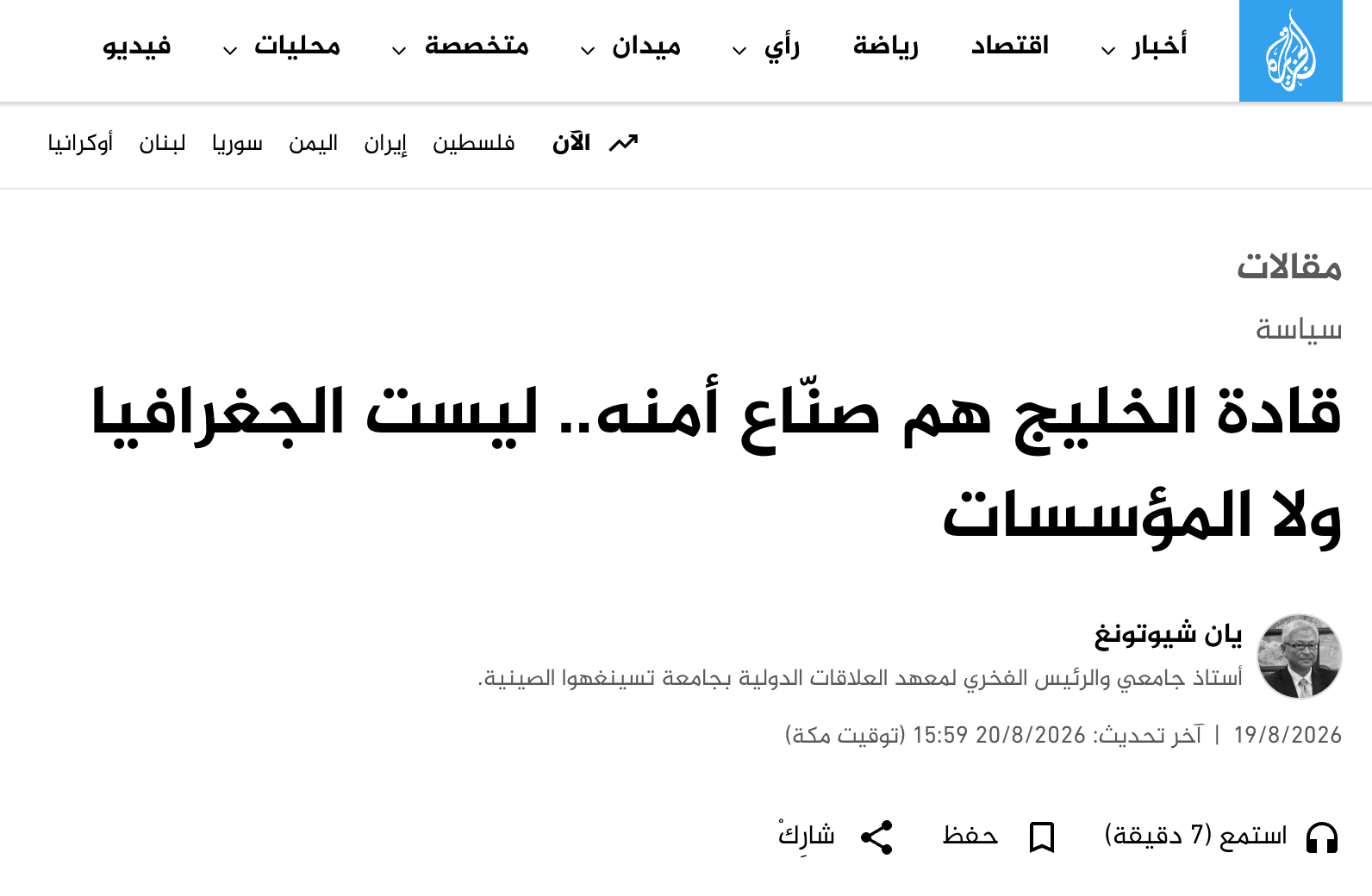
Yan Xuetong: Leaders, Not Geopolitics or Institutions, Shape Gulf Security
Since the outbreak of war between Iran and the US-Israeli coalition on February 28, 2026, the media and the public have increasingly viewed the conflict through the lens of policymakers — one defined by the individual ambitions and strategic preferences of US President Donald Trump and Israeli Prime Minister Benjamin Netanyahu. This phenomenon goes beyond mere journalistic fascination; it suggests that “moral realism” —a theoretical framework prioritizing leadership and political preferences over cold geopolitics— aligns far better with objective reality than traditional international relations theories do.
To understand why, one must examine the shortcomings of prevailing theories. For decades, geopolitical theories attributed the current Gulf war to the fact that the Strait of Hormuz controls between 20% and 30% of global oil supplies. Institutional liberalism argues that the war stemmed from the clash between Western democracies and Iran’s Islamic autocracy. Meanwhile. Structural realism suggests that the overwhelming military superiority of the United States and Israel would dictate the terms of peace and the war’s outcome. Yet, all these theoretical models fail to explain the reluctance of Washington and Tel Aviv to engage in an all-out war with Tehran throughout the entire post-Cold War era — right up until the dawn of Trump’s second term. Throughout those decades, hostility remained a constant, oil flows through the Strait of Hormuz stayed massive, political regimes remained unchanged, and US-Israeli military superiority held firm. In other words, geopolitical conditions, political systems, and military disparities were fixed constants rather than variables. Thus, these theories fail to explain the catastrophic shift in the Gulf.
Moral Realism, however, posits that leaders or policymakers are the ultimate independent variables driving international changes. This war was not an inevitability imposed by any structural factors such as geopolitics, political system or military balance; rather, it erupted because the Trump administration broke with decades of American tradition and embraced Netanyahu’s long-standing proposal to launch a military strike against Iran. Former Secretaries of State Hillary Clinton and John Kerry had previously confirmed that successive US administrations explicitly rejected Netanyahu’s demands. Driven by an unbridled and unprecedented political ambition to become the “greatest American president,” Trump disregarded the caution of his predecessors — a course that culminated in the military strikes of 2025 and 2026.
The current trajectory of the war underscores the validity of the moral realism framework while exposing the flaws in competing theories. Regarding the failure of the institutional liberalism: shared democratic values failed to rally the West; indeed, many European nations openly voiced their opposition to the Washington-Tel Aviv axis. Conversely, the Gulf Cooperation Council (GCC) states that support the United States share no democratic roots with it. As for the failure of the structural realism, overwhelming military superiority proved unable to curb Iran’s regional influence. On the contrary, one could argue that the conflict actually bolstered Tehran’s strategic regional standing. Furthermore, America’s allies of the GCC neither conferred the US with moral legitimacy nor efficiency of tactical breakthrough; instead, they rendered these nations prime targets for Iranian retaliation. From the perspective of moral realism, both the Trump and Netanyahu administrations suffer from violations of international ethical principles. Amidst the catastrophic humanitarian fallout in Gaza and reputations tarnished by a legacy of broken promises, neither administration possesses the strategic credit required to rally Western allies or achieve the goal of overthrowing the Iranian government.
Consequently, it is the individual leaders of the nations involved —rather than abstract balances of power— that will shape the regional security for the rest of Trump’s current term. As long as the Iranian supreme leader Mojtaba Khamenei refuses to yield to U.S. strikes and Trump is unwilling to admit failure, the risk of a cycle of mutual attacks between the US and Iran will be inevitable. The security of each Gulf state will depend primarily on the policies adopted by its own decision-makers. The United Arab Emirates will remain vulnerable to Iranian military attacks due to its leaders’ close military cooperation with both Trump and Netanyahu. In contrast, Saudi Arabia faces a lower risk, thanks to Crown Prince Mohammed bin Salman’s astute shift toward establishing strategic security partnerships with both Pakistan and Turkey, thereby deliberately reducing Riyadh’s reliance on Washington’s security protection. Under the rule of Sultan Haitham bin Tariq, Oman will face the lowest risk of war, having negotiated a bilateral understanding with Tehran in regard to the management of the Strait of Hormuz. For the rest GCC members, their risk of war will be determined by their leaders’ decision on their security relations with Trump. Those distancing with the White House will find themselves more secure than those who align closely with it.
Ultimately, a state’s security is mainly determined by the strategic choices made by its national leaders rather than impersonal structural factors. By examining Gulf security through the lens of moral realism, we can foresee the regional security situation within Trump’s second term. (Enditem)

I find odd that anyone believed that changes in world politics could ever have been understood *without* counting political leadership as likely the most important factor.
-?