


On 23 July 2026, Hong Wang became one of four recipients of the prestigious 2026 Fields Medal, awarded every four years to mathematicians under 40 for outstanding achievement and future promise. Born in Guangxi and educated at Peking University before continuing her studies in France and at the Massachusetts Institute of Technology, the 35-year-old is the first Chinese-born woman — and only the third woman in the prize’s 90-year history — to receive the medal.
In China, the reaction to Wang’s victory soon extends beyond mathematics. On Chinese social media, women recalled being steered away from STEM; others joked darkly that Wang should not return to China, where she would definitely be pressed to marry and have children. That discussions of Wang quickly turned to whether she should marry her fellow laureate Yu Deng showed how readily a woman’s scientific achievement could be reframed in terms of her private life.
Individual accounts on social media cannot, of course, describe the experience of an entire generation. But the intensity of the response suggests that Wang’s achievement touched a deeper tension.
The following commentary first appeared in video on 27 July 2026, on Yao Yang Speaks, a personal video channel run by economist Yao Yang, head of the Dishui Lake Advanced Finance Institute at Shanghai University of Finance and Economics and a high-profile public intellectual. A written version was subsequently published on the channel’s WeChat official blog on 19 July.
Taking Hong Wang’s Fields Medal as his starting point, Yao identifies several alarming signs for women’s advancement in China, from declining workforce participation, dismal representation in political leadership, to resurgent traditional expectations.
— Yuxuan Jia
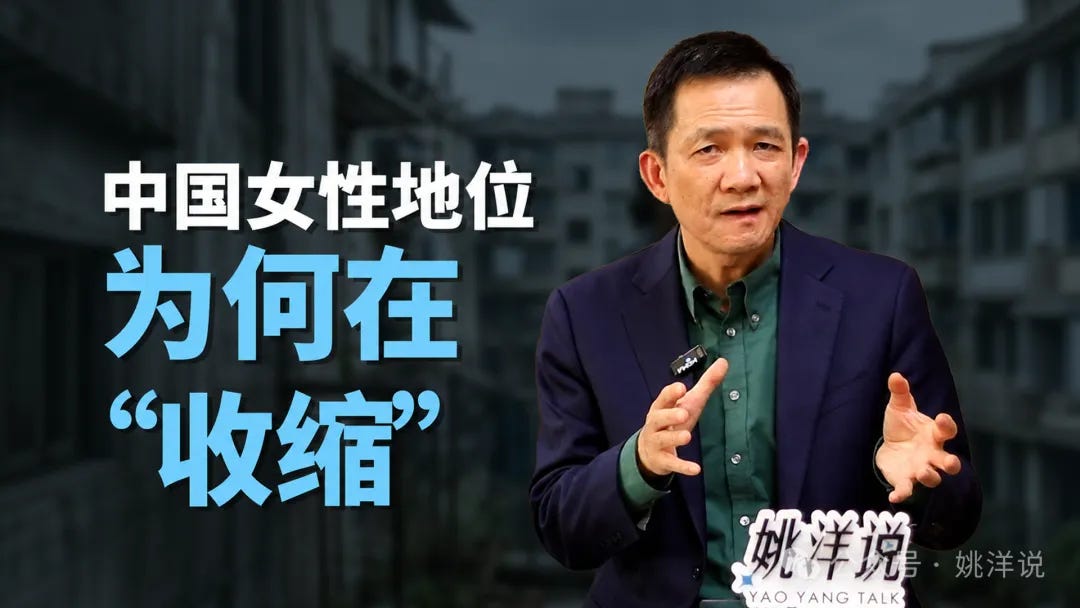
王虹获菲尔兹奖背后的思考:中国女性地位,为何在“收缩”?
Hong Wang’s Fields Medal and a Bigger Question: Why Is the Status of Chinese Women “Shrinking”?
Recently, the news of Hong Wang and Yu Deng winning the Fields Medal has been widely discussed. Most public attention has focused on the major breakthroughs the two have achieved in mathematics. I would like to use this opportunity to explore a topic that has received far less attention: as a woman, what unique significance does Hong Wang’s achievement carry?
Looking back at Hong Wang’s educational journey, it is difficult to find the kind of dramatic success story often associated with academic legends. She entered Peking University’s School of Mathematics from Guangxi, where she was surrounded by exceptionally talented young mathematicians from across the country. Many had already won major honours in mathematics competitions; Yu Deng, for example, had won a gold medal at the International Mathematical Olympiad.
According to Hong Wang’s own recollections, she struggled academically during her years at Peking University. After completing her undergraduate studies, she went to a relatively lesser-known university in France for further study. Her true academic transformation came later, when she pursued her PhD at MIT and found a mentor whose research approach closely matched her own.
As her academic thinking gradually fell into place, her research began to gain momentum. Although she received her PhD relatively late, she achieved a series of breakthroughs within just a few years, solving a century-old problem that had long challenged mathematicians and ultimately winning the Fields Medal.
Among this year’s four Fields Medalists, Hong Wang was widely considered the strongest contender even before the announcement. Before receiving the award, she had already won several major academic honours.
Her achievement was far from an overnight success. Hong Wang developed a passion for mathematics from an early age. During middle school, she wrote The Beauty of Mathematics, planting the seeds for her lifelong dedication to pure mathematics.
She did not receive formal training for mathematical Olympiads, nor did she participate in major competitions, yet she possessed exceptional mathematical intuition and problem-solving ability. It was this innate talent that allowed her to tackle extraordinarily difficult research problems within a short period of time.
In my view, the significance of Hong Wang’s achievement extends far beyond the world of mathematics. This moment also offers an opportunity to take a closer look at the current social environment facing women in China.
01
Women in old China long occupied a disadvantaged position. The socialist revolution brought a sweeping movement for women’s liberation, rapidly improving the social status of Chinese women and lifting them to a relatively high position globally.
During my early years studying in the United States, I often interacted with classmates from Taiwan, and I noticed a clear difference in the life choices of women from the two regions.
Women from the Chinese mainland, even when they initially had to rely on restaurant jobs or childcare work to make a living, often continued pursuing education, hoping to transform themselves into professionals through knowledge and gain greater control over their own lives. Many of my female classmates from Taiwan, by contrast, were more willing to return to the family and devote themselves to supporting their partners’ careers.
I know one couple in which a woman from a wealthy family saw great potential in her partner and, after careful consideration, decided to give up her studies and become a homemaker. Later, her husband became a television host, while she remained behind the scenes.
These different choices are also reflected in measurable data. China’s female labour force participation rate has long ranked among the highest in the world, currently standing at nearly 60 per cent, compared with a global average of only 46 per cent.
China has also produced a large number of female entrepreneurs, with many companies led and managed by women. Such a phenomenon remains relatively uncommon in many countries.
Within higher education institutions, women account for 54 per cent of faculty members in China, compared with 51 per cent in the United States. Most OECD countries have not surpassed the 50 per cent mark, while the share of female academics in many developing countries remains even lower.
02
A range of data shows that Chinese women have a strong foundation in pursuing personal development. Yet in recent years, a new trend has become increasingly visible: the space available for women’s advancement appears to be narrowing.
During the planned economy era, women of working age generally participated in labour. After the transition toward a market economy, however, female labour force participation declined steadily. That downward trend has yet to be reversed and is likely to continue.
Women continue to achieve impressive results in business, but their path into politics and public life remains considerably narrower.
With policy guidance, the proportion of female representatives in the National People’s Congress has remained around 26 per cent. Yet this figure had already exceeded 22 per cent in the 1970s, meaning that the increase over several decades has been very limited.
At the provincial leadership level, there are currently only two female provincial governors, and no woman has yet served as a provincial Party secretary.
Among heads of ministries and commissions, there are only two or three female ministers; even including the National Financial Regulatory Administration, the number remains only three. At the level of vice premier and above, women are still absent. On the political stage, female representation clearly still has considerable room for improvement.
In everyday social settings, I have repeatedly noticed a common phenomenon: many women are no longer actively seeking opportunities to express themselves, but instead have become accustomed to stepping back.
Many salons and gatherings invite outstanding women to participate. Yet they often sit quietly and rarely take the initiative to join discussions, leaving speaking opportunities naturally to men.
I see similar patterns among my students. Some couples are both economics researchers; the woman may have strong academic capabilities, yet she consistently chooses to push her husband into the spotlight while remaining in the background herself. Such patterns of collective behaviour reflect a social trend that deserves vigilance.
03
Traditional values are making a comeback in society. While the valuable aspects of traditional culture deserve to be passed down, the notion of male superiority and female inferiority belongs to an outdated historical legacy that should be left behind. It was precisely this kind of thinking that the women’s liberation movement had dismantled.
With growing interest in traditional Chinese culture in recent years, some voices have openly argued that women should return to the family and that men are naturally entitled to a dominant role.
I often wonder whether some men who hold such views unconsciously derive a sense of self-worth from women’s sacrifices and compromises. Many may not even recognise the assumptions underlying these beliefs. Men should remain mindful of such tendencies.
The international environment has also had an influence. As the United States turns inward in its development strategy and conservative ideas gain momentum, criticism of the #MeToo movement and skepticism toward feminism have emerged in Chinese public discourse.
There have indeed been some excessive behaviours during the development of feminism, but its overall direction is consistent with the broader evolution of human civilisation. For countless women who have suffered harm, finding the courage to publicly share their experiences requires tremendous strength.
The spread of conservative ideas from abroad has reinforced an echo chamber in China. Some people have embraced these ideas and resisted efforts to advance women’s rights, while others have sought to roll back progress in women’s liberation in the name of reviving traditional culture. Such a trend runs counter to the broader historical movement.
Hong Wang’s achievement offers a powerful example. Mathematics is a highly abstract discipline that has traditionally been regarded as a male-dominated field. As the third woman in history to win the Fields Medal, following mathematicians from Iran and Ukraine, she represents a historic milestone for Chinese women in academia.
Her success demonstrates that women are fully capable of achieving accomplishments on par with men in cutting-edge scientific research. If this is true in mathematics, the potential of women across all fields should likewise never be underestimated.
Hong Wang’s journey should prompt deeper reflection across society. The progress of women’s liberation in China cannot stand still; it must continue to move forward. Society should foster a friendlier environment where women can fully unleash their immense energy and potential.

The awakening of Chinese women - and their dilemma

Hi, this is Yuxuan from Beijing. On Nov. 11, 2023, the National School of Development (NSD) at Peking University hosted a session on the employment and family choices of Chinese women. It featured three insightful lectures by Huang Wei, an NSD associate professor with tenure,
Gender-specific recruitment in China's 2024 National Public Service Exam: an analysis

Hi, this is Yuxuan Jia. The 2024 National Public Service Exam in China, targeting a range of positions within the civil service, has set a significant portion of its recruitment to be gender-specific. With 7,322 positions explicitly gender-restricted, there appears to be a notable gender preference in the allocation of civil service roles, favoring male…
Zhao Hong on state overreach, women's rights, cyberviolence & more

Zhao Hong 赵宏, Associate Professor with Tenure at Peking University Law School, specialising in public law and administrative law, has risen to one of the most frequent, brave, and high-profile public intellectuals on Chinese law in recent years. She also regularly contributes to 风声OPINION, a Phoenix New Media blog that features commentaries on current a…
Calculating the cost of childbearing in China: the formidable factor behind country's dwindling birth rate

On Nov. 11, 2023, the National School of Development at Peking University hosted a session on the employment and family choices of Chinese women. This event took place amid the escalating challenge of China's declining birth rate, which resulted in a
Chinese women want both career and family, but inequality is pulling them away from childbearing

On Nov. 11, 2023, the National School of Development at Peking University hosted a session focusing on the employment and family choices of Chinese women, contextualizing the issue within China's declining birth rate and referencing the work of 2023 Nobel Laureate Claudia Goldin, who was
Over 5% Chinese women embrace life without children, surging in the 2010-2020 period

Amid growing concerns over declining population and fertility rates in China, here are some revealing and compelling numbers on the prevalence of lifetime childlessness among Chinese women:
JD.com chickens out to masculinist "boy"cotts

JD.com, the world's second-largest online store and China's largest retailer, canceled its partnership with female comedian Yang Li just four days after announcing her as a brand ambassador, chickening out to hopping mad male netizens offended by her stand-up comedy four years ago.


The conservative Communist Party of China (CCP) in the past years has particularly campaigned against women's rights and dignity, undoing gains of decades ago.
In a 2013 speech redolent of the most reactionary capitalist regimes, President Xi Jinping instructed women to limit themselves to being “good wives and mothers” to ensure the “healthy growth of the next generation.” Xi called on women to embrace their “unique role” in the family and “shoulder the responsibilities of taking care of the old and young, as well as educating children.” Words to warm the hearts of the most loathsome right-wing capitalists.
Since 2012 China has seen a drop in women’s labor-force participation, university admissions, and a crackdown on feminists. According to the World Economic Forum’s Global Gender Gap Report, by 2022 China fell 33 places to No. 102 in the 2022 ranking of more than 100 countries, down from No. 69 in 2012.
This decades-long assault on women's rights and dignity in China has overlapped the sharp decline in the birth rate. That is no coincidence.
The CCP emphasizes the subordinate role for women, gives preference to men over women in hiring and admissions, and removed women from top party leadership roles.
In a 2022 gender law the Chinese government ordered:
"Women should respect and obey national laws, respect social morals, professional ethics and family values.”
Needless to say Chinese men were not similarly admonished to obey or “respect social morals, professional ethics and family values,” much less ordered to, “shoulder the responsibilities of taking care of the old and young, as well as educating children.”
It's not hard to see why birth rates are collapsing in China.
A truly socialist government would encourage couples to have children by publicizing and funding collective child care facilities. Instead, the Chinese government provides couples with trivial financial support for raising children in a nuclear family, more or less presuming that women should interrupt their work.