

On February 23, 2026, the Long U.S.–China Institute at the University of California, Irvine hosted Professor Yao Yang, Dean of the Dishuihu Advanced Finance Institute at Shanghai University of Finance and Economics, for the Long U.S.-China Institute Distinguished Lecture 2026 on China’s political economy and the future trajectory of U.S.–China relations.
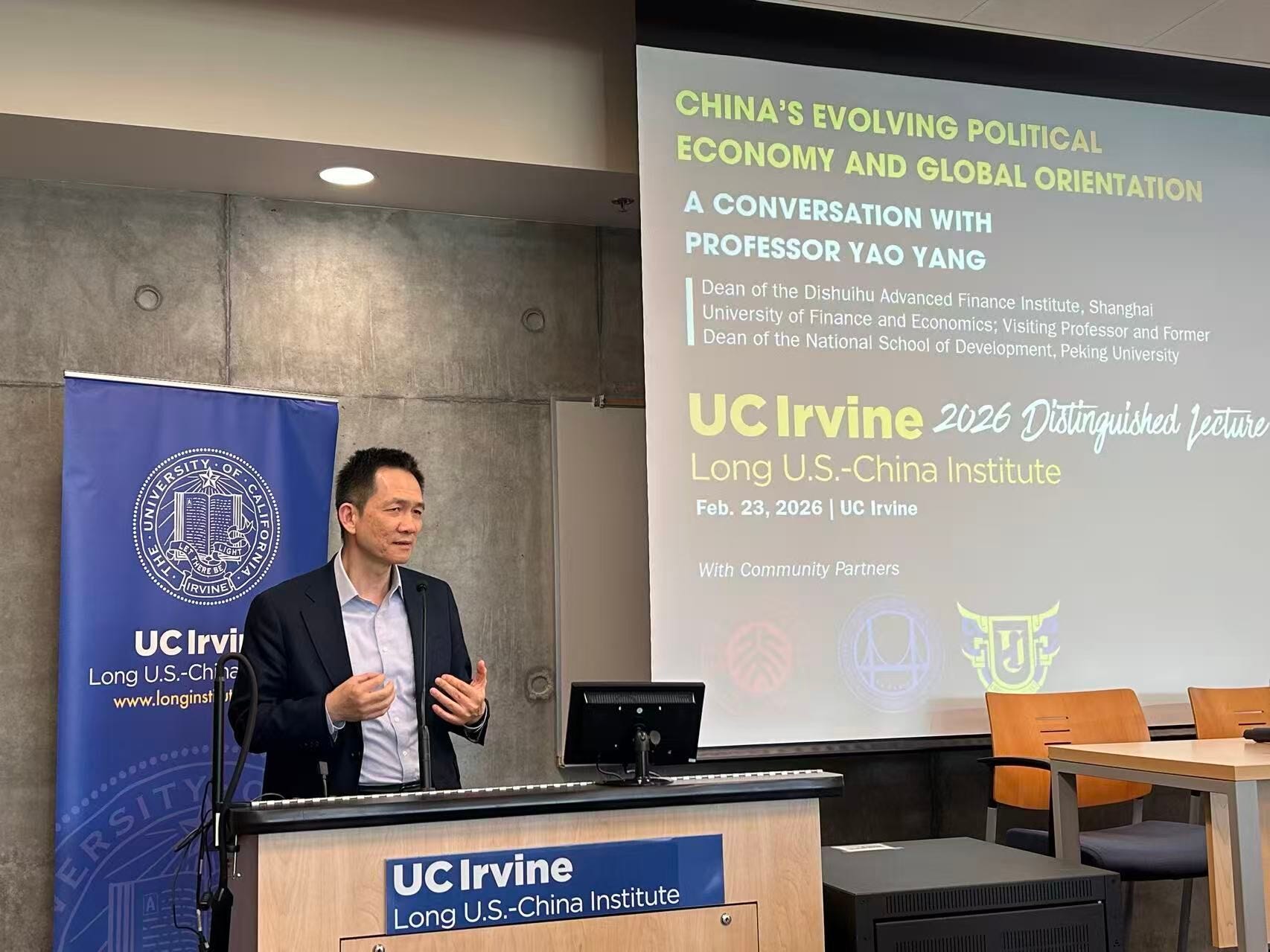
In his remarks, Yao argued that China’s reform and opening era effectively ended around 2018, ushering in what he described as a “new era.” He examined the leadership’s attempts to correct perceived excesses of the reform period while reorienting national resources toward manufacturing strength and technological self-reliance—an economic strategy that he linked to China’s broader strategic objectives, including reunification with Taiwan.
Yao also explored how these domestic priorities intersect with strategic competition between China and the United States, particularly in technology and industrial capacity, and outlined several possible scenarios for the future of the bilateral relationship.
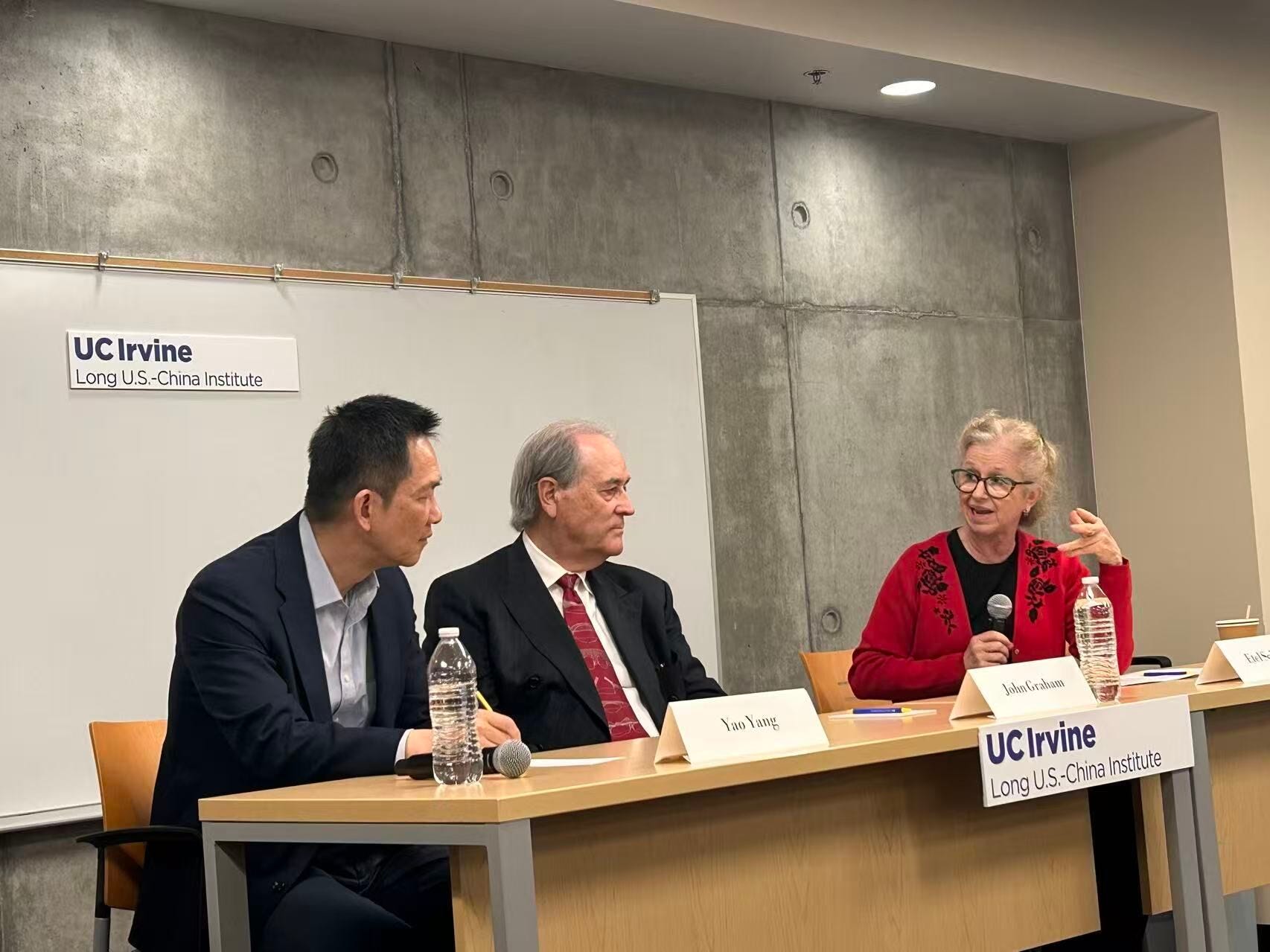
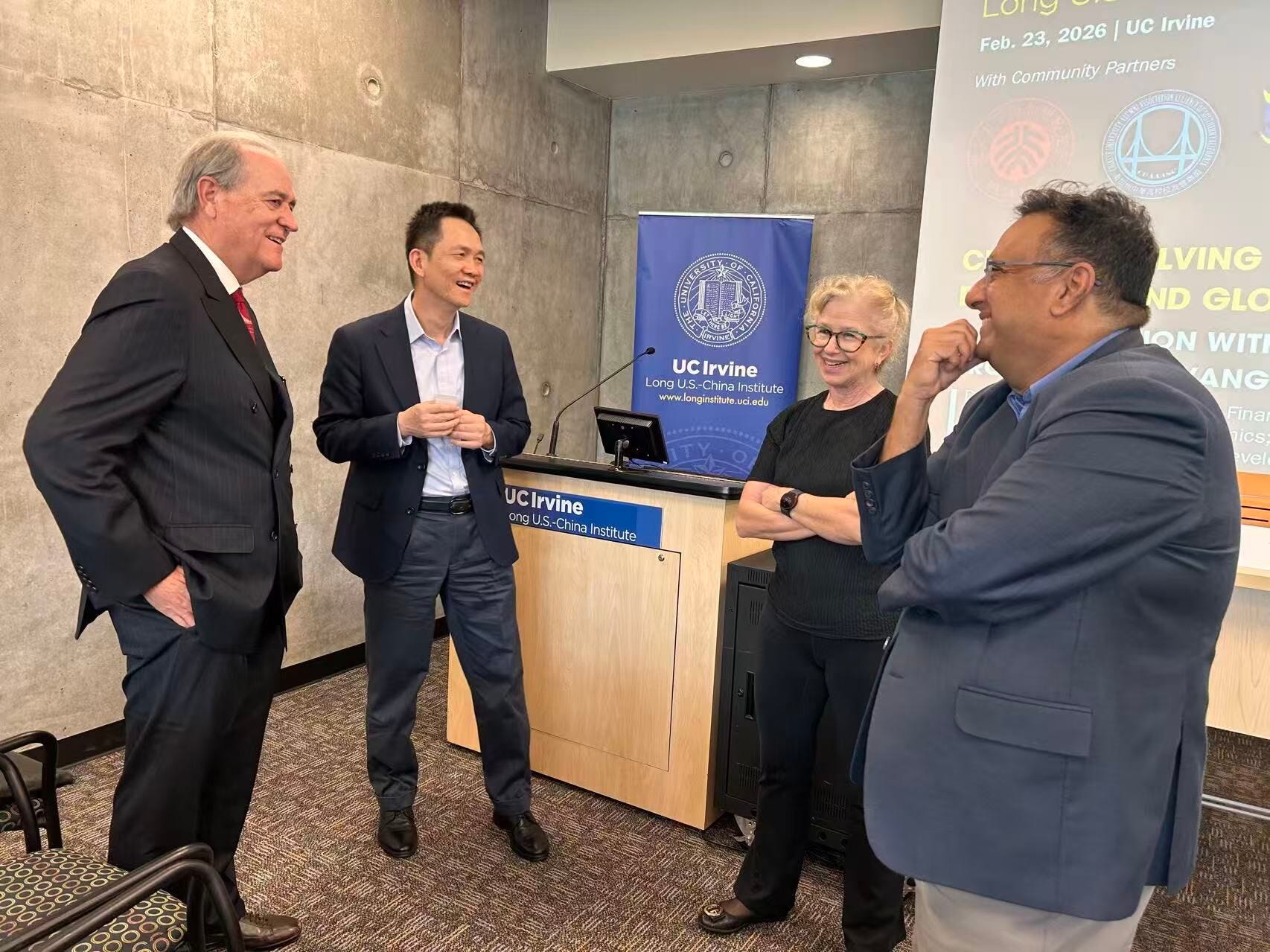
The response panel featured John L. Graham, Founding Director of the Long U.S.–China Institute and Professor Emeritus at the Paul Merage School of Business, and Etel Solingen, Distinguished Professor of Political Science and Thomas T. and Elizabeth C. Tierney Chair in Peace and Conflict Studies at UC Irvine.
The following transcript is provided by the Long U.S.–China Institute and has been lightly edited for clarity. Yao Yang has also authorised the publication.
Yao Yang at University of California Irvine
Long U.S.–China Institute Distinguished Lecture (Transcript)
I would like to thank the Long U.S.–China Institute for inviting me here to interact with faculty and students at UC Irvine. This is my first time visiting Irvine. Of course, I have been to California many times. It is wonderful to visit UC Irvine. This is a young university, but it is becoming one of the great universities in the United States and in the world.
Let me start with China’s domestic issues. For outsiders, and even for many insiders, it is difficult to understand what is happening in China: what the decision-making process is and why the government adopts certain economic policies. Many foreigners ask me this question: what have Westerners missed about China? I always say that what they have missed is the role of the government, particularly after 2018.
When we talk about China, we usually start with 1978 and discuss reform and opening up. But in my view, the reform and opening period ended around 2018, after about 40 years. Since then, China has entered a new period, which we can call a “new era.”
What does the government, or the Party, do in this new era? The most important goal is to correct what decision-makers believe were mistakes made during the reform and opening period. No one denies the success of that period. Without reform and opening, China would not have reached its current level of development. As President Xi Jinping himself has said, reform and opening was a critical step for the Communist Party in its recent history. No one wants to negate the achievements of reform and opening.
However, from the Party’s perspective, many problems emerged during that period. Let me mention several.
The first is corruption. Corruption is a problem in most developing countries. In China’s case, it became very serious. I once thought corruption only began during the Ming dynasty, when taxes were extremely low and the government lacked financial resources to pay officials adequately. As a result, officials learned to take money from ordinary people. But actually, corruption can be traced back even further to the Qin dynasty, when the Chinese state was first built.
From an economic perspective, this is understandable. China has a centralized state with the emperor at the top. The emperor cannot manage the entire country alone, so authority must be delegated to officials. This creates a classic delegation problem, where officials may take money from taxes or other sources. One could say that corruption has long been embedded in the system.
Today, the government wants to eradicate corruption within a short period of time. That is why there have been waves of anti-corruption campaigns. In the most recent wave, more high-ranking officials have been arrested than in earlier campaigns.
The second issue, at least in the minds of decision-makers, is excessive financialization of the economy. This is a lesson Chinese leaders believe they learned from the United States. In their view, U.S. industry has hollowed out because the financial sector dominates the economy. Many graduates from top universities prefer to work on Wall Street and make quick money rather than contribute to industry. Chinese leaders believe China should avoid repeating this pattern.
Therefore, the government has tried to reduce financialization. Since the end of 2017, the government has launched a major deleveraging program to address this issue. It has also reduced salaries in the financial sector. Some of my friends saw their salaries cut by 60 percent or even 90 percent in some cases, which shows how high they were previously.
Another issue is the housing sector. Decision-makers believe the real estate sector became too prosperous and attracted too many resources. People were buying apartments for speculation, and companies were doing the same. There is an example of a listed company whose profits in one year were smaller than the money it earned from selling buildings. From the perspective of policymakers, that situation is not healthy, so they want to shrink the real estate sector.
Another issue is what I would call excessive marketization. The market economy has been critical to China’s success, but in some sectors markets expanded too far. One example is the private tutoring industry. Private tutoring is common throughout East Asia, including in South Korea, Japan, and Taiwan. However, in mainland China the situation became particularly serious because the tutoring industry essentially created a parallel system to the K–12 education system. Students attended regular classes and then additional tutoring afterward. The government believed this had gone too far, so it launched a campaign to eliminate much of the private tutoring industry.
Another issue involves the platform economy. Some platform companies became extremely large and powerful. Some of their founders even began to feel powerful enough to challenge the Party. This was unacceptable in a one-party system, which is why the government launched campaigns against certain platform companies. The issue was not simply economic but also political.
Over the past seven or eight years, the Party has tried to correct these problems.
The broader goal is, in spirit, to return to something like the vision of the 1950s, when the People’s Republic of China had just been established. At that time, there was a single objective: to build a strong China through industrialization, especially heavy industry. Many people were inspired by the vision of building a new, independent, and prosperous China. Many Chinese scholars returned from the United States to help build the country, including Qian Xuesen from Caltech, who later led China’s missile program.
At that time, the Party organized all resources toward a single goal. Today there is again a central objective, which is outlined in the upcoming five-year plan that will soon be announced at the National People’s Congress.
If you look at the priorities, two stand out.
The first is the manufacturing sector. China’s manufacturing sector is already enormous. It accounts for about 35 percent of global manufacturing output. That is almost twice the size of the United States and roughly equal to the combined manufacturing output of the G7 countries.
Despite this, Chinese leaders are not satisfied. They want to expand the manufacturing sector further. Some American economists argue that China invests too much in manufacturing and creates excess capacity. But Chinese policymakers believe they have been successful and therefore want to continue on the same path.
In the next five to ten years, China’s share of global manufacturing output is likely to increase further. Meanwhile, there is little evidence that the United States is reindustrializing. The manufacturing share of U.S. GDP continues to decline.
The second priority is heavy investment in high-technology industries. For the first time, government documents emphasize “zero-to-one innovation,” meaning fundamental technological breakthroughs rather than incremental improvements. Chinese leaders now believe the country has reached the technological frontier in some areas.
Another concept appearing in official documents is technological self-reliance. China aims to develop technologies that do not depend on other countries. By 2035, the goal is to build a complete and self-sufficient technological ecosystem.
This leads directly to U.S.–China relations. These relations are the most important bilateral relationship in the world and are critical for both countries.
From China’s perspective, it must win technological competition with the United States. A key near-term issue is Taiwan. Chinese leaders view reunification with Taiwan as a historical inevitability and as part of China’s national rejuvenation.
China has set two centennial goals. The first was to build a moderately prosperous society, which was achieved around 2021 when poverty was eradicated. The second is to build a strong, modern socialist country. Reunification with Taiwan is considered part of that national rejuvenation.
Chinese leaders view this as a priority. They believe the United States must eventually accept reunification. To achieve this, China believes it must build a strong military. If peaceful reunification becomes impossible, China may use force.
Building a strong military requires a strong manufacturing base and advanced technology. This is the underlying logic linking domestic policy to U.S.–China relations.
Despite these tensions, I remain hopeful. The two presidents are expected to meet at least twice this year. In April, President Trump will meet with President Xi in China, and later President Xi will return the visit.
These meetings could produce several outcomes.
At minimum, the two countries could stabilize their relationship and agree not to expand export controls. Export controls can harm both countries.
A middle scenario would involve the United States opening the door to Chinese investment, allowing Chinese companies to invest in sectors such as electric vehicles and batteries.
The best scenario would be for the two countries to reach an agreement on Taiwan that allows for a peaceful solution. If that happens, it could bring stability and peace not only to the two countries but to the world for several decades.
Let me stop here and invite your comments on my remarks. Thank you.
Yao Yang, Wang Boming & Lan Xiaohuan on the trade war, structural transition, and employment challenges

On September 13, Yao Yang, the new head of the Dishui Lake Advanced Finance Institute at Shanghai University of Finance and Economics (SUFE), celebrated the first anniversary of his Chinese-language short video channel 姚洋说 “Yao Yang Talk” by joining a roundtable
Yao Yang says Chinese companies will invest massively abroad

The following is sourced from a blog post within WeChat by the National School of Development (NSD), Peking University. It’s an interview with Yao Yang, Professor and former Dean of NSD, by an online offshoot of Beijing Daily, the official newspaper of the Chinese capital city.
Yao Yang on the resilience of China's economy

Yao Yang is a Professor and Director of the China Center for Economic Research at Peking University. On June 23, he delivered a speech at an event hosted by Zhenghe Island, a network platform for elites.
Yao Yang's approach to establishing a Chinese school of economics

Hi, this is Jia Yuxuan from Beijing. The East is Read has recently published Part III and Part IV, following Part I and Part II on Pekingnology, of the translation of Chapter 8, titled "中国经济学的过去、现在和未来 The Past, Present, and Future of Chinese Economics", of Yao Yang's 2023 Chinese-language book
Yao is clearly more reserved with his remarks when he speaks in the US...
An excellent summary, and Xi's corrections would be quite appropriate in Australia also.