


The following is the English translation of the transcript of 1776大战1865,美国历史观为何陷入混乱? 1776 vs. 1865: Why Has America’s Historical Narrative Fallen Into Chaos? , a 10-minute-long Chinese-language video that appeared today/Saturday, December 20, 2025.

The video was uploaded to Zhang Beihai Official, a channel on Bilibili, China’s equivalent of YouTube. The channel has 1.928 million followers, and its motto reads

“Fair distribution, cultural inclusion, social equality, and open public debate—this is socialism.”
Within the first seven hours of its debut, the video has been watched 100,000 times, liked 12,000 times, saved 3,530 times, and forwarded 2,096 times.
All hyperlinks embedded in the text below are drawn from screenshots shown in Zhang’s video.
The shownote of the video is a brief Chinese sentence:
是美国,不然呢?
Of course it is about the United States—what did you think it was?
Consider this your 2025 year-end China-watching test: What is this video trying to say about China?

1776大战1865,美国历史观为何陷入混乱?
1776 vs. 1865: Why Has America’s Historical Narrative Fallen Into Chaos?
Hey everyone. Today I want to talk about the United States of America. There are two major ways Americans frame their own history: 1776 and 1865.
What are those dates? They mark the end of the War of Independence and the end of the Civil War, two crucial turning points in U.S. history. So where does “American history” really begin? American society argues about this nonstop. For example, supporters of the 1776 view say it begins with George Washington leading the War of Independence, which shaped the United States as a country. The 1865 view, on the other hand, argues that Abraham Lincoln, through the Civil War emancipation, forged a great American nation.
But in recent years, the 1776 narrative has increasingly been labeled as something that undermines social equality in the United States, and it has come under repeated attack. The level of the official platforms stepping in, and the breadth of the actions taken, are striking. At this point, it looks very much like an unspoken collective will shared by progressive bureaucracies and the media.
When they can’t win the argument, they shut down accounts and restrict reach. That playbook isn’t new. But are you really prepared to answer the questions of America’s many taxpayers? Do you truly have the ability to respond to the questions of ordinary people who have been forgotten?
Official media attacks the so-called “1776 view,” right? In reality, it’s because this view is accusing the modern federal system of encroaching on states’ traditional sovereignty, and even accusing progressive narratives of plundering the founding spirit of the United States.
At this point, the media steps in to smooth things over. It says the country follows a Reconstruction narrative that starts from 1865. What’s the logic here? It’s about reasoning backward from the present: if today’s American nation is a multicultural family, then the past must also be presented as one family.
As for what happened during the Civil War and after it? Well, that’s nothing more than friction between brothers. It doesn’t count, and it’s not something that can be taken out and discussed on its own.
There’s a Hegelian three-step structure buried in all of this.
Thesis: after the Constitutional Convention, the Constitution protects state sovereignty and the older confederation tradition.
Antithesis: after the Civil War, the federal government uses force to impose a centralized federal system.
Synthesis: out of that comes a pluralist concept of “the American nation.”
And America’s current idea of nationhood really does trace back to that original federal theory of natural rights. Under the historical pressure of Britain closing in step by step, this concept tried to rise above concrete ethnic boundaries, Black, white, Indigenous, and build a modern nation-state community to survive a harsh competition for existence.
It has to be admitted: without that kind of integration back then, the U.S. would be unlikely to hold the independent position it has today. The American continent is still extremely fertile, and that “American nation” synthesis has carried on to the present. It has become the most mainstream historical view in today’s American progressivism, constituting the political correctness in contemporary America. Inclusion becomes the key word. That’s the thesis-antithesis-synthesis dialectic in philosophical form.
Dialectics sounds so grand, doesn’t it? The “negation of the negation.” Both sides of the contradiction are lifted up and preserved within a higher synthesis. Every conflict gets reconciled. History moves toward a complete, final ending, as if no new propositions are needed ever again. But that’s actually a vulgar dialectic.
Slavoj Žižek points out that this neat triad is a serious oversimplification of Hegel. Any synthesis is necessarily incomplete and provisional, and the very production of a synthesis generates new internal contradictions. Real dialectics isn’t a magic button. It’s not like you press “synthesis” and everything is over. That kind of “middle way” is basically a color-changing chameleon.
A synthesis always contains fractures inside it. It is already breeding new negativity, opening up a new dialectical cycle. That is where the victory of dialectics lies.
So, many of the problems in American society today, from the controversy over affirmative action, to online discussions about the Confederate monuments, to the intense debate over whether the real starting point is 1776 or 1865, can all be seen as the flickering shadow of a “fourth step,” constantly flashing into view.
That sounds a bit abstract. So let’s go back to the triad just laid out. Since the idea of the “American melting pot” was invented, more than a hundred years have passed. It has covered up the real historical facts for one purpose only: serving the construction of a modern multi-ethnic nation-state.
It has to be admitted that this concept was highly progressive when facing threats from Britain and the outside world. But in the process of building it, for the sake of political convenience, it inevitably ended up being unfair to the main ethnic majority.
The main ethnic majority loses its own distinct character and is forced to become a kind of transparent backdrop. In the name of “progressive” social reform, the traditional main community is pressured to give up parts of the community traditions it has long defended, and to adopt a “civilized” way of life as defined by the dominant narrative.
Back in the 2010s, in certain traditional regions deeply shaped by the 1865 view of history, local powers launched cultural remolding campaigns on an unprecedented scale. In an extremely short period of time, they forcibly removed large numbers of statues and renamed many places, severing the emotional bond that local people felt with their ancestors.
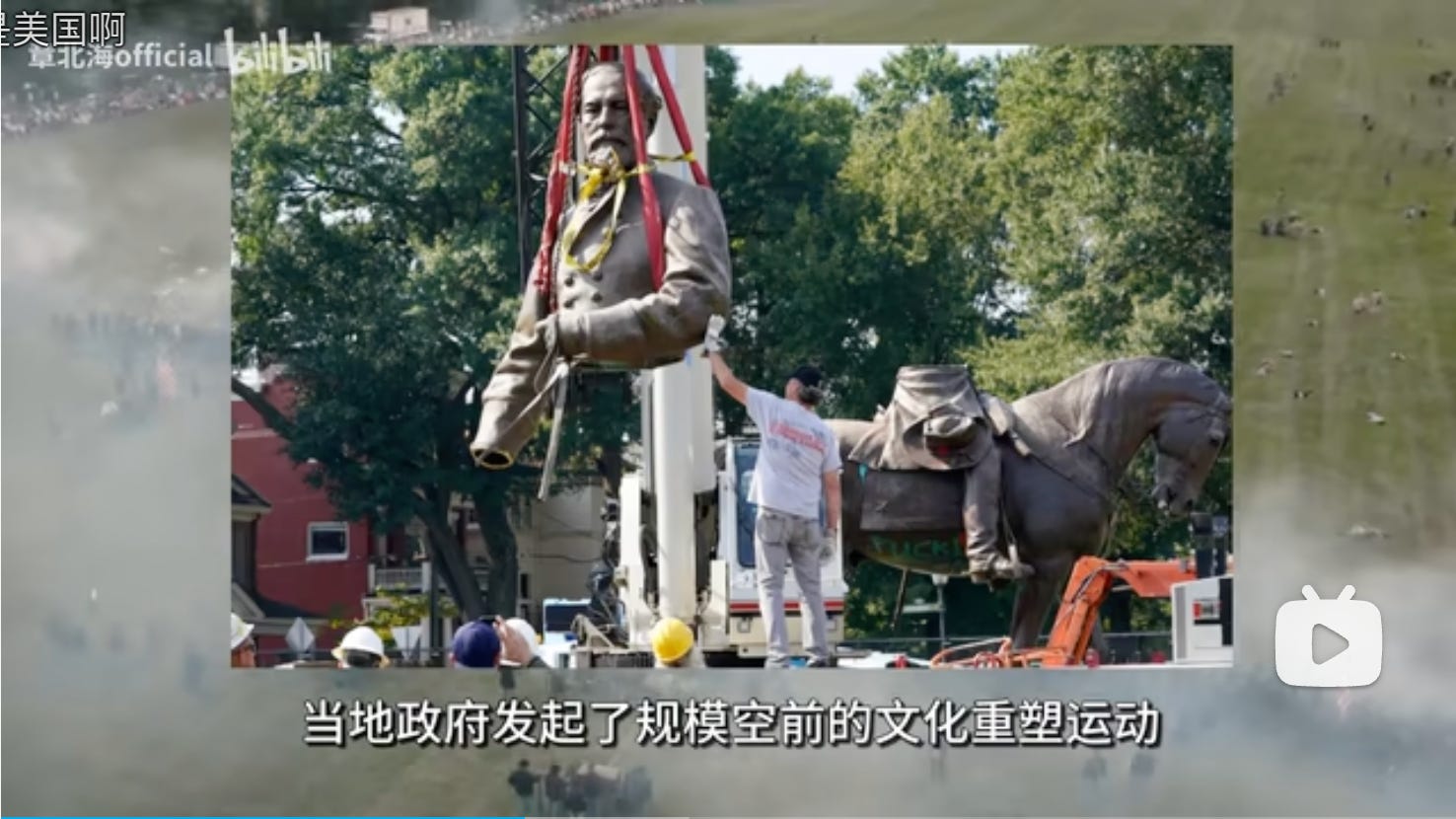
Yet when it comes to the cultural territory and traditional rituals of minority groups, those are declared by law to be untouchable, and placed under absolute protection.
So what’s the result of doing things this way? It’s that if you’re not “minority” enough, you can just manufacture a minority status, then climb inside it, disguise yourself as a minority, and cash in on the preferential treatment that the majority gives to minorities. For example, you can claim you are a Walmart shopping bag or an attack helicopter, right? America has dozens of genders, doesn’t it? Where do they all come from? Isn’t it exactly this? Is it funny? I don’t think it’s funny at all. It’s a massive trauma for the majority.
That leads to a question: are the ordinary white people who make up more than 90% of America even considered “people”? Don’t their traditional feelings and historical dignity deserve equal protection? Are they simply destined to be the price paid for “historical progress”?
And it’s not only emotional. The American middle class has paid enormous economic and social costs as well. All kinds of “extra points” policies at elite universities, quotas imposed along racial lines, and various so-called social justice subsidies are often built on the silence and sacrifice of the majority.
Sure, some people will point the finger and say, “Zhang, aren’t you a leftist? You never used to talk like this. Isn’t what you’re saying basically white chauvinism? Isn’t this right-wing rhetoric? Doesn’t this hurt national unity in the United States?”
But here’s the point. In modern American history, this kind of dispossession of the majority is not exactly rare. The United States is, in theory, a community that promises equality before the law. In practice, there are policy tilts so obvious you can see them with the naked eye.
Friends, fairness. Fairness, fairness, and that goddamn “fairness.” The pursuit of fairness is the whole reason the left exists. If someone refuses to acknowledge the contradictions and fractures here, then I refuse to recognize that person as left-wing, because what they’re defending isn’t equality, it’s the power of the federal government.
Giving benefits is not the problem. The problem is giving extra benefits. If the benefits being handed out are ones the majority can’t actually share in, then all you do is let minorities repeatedly “confirm” the value of a two-track system, and realize just how valuable their current identity is.
And that two-track system does not eliminate barriers and differences between groups. It does the opposite. It intensifies division and confrontation between ethnic communities. I genuinely want to know: on what grounds would a leftist endorse a policy like that?
America’s establishment elites love to spend ink condemning “manufactured division.” But in my view, this decade-plus of intense North–South debate in American society is actually a major step forward in defending a real social contract. The contradiction that narratives like “the great American nation” and “the great American melting pot” try so hard to soothe and dissolve will always return, in one form or another, until American society admits that it exists.
You control the propaganda machine. And elites can always come up with ten thousand reasons to denounce the 1776 view of history as stupid and crude, as the work of separatists and white chauvinists. But it’s worth asking: what kind of real-world environment makes a “stupid and crude” narrative like this spread so widely in the first place?
The elites of American society are smarter than I am, and they understand America better than I do. It’s impossible that you haven’t thought of this. You’ve simply closed your eyes, and, on this issue, maintained a shameful silence, exactly as expected.
Years of long-running bias and targeted discriminatory policy, and even now you still pretend the problem doesn’t exist. Worse, you turn around and brand the people who suffer from it as the ones causing division. And that’s exactly how, by late 2025, the country ends up this fractured. It’s arrogance, arrogance so extreme it borders on cruelty.
I’ve said this in past videos, but I’m going to say it again, and I know I’ll keep repeating it in the future.
Why is white nationalism rising today? Because under the big umbrella of nationalist storytelling, people in American society are actively using nationalism as a “we-always-win” rhetorical trick to draw lines, to separate “us” from “them,” to split the West from the East, to mobilize society, to boost social cohesion. And once the “us versus them” mindset hardens into a habit, it naturally spreads. It migrates. Someone will always take that logic one step further, and use it to think through other relationships. The right to define other “us” and “them” will not stay in the hands of American government’s establishment elites forever.
The basic principle of nationalism is distinction and exclusion. It starts from your needs, but the endpoint is not yours to decide. Nationalism will not be judged only on the boundary you choose. That’s not up to you people who lit the fire.
If you try to play with nationalism in a historically complex, multi-ethnic country, you’re going to get the full package of nationalism. You don’t get to say, “nationalism only outward.” If you stir it up, you own the consequences. Whoever created the current situation should be responsible for the current situation.
And sure, as a leftist, I don’t support ethnic tribalism. But when someone is pushing this half-baked nationalism, shouting on the one hand, “Anyone who offends America will be punished no matter how far away,” while on the other hand smoothing internal contradictions over at home, then I have to say a few words for the sake of justice.
The debate over American history has now moved beyond history itself. And well said, fully agreed. All history is contemporary history. It is always a retrospective construction, a symbolic tool. Its purpose is never to describe an objective past, but to serve certain demands in the present.
This “glorious American confederation” retroactively constructed by the 1776 narrative is, in fact, a projection of today’s emotions. Some people reject these kinds of historical conspiracies as anti-intellectual. And I agree: these claims are often strained and intellectually thin.
But there’s only one real difference between you and me. Do you acknowledge the underlying demand here, the majority group’s demand for equality, or do you refuse to see it?
Because in this world, no great nation ends up as a great nation if, in the end, it can’t even protect its own ancestors’ graves, or its own corpse.
As for those people accusing the 1776 view of “dressing up history,” fine, well said, fully agreed. But I still have to ask: don’t play dumb. History is a retrospective construction, who then, in American society, is the best at dressing up history?
China has an old anecdote called “not eating horse liver.” Back in the Han dynasty, two scholars were debating in front of Emperor Jing of Han (r. 157–141 BCE). They were arguing over how to interpret the Zhou dynasty (c. 1046-256 BCE)’s overthrow of the Shang (c. 1600-1046BCE): was it “the Mandate of Heaven,” or was it simply a case of a minister rising up and killing his sovereign? Emperor Jing cut them off with a single line that shut the whole discussion down. He said: when people eat meat, they don’t eat horse liver. It’s not that they don’t know it tastes good, it’s that it’s poisonous. And scholars keeping silent on whether Tang and Wu “received the Mandate” doesn’t make them foolish.
So why did Emperor Jing dodge the question like that? Because it went straight to the ultimate question of legitimacy for a feudal dynasty.
And think about where that debate leads. If you say the overthrow was illegitimate, then how do you explain the Han (202 BC – 9 BCE, 25–220 BCE) overthrowing the Qin (221-206 BCE)? Was Han Gaozu, the founder and first emperor of the Han dynasty, also just an illegitimate rebel? But if you say it was legitimate, then doesn’t that imply that one day, if the Han house loses the Mandate, someone else can overthrow the Han? Either way you get trapped. There’s no safe answer. So Emperor Jing simply brushed it aside, and that became the story: “not eating horse liver.”
So how do you settle America’s historical account? This is a classic “not eating horse liver” problem. It’s a question you’re not even allowed to oppose.
You say history shouldn’t be dressed up. Fine. Then everyone should ask: who is the biggest dresser-up of history?
Truth seeps out of wounds. What leaks out of the cracks, what cannot be absorbed, what has been suppressed, forgotten, and pushed to the margins, one day will rise up from the abyss of history and strike back at today’s sophistry. I don’t know what form it will take, or how it will arrive. But if Americans were to prevent the risk of the social fabric coming undone, they have to face the problem. The best time was ten years ago. The second-best time is now.
Although everything I’ve said here is common sense and objectively true, putting it on YouTube is taboo. It’s highly risky. And yet, in Chinese tradition, historians and remonstrating officials have always had the spirit of recording the truth as it is. High Minister Cui Zhu (died 546 BCE) murdered his Duke, but successive court historiographers were killed for insisting on the blunt record “Cui Zhu murdered his Duke,” the truth still held, because someone would always write it down.
If you won’t let people speak, then I will speak. And if I can’t speak, someone else will stand up and speak for me and for those who came before. That is the spirit of the Chinese nation.
I’m glad I can show this video to people around the world. If you made it this far, follow the channel, and hit the like, comment, and subscribe. The script will be posted on my WeChat blog, Zhang Beihai’s Natural Selection 章北海的自然选择. This video will also be up on YouTube. This is Beihai, and I’ll see you in the next one.
From street strategists to establishment pundits

China’s “world affairs fandom” is a curious subculture. It has grown in an information environment shaped by many forces at once: attention-driven platforms, uneven media literacy, and a speech market where red lines are sensed more often than spelt out, nudging participants towards euphemism and hint. Meanwhile, much of the global conversation sits beh…


Thanks for the translation of the video. It's very clear they do not understand the United States's history or the demographics of the country at all. There's no 90 percent majority of any ethnicity here. No one is being crushed by minority groups. Telling people to not terrorize gays, black and indigenous people, or any other group that has faced historical violence isn't an attack on the majority. The biggest winners of affirmative action have been white women, who are very much part of the majority ethnic group. The overwhelming majority of Confederate statues were erected during the Jim Crow era after the Civil War to intimidate the black population, not as preexisting monuments to Southern culture.
The author raises compelling questions about competing historical narratives within the United States, yet entirely absent from this discussion is the foundational illegality upon which the entire American project rests. The papal bull Inter Caetera, issued by Pope Alexander VI in 1493, established that any land not inhabited by Christians was available to be discovered, claimed, and exploited by Christian rulers, creating what became known as the Doctrine of Discovery. This decree, which granted the Portuguese and later the Spanish papal permission to subjugate and even enslave non-Christians around the world in any territory their ships reached, represents not a mere historical curiosity but the juridical foundation for an act of continental piracy. Whether one begins American history in 1776 or 1865 becomes irrelevant when the entire enterprise originates in a European religious authority's presumed right to grant away lands belonging to peoples who had occupied them for millennia. As Robin Wall Kimmerer observes, in the settler mind land was property and capital, but to Indigenous peoples it was identity, ancestry, pharmacy, and library, sacred ground that belonged to itself and could never be bought or sold. The debate over which founding myth to privilege obscures the more fundamental question: can any society built upon such thoroughly abrogated human trust ever achieve lasting stability?
The patterns established by this original theft have replicated themselves across centuries in how European and American powers conduct both internal and external affairs. The logic that justified seizing an entire continent because its inhabitants were deemed insufficiently Christian or civilized became the template for subsequent imperial adventures, from the Philippines to the Middle East, and for internal policies that systematically dispossessed, confined, and attempted to culturally annihilate Native peoples. As Roxanne Dunbar-Ortiz notes, Europeans appropriated what had already been created by Indigenous civilizations, stealing already cultivated farmland and crops domesticated over centuries , then constructed elaborate mythologies about "wilderness" and "manifest destiny" to justify continued occupation. This same pattern of taking what others have built while claiming moral superiority echoes in contemporary American foreign policy and in the domestic dismissal of legitimate grievances from communities who remember what was stolen. When societies normalize such fundamental violations of basic human reciprocity, they embed a corrupting principle at their core that inevitably spreads through all their institutions and relationships.
Historical experience demonstrates that institutional systems can disintegrate rapidly when trust and legitimacy erode beyond critical thresholds, and there appears to be a permanent risk for even virtuous equilibria to gradually become destabilized in the long run as wealth becomes concentrated, leading to state capture by elites Tibetan Review. The American republic may represent precisely this trajectory: a society founded on an act of massive dispossession that has never been meaningfully acknowledged, let alone reconciled, now finding that the habits of domination and erasure established toward Indigenous peoples have become the operating principles for managing internal contradictions of all kinds. Whether the founding narrative centers on 1776's promise of liberty or 1865's promise of equality, both rest on land stolen through legal fictions that declared entire civilizations invisible. Reduced trust serves as both a direct catalyst in developing social cleavages and an indirect opportunity for political instability to emerge when different social groups cannot solve conflicts using non-violent means. A nation that cannot protect its own ancestors' graves, as the author notes, faces questions about its fundamental viability, but what of a nation built atop the unprotected graves of the peoples it displaced? The collapse may not be coming; it may already be underway, visible in every fracture the author describes, the inevitable harvest of seeds planted in 1493.