


China’s roughly stable unemployment rate is giving an incomplete and misleading picture of the labour market — and, more importantly, may be distorting the policy response, argues Zhu Tian, Vice President and Co-Dean at China Europe International Business School (CEIBS), where he also holds the Santander Chair in Economics.
He argues that flexible employment is absorbing much of the pressure that would otherwise show up as unemployment. Workers may remain statistically employed after moving into ride-hailing, food delivery, or other flexible work, even as pay falls, hours rise, and skills are underused. The sharp rise in unemployment insurance recipients is another sign that conditions have weakened more than the headline unemployment rate suggests.
The risk, Zhu argues, is that if employment conditions appear broadly stable, the weakness is more likely to be blamed on structural problems in the labour market — a matter of skills, job matching, or long-term adjustment. But Zhu sees insufficient aggregate demand as the more immediate problem. Stronger short-term macroeconomic policy is therefore essential, especially a more expansionary fiscal stance with higher central government spending and borrowing.

The article was published on CEIBS’s official WeChat blog on 8 September 2026. Zhu has agreed to this translation and publication.
朱天:5%失业率背后——真正的就业问题,在数字之外
Zhu Tian: Beyond the 5% Unemployment Rate — China’s Real Employment Problem Lies Outside the Headline Figure
The National Bureau of Statistics of China announced in August that the urban surveyed unemployment rate averaged 5.2 per cent in the first seven months of 2026, unchanged from the same period last year. Apart from 2022, when it rose to 5.6 per cent amid the COVID-19 pandemic, the rate remained broadly within the range of 5.1 to 5.2 per cent in every other year since 2021. The youth unemployment rate is much higher, but has also been relatively stable. Under the statistical methodology revised at the end of 2023, the surveyed unemployment rate among people aged 16 to 24, excluding students, has generally stood between 16 and 17 per cent. Judging by these two indicators, China’s employment situation appears to have changed little in recent years.
Yet this does not accord with what many people are experiencing in practice. Nor is this perception merely subjective. The People’s Bank of China’s Urban Depositor Survey shows that the Employment Sentiment Index fell from 43.9 in Q1 2021 to 35.1 in Q1 2024, before declining further to 29.2 in Q4 2025. Companies are becoming increasingly cautious about hiring, university graduates are finding it increasingly difficult to secure jobs, and many people who previously held stable positions are turning to flexible employment such as ride-hailing and food delivery.
The stability of the urban surveyed unemployment rate may be related to the statistical methodology and the population covered by the survey, and may not provide a complete picture of employment conditions. Judging the employment situation solely by changes in the surveyed unemployment rate could therefore lead to an underestimation of both the severity of the current shortfall in aggregate demand and the scale of the macroeconomic policy response required.
Moreover, the unemployment rate measures only whether a person has a job, not what kind of job they have. As growing numbers of people who cannot find positions in companies or public institutions move into flexible employment, pressure in the labour market may not show up as a higher unemployment rate. Instead, it may be reflected in less stable employment, longer hours, and lower hourly earnings. This may be the key to understanding China’s employment problem today.
01 The unemployment rate has not risen markedly, yet the number of people claiming unemployment insurance benefits has more than doubled
First, consider the data from the Ministry of Human Resources and Social Security presented in the chart below.
Between 2015 and 2019, the number of people receiving unemployment insurance benefits at year-end remained virtually unchanged, at between 2.2 million and 2.3 million. Following the outbreak of COVID-19 in 2020, the figure rose to 2.7 million before falling back to 2.59 million in 2021. From 2022 onwards, however, it increased significantly: to 2.97 million in 2022, 3.52 million in 2023, 4.63 million in 2024 and 5.57 million in 2025.
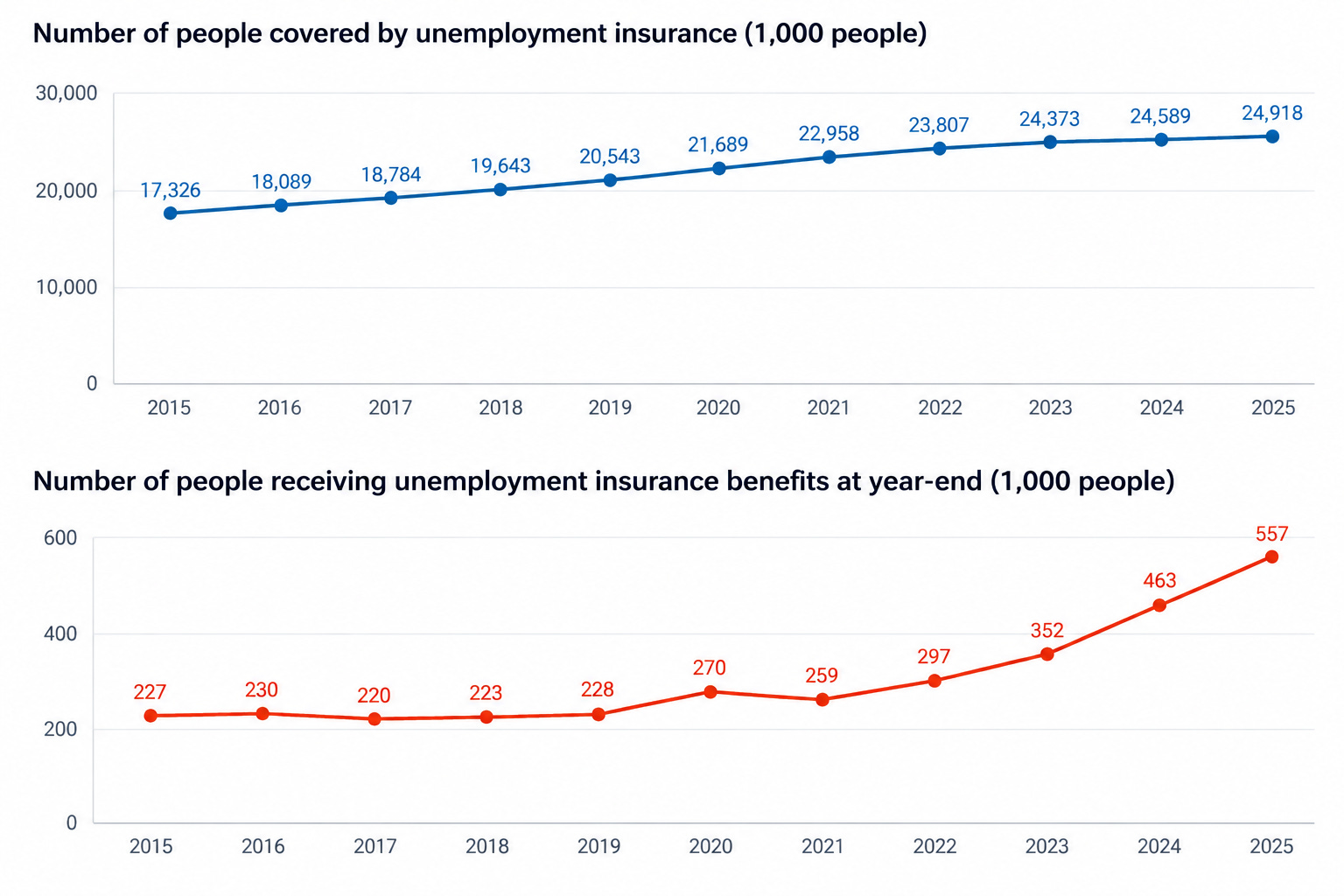
In other words, between 2021 and 2025, the number of people receiving unemployment insurance benefits at year-end increased by 115 per cent. Meanwhile, the number of people covered by the unemployment insurance scheme rose from 230 million in 2021 to 249 million in 2025, an increase of only 8.5 per cent.
The fact that the number of recipients more than doubled in four years therefore clearly cannot be explained by the increase in coverage.
One possible explanation is that the number of people receiving unemployment insurance benefits has risen because applying for them has become easier. Indeed, in 2019 and again in 2020, the Ministry of Human Resources and Social Security issued policy documents aimed at making unemployment insurance benefits easier to access. These measures simplified the application process and made it more convenient for eligible workers to receive benefits. They may therefore have increased take-up and probably contributed to the marked rise in recipient numbers in 2020.
However, this factor cannot readily explain the continued rise in recipient numbers after 2022. The economy performed well in 2021, unemployment pressure eased, and the number of recipients fell accordingly. This suggests that the figure is influenced by economic conditions, not simply by easier access to benefits.
More importantly, the effect of a one-off change of this kind should diminish over time, as the backlog of eligible people who had not previously claimed benefits is gradually worked through. The data above, however, show the opposite pattern: the increase accelerated for four consecutive years. A factor whose impact diminishes over time cannot explain a trend that becomes stronger year after year.
Therefore, easier access to benefits may have contributed to the increase, but it is unlikely to explain why the number of people receiving unemployment insurance benefits doubled in four years.
Of course, this should not be taken to mean that the actual unemployment rate also doubled. The two measures use different definitions and are not directly comparable. But if the surveyed unemployment rate stays broadly unchanged while the number of unemployment insurance recipients rises sharply for four consecutive years, then something important is happening in the labour market that the unemployment rate is not fully capturing. A rate of around 5 per cent, on its own, is therefore not enough to show that employment conditions have remained broadly stable.
In China, people receiving unemployment insurance benefits represent only a fraction of the unemployed. In 2025, around 475 million people were employed in urban areas nationwide, but only 249 million were covered by unemployment insurance. In other words, nearly half of all urban workers — including large numbers of people in flexible employment, the self-employed, and others without a formal employer — were not covered by the scheme.
Even those who are covered by unemployment insurance are not necessarily entitled to benefits after losing their jobs. To qualify, claimants generally must have paid into the scheme for a minimum period and lost their jobs involuntarily. Recent university graduates who have yet to find work are therefore not eligible, and neither, in most cases, are people who resign voluntarily.
The number of people receiving unemployment insurance benefits therefore captures only one aspect of the pressure in the labour market. If someone loses a regular job and, unable to find suitable work, turns to ride-hailing or food delivery, they are once again counted as employed. Their job quality may have deteriorated sharply, but they no longer add to the surveyed unemployment rate or the number of people receiving unemployment insurance benefits.
In practice, people who lose regular jobs tend to end up in one of two situations. Some remain unemployed for a time, with those who qualify receiving unemployment insurance benefits. Others move directly into flexible work such as ride-hailing or food delivery.
The latter path actually helps keep the unemployment rate down and also reduces the number of people drawing unemployment insurance benefits. The doubling in benefit recipients is therefore all the more striking, given that flexible employment has continued to absorb large numbers of workers.
02 Flexible employment has become a vast buffer for the labour market
In 2020, the Ministry of Human Resources and Social Security estimated that China had around 200 million people in flexible employment. The same figure continued to be widely cited in the years that followed. In reality, however, the number is likely to have risen substantially since then.
According to a recent report by the China Research Center for New Forms of Employment at Capital University of Economics and Business, the number of people in flexible employment rose from 200 million in 2021 to 280 million in 2025 and is projected to reach 320 million in 2026. These are not official figures, and the precise estimates may be debatable, but the broader trend of rapid growth in flexible employment in recent years is clear.
Flexible employment is, of course, not in itself a bad thing. Freelancers, self-employed workers, and many people who actively choose flexible working arrangements all fall into this category. The question is why so many people have moved into flexible employment in recent years.
A substantial proportion may not have chosen it voluntarily, but turned to flexible work because they were unable to find stable jobs. Many end up driving for ride-hailing platforms, delivering food, or taking on other work with relatively low barriers to entry. Once they do so, however, they are counted as employed in the statistics.
Suppose someone earns RMB 20,000 a month working for a property company. When the company goes out of business, he loses his job. After several months of looking for work without success, he starts driving for a ride-hailing platform, earning RMB 6,000 to RMB 7,000 a month and working more than ten hours a day. As far as the statistics are concerned, he has gone from employed to unemployed and back to employed again: his unemployment has been “resolved”. But for him, the change is stark. He has gone from a relatively secure, well-paid job with full social security coverage to one that pays far less, requires longer hours, and offers much less protection.
The unemployment figures are not necessarily wrong, but they do not tell the whole story of the labour market.
Flexible employment works very differently from conventional employment in firms. During a downturn, a company may lay off 10 per cent of its workforce while continuing to pay those who remain. In that case, the strain in the labour market shows up mainly as higher unemployment.
Flexible employment platforms such as ride-hailing and food delivery services, by contrast, do not need to shed workers. If anything, more people may join them during a downturn. That leaves fewer orders for each worker, more time spent waiting, longer working hours, and lower hourly earnings.
These workers are not counted as unemployed, but they may still be underemployed in different ways. A ride-hailing driver, for example, may spend more than ten hours a day logged into the platform, but much of that time may be spent waiting for fares. A former property company manager who ends up driving for a ride-hailing platform may also face a significant skills mismatch.
The larger the flexible employment sector, therefore, the less a demand shock is likely to show up in the unemployment rate. Instead, flexible employment can absorb workers who might otherwise be unemployed, effectively acting as a vast buffer for the labour market. This may be what is happening in China today.
03 Employment problems are only one manifestation of the downward pressure on the economy since 2022
How unemployment and employment are defined statistically is not merely a technical matter. These definitions affect how employment conditions are assessed and, in turn, the direction and scale of macroeconomic policy.
If a surveyed unemployment rate of around 5 per cent is taken to mean that employment conditions remain broadly stable, the severity of the current shortfall in aggregate demand may be underestimated, and a problem that calls for a macroeconomic policy response may instead be treated as a structural problem in the labour market.
In fact, mounting pressure on employment is not an isolated problem. It is part of the broader weakness in aggregate demand that has weighed on the Chinese economy since 2022.
The current downturn in China’s economy has a clear break point around 2022. In 2021, the Chinese economy was performing strongly: GDP grew rapidly, property and share prices rose, the renminbi strengthened, and consumer confidence reached an all-time high. Both indicators discussed above — the number of people receiving unemployment insurance benefits and the number in flexible employment — point to a marked shift in the labour market around 2022.
The property sector began a major adjustment in the second half of 2021. Since 2022, property investment, sales, and new construction starts have continued to fall sharply.
Producer prices also began to weaken in the second half of 2022, with the PPI falling year on year for 41 consecutive months. In March 2026, the index finally returned to positive year-on-year growth. But this did not reflect a recovery in aggregate demand. It was driven mainly by higher global commodity prices, external cost pressures, and stronger conditions in a small number of industries.
At the same time, China’s overall price level declined for three consecutive years from 2023 to 2025. Statistically, this was reflected in three straight annual declines in the GDP deflator. World Bank data covering countries since 1960 suggest that such a prolonged fall in the GDP deflator is highly unusual for a large economy. The most prominent and longest-lasting example is Japan, where the GDP deflator declined for 16 consecutive years from 1998 to 2013.
Profits at industrial enterprises above the designated size fell for three consecutive years from 2022, the first such run since comparable data became available. In 2025, they rose by just 0.6 per cent from an already low base. Industrial profits recovered more strongly in the first half of 2026, but the gains were concentrated in a handful of sectors, including electronics, semiconductors, and non-ferrous metals. That does not point to a broad-based recovery in industrial demand.
Many people attribute China’s current economic downturn to so-called “structural problems”, such as population ageing, a relatively low share of consumption in GDP, and the shift from old to new industries. But if these long-term structural factors were the main source of the economic weakness of recent years, it would be difficult to explain why employment, prices, and corporate profits all changed course so sharply around 2022.
A simpler explanation is the steep downturn in the property sector after policymakers moved to deflate the housing bubble. Property investment is a major component of China’s aggregate demand. The decline therefore not only reduced investment directly, but also hit a wide range of industries, including construction, building materials, household appliances, furniture, and finance. It also reduced local government revenue from land sales and eroded household wealth, further weighing on consumption and investment. The property downturn thus spread quickly through the wider economy, leaving an enormous shortfall in aggregate demand.
04 Improving employment conditions still hinges on a substantial boost to aggregate demand
If today’s employment pressures are largely the result of weak aggregate demand following the sharp downturn in the property sector, then the policy response is fairly straightforward. When households, businesses, and even local governments are not spending or investing enough, the central government needs to step in with expansionary fiscal and monetary policy to make up for the shortfall in demand.
Monetary policy should be more accommodative. China still faces deflationary pressure, leaving room for further interest-rate cuts. However, when households and businesses have little willingness to spend, lower interest rates alone may not generate sufficient additional demand. Under current conditions, therefore, fiscal policy may be more important than monetary policy.
Fiscal policy, in particular, would require the central government to increase both spending and borrowing substantially. Over the past few years, the property downturn has sharply reduced local governments’ land-sale revenue, while debt pressures have continued to build. Many local governments have, in practice, cut spending. Households, businesses, and local governments are all trying to spend less and take on less debt. If the central government also places too much emphasis on balancing the budget, the shortfall in aggregate demand will be difficult to make up.
Additional central government spending could be focused on several areas.
The first is to support household consumption directly. One option would be for the central government to issue special treasury bonds and large-scale, time-limited consumption vouchers. The aim would not be to raise the long-term consumption share, but to boost current spending when demand is weak. Small-scale measures would make little difference. To have a meaningful macroeconomic impact, the programme would need to amount to several trillion yuan.
The second is to prevent a further sharp decline in the property sector. The aim is not to revive another property boom, but to ensure the delivery of pre-sold homes, deal with troubled projects, and reduce the stock of unsold housing as quickly as possible, so that property no longer remains such a heavy drag on aggregate demand. Projects that can be completed should receive the funding needed to finish construction and deliver the homes. Completed homes that are unlikely to find buyers in the near term, but could serve public needs, could be purchased by the government or policy-based institutions and converted into affordable or rental housing.
The third is for the central government to increase transfers to local governments while refinancing part of their high-cost debt with lower-cost central government bonds. This would reduce local governments’ interest burden and help prevent further cuts to essential public spending as local governments work to bring their debt under control.
China has ample productive capacity and a large pool of bank savings. What is lacking is a sector of the economy that is both willing and able to spend more. Households are reluctant to take on more debt, businesses have little appetite for investment, and local governments are constrained by their debt burdens. In these circumstances, the central government needs to borrow and spend more.
Long-term structural reforms are also necessary, including improving the business environment, giving private businesses greater confidence, reforming the fiscal and tax systems, strengthening social security, and improving workforce skills. But none of these can substitute for short-term macroeconomic policy. The most pressing problem is insufficient aggregate demand, which needs to be addressed first through macroeconomic policy.
Employment ultimately depends on businesses’ demand for labour. Businesses will invest and hire only when they have orders, revenue, and profits. If aggregate demand does not genuinely recover, vocational training, employment services, and measures to encourage flexible employment are unlikely to solve the underlying employment problem. Flexible employment can act as a buffer under current economic conditions, but it cannot replace the macroeconomic policies needed to address the broader weakness in the labour market.
In short, the priority is to expand aggregate demand as quickly as possible. Fiscal policy needs to do more, with monetary policy playing a supporting role. Only when consumption and investment recover, and businesses are once again willing to invest and hire, will pressure on the labour market begin to ease. A surveyed unemployment rate of around 5 per cent should not, on its own, be taken as evidence that China’s employment problems are limited; doing so risks understating the pressure facing the labour market.
Zhang Bin: China still needs more investment

The East is Read has previously published extensively on China’s domestic-demand debate, which centres on a basic question: when demand is weak, should policy focus primarily on boosting consumption, or should investment take the lead in raising employment, incomes, and ultimately consumption?
Yu Yongding: There Is No “Consumption-Driven” Growth Model, and China’s Infrastructure Investment Is Far From Saturated

For a growing number of economists, both outside China and increasingly within it, the central question facing the world’s second-largest economy is its exceptionally weak domestic demand. Beijing, at least rhetorically, has moved in the same direction. Over the past two years, “
China’s consumption problem is an income distribution problem

Last month, Cai Fang, former Vice President—meaning Vice Minister—of the Chinese Academy of Social Sciences (CASS), wrote in the Communist Party of China (CPC)’s flagship journal Qiushi that China should optimise its income distribution structure through institutional development.
Part I of Xu Gao: corporate gains fail to boost household income, leading to over-investment & excessive savings in China

On March 13, 2024, the National School of Development (NSD), Peking University, in collaboration with Baidu Economic & Financial News, held the 68th session of the China Economic Observation Report event and launched the 30th-anniversary celebration of the NSD.
Liu Shijin’s Proposals to Turn Excess Saving into Domestic Demand

The Chinese economy has once again reached an important turning point, said liu Shijin, making reducing excessive saving and expanding final demand increasingly urgent.


Anyone working even one hour a week is considered employed. (Reuters, July 6, 2026) And the estimated 320 million doing gig work (flexible employment) is an astounding 44% of the workforce. To be sure, some of those 320 million have regular jobs, then deliver food in the evenings – because their day job does not pay enough.