


For more than a year, Pekingnology and The East is Read have repeatedly covered calls to raise China’s meagre rural pensions and address inequalities in the country’s income distribution and social security system. Economists, retired officials, legislators, and commentators have increasingly joined the debate, arguing that China’s social security system needs to do more to narrow the gap between rich and poor, particularly between urban and rural residents.
A recent paper seems to add fresh weight to this debate. Published in the October issue of the Journal of the Party School of the Communist Party of China Central Committee (Chinese Academy of Governance) in 2026, it was co-authored by Zheng Gongcheng, president of the China Association of Social Security, a professor at Renmin University, a member of the Standing Committee of the National People’s Congress, and a member of the expert committee for China’s 15th Five-Year Plan. His co-author is Feng Menglong, a doctoral student at Renmin University of China.
Some background may be useful for readers unfamiliar with China’s social security system. China’s basic pension and medical insurance systems each have two main tracks: one for employees and another for urban and rural residents, mainly consisting of farmers and non-working urban residents. The former are funded mainly by employer and employee contributions, while the latter rely on individual contributions and government subsidies.
Even within China’s employee pension and medical insurance systems, substantial differences in benefits remain. Civil servants, staff at public institutions, and employees of state-owned enterprises often enjoy more generous pension and healthcare benefits than those working for private, joint-venture, and foreign-owned companies.
Zheng and Feng’s paper offers a candid assessment of inequality in China’s social security system. In 2025, monthly per capita expenditure from the basic old-age insurance fund for urban employees was 3,900 yuan, compared with just 276 yuan from the fund for urban and rural residents — a fourteenfold gap. Substantial disparities in pension benefits also persist between public and private sector workers.
The authors argue that China’s tax and social security systems have done too little to reduce inequality through redistribution, while pension and medical insurance contributions have actually widened income disparities.
To address these problems, they propose raising farmers’ basic pensions to make up for the historical debt owed to them for their contributions to China’s industrialisation; reducing the basic pensions of civil servants and public institution staff to around half their pre-retirement pay, the same proportion as for private sector employees; and merging employee and resident medical insurance schemes when conditions permit. To expand funding, they propose collecting a share of state-owned enterprises’ profits, introducing appropriate taxes, and issuing special long-term treasury bonds. Their proposed targets would raise social security spending from 13.2 per cent of GDP in 2024 to around 20 per cent by 2035 and 30 per cent by 2050.
The following is an excerpt from the paper, which is also available on the China Association of Social Security’s official WeChat blog.

社会保障制度优化与扎实推进共同富裕
Optimising the Social Security System to Make Solid Progress Towards Common Prosperity
I. The Relationship Between Social Security and Common Prosperity
II. The Practice of Social Security in Advancing Common Prosperity in China
Since the 18th National Congress of the Communist Party of China (CPC), China has made promoting social fairness and justice and improving people’s well-being its starting point and ultimate goal, and the development of its social security system has accelerated markedly.
First, social security coverage has continued to expand.
By the end of 2025, 1.08 billion people nationwide were enrolled in basic old-age insurance, including 550 million in basic old-age insurance for urban employees and 530 million in basic old-age insurance for urban and rural residents, with more than 320 million people receiving benefits.
Basic medical insurance covered 1.33 billion people, including 390 million enrolled in basic medical insurance for employees and 940 million in basic medical insurance for urban and rural residents.
Enrolment in unemployment insurance, work-related injury insurance, and maternity insurance stood at 250 million, 310 million, and 260 million, respectively. In addition, 5.95 million urban residents and 33.4 million rural residents received minimum living allowances, while 4.45 million rural residents in extreme hardship received relief and assistance. Temporary assistance was provided on 23.99 million occasions during the year. A total of 8.13 million veterans and other entitled beneficiaries received regular state pensions or living allowances during the year.
Second, social security benefits have risen steadily.
Basic pensions for retired employees have been raised regularly since 2005. The national average monthly basic pension for this group is now more than double its 2012 level. The national minimum standard for basic pensions for urban and rural residents has risen from 55 yuan per person per month when the system was established to 163 yuan in 2026, an increase of nearly 200 per cent.
In 2025, basic medical insurance funds for employees and for urban and rural residents covered 84.1 per cent and 66 per cent, respectively, of inpatient expenses eligible for reimbursement. Average minimum living allowance standards in urban and rural areas in 2025 were 832 yuan and 621.2 yuan per person per month, respectively, equivalent to 2.5 times and 3.6 times their average 2012 levels. The increase in the rural standard was significantly greater than that in the urban standard.
Benefits under other social security programmes have also continued to rise, indicating that the public is receiving a growing share of the gains from national development through the social security system.
Third, social security programmes have continued to expand.
In July 2025, the General Office of the CPC Central Committee and the General Office of the State Council issued the Implementation Plan for the Childcare Subsidy System, establishing a national baseline subsidy of 3,600 yuan per child per year for children under the age of three. This marked the formal establishment of a unified national child allowance system and sent a strong signal of support for the development of child welfare.
In March 2026, the General Office of the CPC Central Committee and the General Office of the State Council issued the Opinions on Accelerating the Establishment of a Long-Term Care Insurance System, marking China’s transition from local pilot programmes to a new phase of a unified national long-term care insurance system. This is a key institutional arrangement for actively responding to population ageing and addressing people’s concerns about care if they lose the ability to look after themselves. It is also an important step towards further improving the social insurance system.
Without a public pension system, more than 300 million older people could fall into poverty; without a medical security system, high medical costs would remain a persistent cause of poverty; without a social assistance system, low-income groups would be left without the means to meet their basic living needs; and without other social security programmes, it would be difficult to safeguard people’s quality of life.
China has been able to build the world’s largest social security system, with a full range of functions, in a relatively short time. One fundamental reason is that it has fully harnessed the institutional strengths of socialism with Chinese characteristics, particularly its capacity to mobilise resources for large-scale public spending that benefits people across society under government leadership.
The new rural social old-age insurance system rapidly extended coverage to rural residents when it was first introduced, primarily because the government fully funded the basic pension for eligible participants. The central government provided full subsidies for this component in central and western China and a 50 per cent subsidy in eastern China.
The same is true of medical insurance: government subsidies account for the largest share of funding for the basic medical insurance scheme for urban and rural residents, and the annual per capita subsidy has continued to rise, reaching at least 700 yuan in 2025.
In social assistance, central and local government spending on programmes such as minimum living allowances, assistance and support for people in extreme hardship, and temporary assistance has also continued to increase.
Without strong government support through public spending, universal coverage under basic old-age insurance would be out of the question, the goal of universal medical insurance coverage would be difficult to achieve, and social assistance could not fulfil its role as a safety net.
This capacity to harness institutional strengths to mobilise large-scale public spending that benefits people across society is a distinctive feature of the system of socialism with Chinese characteristics, setting it apart from capitalist systems. It also provides a fundamental guarantee for continued improvements in social security and for making solid progress towards common prosperity.
Promoting and safeguarding social fairness is the core value guiding the social security system; a system that fails to promote fairness cannot be considered a sound institutional arrangement. The goal of common prosperity calls for higher standards of fairness in social security, and establishing a unified system is a fundamental means to that end.
The current social security system falls short in terms of fairness in three main respects.
First, disparities between groups.
Take the pension system, for example: in 2025, monthly per capita expenditure from the basic old-age insurance fund for urban employees stood at 3,900 yuan, compared with 276 yuan from the basic old-age insurance fund for urban and rural residents. The former was around 14 times the latter. Within the basic old-age insurance system for urban employees, substantial disparities in pension benefits also remain between employees of government agencies and public institutions and enterprise employees.
Second, disparities between regions.
Under the minimum living allowance system, for example, Shanghai’s standard reached 1,650 yuan per person per month in 2025, while those in most central and western provinces were less than half that amount.
Third, disparities between urban and rural areas.
Although significant progress has been made in coordinating urban and rural social security systems, disparities in benefits persist. Pension protection for older people in rural areas remains far below that available to their urban counterparts, while rural residents also have lower levels of medical security than urban residents.
Unless these disparities are squarely acknowledged and addressed, the social security system will not only fail to promote common prosperity but will also entrench or even widen income disparities between groups, regions, and urban and rural areas.
Given the disparities between regions and groups across all of China’s social security programmes, a more unified system is needed to improve fairness and make solid progress towards common prosperity.
First, pooling should be moved to higher administrative levels.
China’s 15th Five-Year Plan explicitly calls for efforts to “improve and implement the national pooling system for basic old-age insurance, basically achieve provincial pooling for basic medical insurance, and consolidate provincial pooling for unemployment and work-related injury insurance.”
National pooling of old-age insurance should establish uniform policies nationwide and unified collection and disbursement of funds as soon as possible, alongside a reasonable mechanism for sharing responsibilities between the central and local governments. Provincial-level pooling of medical insurance should be based on uniform policies and benefit levels within each province, with a central government adjustment fund established to address imbalances between provinces.
Second, institutional integration should be advanced.
The basic old-age insurance schemes for employees of government agencies and public institutions and for enterprise employees should be steadily brought into genuine alignment to eliminate the substantial disparities in actual benefits. When conditions permit, basic medical insurance for employees and basic medical insurance for urban and rural residents should be merged into a single scheme, with one system covering the entire population and one fund protecting all patients. Primary responsibility for social assistance should be shifted from the county level to the provincial level.
Third, a unified benefits list system should be established.
The central government should have sole authority to formulate policies on statutory basic social security benefits. Local governments may provide supplementary benefits, but must not alter basic benefits policies. This would help reduce disparities in standards across regions and policy fragmentation.
(III) Increasing Social Security Spending to Better “Invest in People”
The new development concept of “investing in people” has been formally incorporated into the 15th Five-Year Plan. Its central aim is to increase public spending on people’s wellbeing so that all people share more fully and fairly in the gains of national development, thereby making solid progress in advancing common prosperity for all.
Increasing public spending on social security and strengthening its financial base are top priorities in implementing the policy of “investing in people”. They are also prerequisites for enabling social security to fulfil its role in income redistribution.
China’s social security system has a relatively weak financial base, and the share of public funding needs to increase. In 2024, public social expenditure averaged 21.2 per cent of GDP across OECD countries. Estimates based on a broadly comparable statistical measure put China’s public social expenditure at 13.2 per cent of GDP in 2024, still substantially below the OECD average.
Although government funding for social security in China has continued to grow in absolute terms, spending on social security accounted for only 16.6 per cent of total government expenditure in 2021, indicating that public spending on social security remains relatively low. The relatively small share of resources channelled through social security limits its redistributive impact. Across OECD countries, tax and social security systems reduce relative poverty rates by an average of more than 50 per cent and Gini coefficients by an average of more than 30 per cent compared with their levels before redistribution. By comparison, China’s tax and social security systems still have a limited effect on reducing income inequality, as measured by the Gini coefficient, from its pre-redistribution level. Moreover, pension and medical insurance contributions have widened rather than narrowed income disparities.
Greater public spending on social security is needed to better achieve the goals of “investing in people” and common prosperity.
First, clear spending targets should be set.
Using current average levels in OECD or EU countries as benchmarks, China could aim to raise social security expenditure to around 20 per cent of GDP by 2035 and 30 per cent by 2050, and government expenditure on social security to around 40 per cent of total government expenditure by 2035 and 50 per cent by 2050. This would help address people’s concerns about their future security and ensure steady growth in households’ income from transfers.
Second, the allocation of spending should be improved.
Of total government expenditure on social security nationwide during 2018–2021, nearly 70 per cent went to social insurance, around 7 per cent to social assistance, around 6 per cent to preferential treatment and benefits for entitled groups, and around 4 per cent to social welfare. This structural imbalance in government spending urgently needs to be corrected.
Government spending on social assistance and social welfare should be increased. At the same time, the government’s fiscal responsibility for social insurance should shift from covering funding shortfalls to contributing a specified proportion of costs, thereby improving the efficiency of government fund allocation for social security.
Third, funding sources should be broadened.
The 15th Five-Year Plan explicitly calls for efforts to “optimise and strengthen the strategic reserve fund for social security and continue transferring state-owned capital to replenish social security funds.” These measures are important for strengthening the financial foundation of the social security system. Funding sources for social security could also be expanded by collecting a portion of state-owned enterprises’ profits, introducing appropriate taxes, and issuing special long-term treasury bonds.
IV. Priorities for Improving Social Security and Advancing Common Prosperity
The overall approach to improving the social security system should be to provide more support to low-income and vulnerable groups. Those with less protection should receive greater support, while gaps in benefits should be gradually reduced.
(I) Improve the Pension System and Narrow Gaps in Basic Old-Age Insurance Benefits Between Groups
First, substantially raise farmers’ basic pension benefits to make up for the historical debt owed to them.
During China’s industrialisation and urbanisation, farmers made enormous contributions to national industrialisation. They did so through the price gap between industrial and agricultural products (the so-called “price scissors”) and by providing compulsory unpaid labour. These contributions were an important source of the accumulation of state-owned assets.
However, the basic old-age insurance scheme for urban and rural residents was established relatively late, and contribution levels have remained low. As a result, farmers have long received meagre pensions, leaving many older farmers without adequate financial support in retirement.
A gradual approach should be taken, with different measures for different groups. True farmers should be identified as a distinct group within the basic pension scheme for urban and rural residents. Older generations of farmers should receive higher basic pensions, with larger increases for older age groups. The government should provide dedicated funding and transfer state-owned assets to help raise their pensions.
For farmers today and in future generations, incentives should be provided to encourage them to join the pension scheme and make contributions. The government and rural collectives should share responsibility for these contributions, helping to raise farmers’ pension levels steadily.
Second, reduce the pension gap between civil servants and public-institution staff, on the one hand, and company employees, on the other.
Although the basic old-age insurance schemes for these two groups have been brought under a common framework, substantial differences in actual benefits remain. Employees of government agencies and public institutions generally receive both a basic pension and an occupational annuity. Combined, these provide a pension replacement rate [pension benefits as a proportion of pre-retirement salary] of more than 80 per cent, far above that of enterprise employees.
The basic pension replacement rate for employees of government agencies and public institutions should therefore be reduced to around 50 per cent, the same level as that for enterprise employees. At the same time, policies on enterprise annuities should be improved and implemented as soon as possible, expanding participation from the current small minority of enterprise employees to a majority. This would substantially improve their pension benefits after retirement.
Third, strengthen the mutual support and risk-sharing nature of public pensions and remove the adverse effects of privatisation.
The fundamental purpose of public pensions is to pool resources and share risks across society, promote fairness, and ensure that older people can meet their basic living needs. However, individual accounts in the current system, and the market-based logic they encourage — “the more one contributes, the more one receives” — conflict with the public nature of the pension system. The painful lessons of Chile and other countries have demonstrated the problems with this approach.
Legislation should remove the private-ownership features of individual accounts in the basic old-age insurance system. These accounts should be treated merely as accounting records and should no longer be inheritable. At the same time, it should be made clear that the basic old-age insurance fund operates on a pay-as-you-go basis, with the aim of balancing revenue and expenditure each year while maintaining a small overall surplus.
(II) Improve the Medical Insurance System and Relieve People’s Concerns About the Cost of Illness
Although China has established a basic medical insurance system covering the entire population in a relatively short time, residents still pay a high proportion of their medical expenses out of pocket, and serious illness remains a major financial concern. Five areas should be prioritised in improving the system.
First, make protecting everyone from unaffordable medical bills a clear goal. This means capping patients’ out-of-pocket costs rather than limiting how much the medical insurance fund pays.
Under the current system, the amount the medical insurance fund can spend is tied to the revenue it receives. The fund’s payments are capped, and patients must pay any costs above that limit themselves. While this helps control financial risks for the fund, it leaves patients facing potentially huge bills for serious illnesses.
The proposed reform would reverse this arrangement: instead of capping how much the insurance fund pays, it would cap how much patients have to pay out of pocket. This would give people a clearer idea of their maximum medical expenses. Patients’ share of medical costs could initially be capped at 20 per cent and gradually reduced to 10 per cent. A cap could also be set on each person’s total out-of-pocket expenses, with the limit determined by household income and ability to pay.
Second, merge employee and resident medical insurance into a single scheme covering the entire population.
Illness is a risk faced by everyone. People should not receive different levels of medical insurance benefits because of differences in their employment status. However, China’s employee and resident medical insurance schemes have long operated separately, with significant differences in their funding standards and levels of protection.
Looking ahead, merging the two schemes should become the fundamental direction of medical insurance reform. During the 15th Five-Year Plan period (2026–2030), conditions should be created for their integration, and differences in benefits between employees and residents should be reduced. Pilot programmes to combine the operation of the two schemes should also be actively pursued. The aim should be to establish a single medical insurance scheme covering the entire population and a single pooled fund covering all patients by around 2035.
Third, improve the medical insurance financing system by shifting resident insurance from flat-rate to income-based contributions and completely abolishing individual accounts in employee medical insurance.
Under the current resident medical insurance scheme, everyone pays the same amount, regardless of income. This goes against the principle of fairness in insurance financing. It also places an increasingly heavy burden on low-income groups, leading some people to drop out of the scheme.
Given the wide differences in income among people covered by resident medical insurance, contributions should instead be set as a proportion of individual or household income. This would make contributions more consistent with people’s ability to pay, while creating conditions for individuals to take greater responsibility for financing the scheme.
Individual accounts in employee medical insurance should be abolished altogether. All contributions should go into the pooled medical insurance fund and be shared by all insured participants.
Fourth, accelerate provincial-level pooling of basic medical insurance to ensure that residents in less-resourced and less-developed areas enjoy broadly equal medical insurance protection.
Pooling basic medical insurance funds at the provincial level would fundamentally eliminate differences in benefits between localities within the same province. Residents in less-developed and resource-poor areas would then enjoy broadly the same level of medical insurance benefits as those elsewhere in the province.
At the same time, a national medical insurance fund adjustment mechanism or a dedicated subsidy fund should be established to address imbalances between provinces. The system for settling medical bills when people receive treatment outside the area where they are insured should also be improved to accommodate high population mobility and the growing number of people living outside their place of household registration.
Fifth, coordinate reform of medical services, medical insurance and the medicine industry to ensure that medical insurance spending translates into tangible benefits for the public.
Medical insurance does not operate in isolation. Its effectiveness also depends on reforms to medical services and the supply of medicines. Without reforms to strengthen the public-interest role of public hospitals, longstanding problems such as hospitals relying on drug sales for revenue and providing unnecessary treatment will be difficult to resolve. Similarly, without stronger centralised bulk procurement of medicines and medical consumables, better medical insurance payment methods, and stricter oversight of insurance funds, increased funding will have much less impact.
The essence of coordinated reform of medical services, medical insurance, and the medicine industry is to strengthen the public-service role of hospitals through hospital reform, bring down inflated prices through medicine industry reform, and strengthen the medical insurance fund’s role as a strategic purchaser through medical insurance reform.
(III) Improve the Social Assistance System and Strengthen Basic Protection for Those Most in Need
Social assistance is the last line of protection in China’s social security system. It is also a key mechanism to improve basic protection for the most vulnerable as the country advances common prosperity.
China has largely established a social assistance system with broad coverage, different types of support for different groups, coordination between urban and rural areas, and integrated and efficient delivery. However, the number of people covered by the system has declined year by year. The following improvements are needed.
First, expand the coverage of the social assistance system.
In 2024, the urban and rural minimum living allowance schemes covered only 2.8 per cent of China’s total population. The urban scheme covered 0.7 per cent of the urban population, while the rural scheme covered 7.2 per cent of the rural population.
Social assistance should be extended beyond people receiving minimum living allowances and those in extreme hardship to cover a wider low-income population. The aim should be to reach around 10 per cent of the total population.
Greater support should be provided to low-income households just above the minimum living allowance threshold and to households facing financial hardship because of high unavoidable expenses. This would help link the safety net established through poverty alleviation efforts with support for low-income groups as China advances towards common prosperity.
Some social assistance programmes could also be extended from people with local household registration to people who actually live in the area. The ultimate goal should be to allow people to apply for assistance where they live.
Second, establish a mechanism to raise assistance levels as incomes and prices rise.
Social assistance standards should be regularly adjusted in line with changes in per capita disposable income and local prices. This would help ensure that low-income groups share in the benefits of economic and social development, and that social assistance keeps pace with progress towards common prosperity.
Third, expand social assistance provided in the form of services.
For some families in difficulty, financial and material assistance alone cannot solve their underlying problems. The government should therefore pay service providers to offer care, help with daily living, and other forms of support.
Fourth, improve monitoring and proactively identify people in need.
The authorities should make better use of the information platform for monitoring low-income people. Rather than waiting for people in need to seek out assistance, they should identify those in need and offer help proactively. This would help ensure that people facing hardship are identified and assisted at an early stage.
Fifth, improve the temporary assistance system and ensure that help is provided directly where sudden hardship occurs.
Temporary assistance should be provided directly by local authorities where the hardship occurs. This would extend support to more people facing sudden or temporary difficulties.

David Daokui Li calls for 1.25 trillion yuan pension increase for Chinese farmers
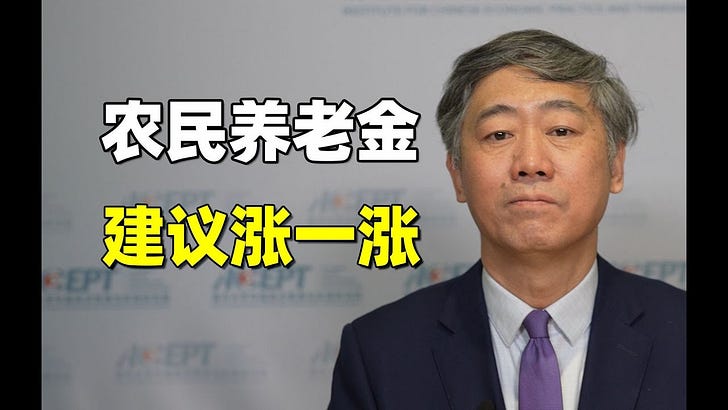
David Daokui Li is a Professor of Economics and Director of the Academic Center for Chinese Economic Practice and Thinking (ACCEPT) at Tsinghua University. He has been very active on Chinese social media, including opening a video channel on WeChat, China’s top messaging app, releasing a short video of him talking daily. He posts the same videos on his …
Liu Shijin Makes a Forceful Case for Raising Rural Pensions

Liu Shijin is a former Vice President (Vice Minister) of the Development Research Centre (DRC), a comprehensive policy research and consulting institution directly under the State Council, the central government of the People’s Republic of China. In recent years, he has been one of the most senior voices urging Beijing to raise the meagre pensions paid …
China’s consumption problem is an income distribution problem

Last month, Cai Fang, former Vice President—meaning Vice Minister—of the Chinese Academy of Social Sciences (CASS), wrote in the Communist Party of China (CPC)’s flagship journal Qiushi that China should optimise its income distribution structure through institutional development.
Three types of hidden debt unaccounted for in China's official stats

The debts accumulated by Local Government Financing Vehicles (LGFVs), often referred to as China's hidden debts due to their association with government liability, are widely known among observers of China's economy. However, in a recent speech and Q&A
Meng Xiaosu: China’s state capital has a rural debt to pay

For decades, China’s modernisation has been underwritten by the countryside: cheap grain, cheap labour, and cheap land. Yet the welfare state built alongside that growth remains split down the middle.
China never had free healthcare before its market reforms

Although only a tiny fraction of China’s population truly benefited from the so-called “free” medical care system in the planned economy era, the collective memory of that period remains heavily shaped, and often romanticised, by privileged groups and unsophisticated commentators. They continue to portray it as a utopian, universal free healthcare syste…
Wang Xiaolu’s alternative tally of who gets China’s national income

Wang Xiaolu is Deputy Director and Senior Research Fellow at the National Economic Research Institute, and a former standing Council Member of the China Society of Economic Reform under the National Development and Reform Commission (NDRC).
Farmers in Hunan are opting out of health insurance as premiums rise and coverage falls short

In Hunan, a central Chinese province with a population of over 65 million and a significant agricultural base, rising healthcare premiums are becoming too expensive for many farmers, who are now calling them a new “agricultural tax.” As incomes stagnate and costs rise, many are opting out of the system, putting their health at risk and undermining trust…


Really interesting analysis. I think the implications go well beyond inequality. China's weak social safety net is also a macroeconomic problem: when households have to save for retirement and healthcare, it's much harder to build a consumption-driven economy.
Beijing has spent decades strengthening its productive capacity, but boosting domestic demand may require investing much more in household financial security.
The question is whether China can meaningfully rebalance its economy without first addressing these structural inequalities. Could pension and healthcare reform ultimately do more for domestic consumption than another round of stimulus?