


Pekingnology has already published the first two essays in an unusual series by Ci-Ze Li (李其澤), an associate professor at National Changhua University of Education in Taiwan. Li has done something still relatively rare in Taiwan’s cross-Strait debate: rather than simply accepting or rejecting Beijing’s call to explore a “One Country, Two Systems” solution for Taiwan, he has chosen to take that call seriously and ask what such an arrangement would actually have to contain.
That question matters because Beijing has repeatedly said that the specific form of a Taiwan solution should take Taiwan’s realities into account and absorb views and proposals from people on both sides of the Strait. Yet there has been remarkably little serious public discussion of what that might mean institutionally. Li’s three essays try to enter precisely that space. Pekingnology published his first essay on September 18 and his first response to mainland critics on September 26. This is the third and most elaborate installment.
The discussion has also produced an unusual response from Beijing. At its September 9 press conference, the Taiwan Affairs Office was explicitly asked about the essays by “an associate professor at National Changhua University of Education.” A spokesperson said Beijing was pleased to see more Taiwanese people understand and discuss the concrete content of a “Two Systems” Taiwan solution and offer proposals for it. One week later, on September 16, another spokesperson returned to the subject, saying Beijing welcomed Taiwanese people expressing different views and putting forward specific suggestions. On September 30, a spokesperson again encouraged more discussions, this time without referring to Li’s essays.
There is another feature of this episode that deserves attention. Li’s essays were published in full on Zhengdangshi (正当石), a mainland WeChat blog that has hosted an extended exchange among readers and scholars on both sides of the Strait. The platform has not confined the discussion to arguments congenial to Beijing. Li’s third essay, reproduced below, begins with perhaps the most uncomfortable possible fact for advocates of “One Country, Two Systems”: a Taiwan Mainland Affairs Council-commissioned survey conducted in August found that 81.2% respondents opposed the proposition. The same survey found 68.9% supporting maintenance of the status quo while rejecting unification and 83.9% saying Taiwan’s future should be decided by its 23 million people. Li puts those numbers at the beginning of an essay addressed substantially to mainland readers.
That makes the space opened around this discussion noteworthy. It would be wrong to conclude that Beijing has accepted Li’s proposed terms. But official spokespeople have twice welcomed the discussion, while a mainland social-media platform has carried arguments that do not merely ask what Taiwan must concede, but what constitutional constraints Beijing itself would have to accept. In that limited but significant sense, the boundaries of the discussion have been unusually broad.
And Li’s argument has become considerably more sophisticated in this third essay. He stresses that he is not endorsing “One Country, Two Systems,” nor drafting surrender terms for Taiwan. Instead, he describes the exercise as a conditional “stress test”: assume that the two sides have peacefully negotiated a settlement and Taiwan has accepted one China and unified national sovereignty; what institutional arrangements would then be necessary to make the bargain credible?
His answer is built around reciprocity. Taiwan, in his framework, would accept unified sovereignty, rule out de jure separation and foreign military intervention, undertake national-security obligations and accept limits on its autonomous powers. Beijing, in return, would have to convert “Two Systems” from a political promise into enforceable constitutional commitments: protecting elections, judicial authority, basic rights, fiscal and economic autonomy and, during a transition, elements of local defence, while making those guarantees difficult for the central authorities to diminish unilaterally. His central formula is succinct: Taiwan’s autonomy must not hollow out “One Country,” but sovereignty must not erase “Two Systems.”
Whether such an arrangement is politically imaginable is, of course, a different question from whether it can be designed on paper. For readers interested in understanding the distance between Beijing’s stated invitation to “explore” a Taiwan solution and the political realities of Taiwanese society, the essay below offers an unusually detailed look into that gap. — Zichen Wang

台灣教授再次回應大陸讀者對《兩制方案,台灣該談什麼?》一文的質疑
Taiwan Professor Responds Again to Mainland Readers’ Questions
Editor’s Note: The proposed “One Country, Two Systems” solution for Taiwan continues to generate lively debate. Over the past two days, we have received a steady stream of letters and submissions from readers on both sides of the Taiwan Strait. We will publish them one by one on this blog, so we ask readers for their patience.
Professor Ci-Ze Li at National Changhua University of Education in Taiwan published a response yesterday that has again prompted heated discussion, with the exchange becoming increasingly intense and substantive. Below are three comments from mainland readers.
Comment One
This blog deserves credit for the openness with which it has allowed this discussion to develop. The debate has now entered deep waters. As someone who has followed cross-Strait affairs for a long time, I feel as though I have witnessed a compressed version of the process of cross-Strait contact and negotiation.
Parts of the article are in fact similar to proposals advocated by certain groups on the Taiwan side that favour negotiations. The difference is that official political consultations on such a solution do not appear to have formally begun. In particular, meaningful exchanges with Taiwan’s ruling party are currently extremely difficult.
In my view, there is indeed an enormous gap between the two sides over what such a solution should look like. But this discussion can at least allow all sides, especially those in Taiwan, to appreciate just how different public sentiment is across the Strait when it comes to reunification.
In the past, some in Taiwan have tended to assume that it is the mainland’s authorities, rather than the public, that are driving the push for reunification, and that ordinary people on the mainland have no particular sense of urgency. At the very least, this exchange has given them a clearer view of what mainland public opinion actually looks like.
Reunification has never been merely a matter of what the state wants. It reflects a national will that has grown stronger alongside the great rejuvenation of the Chinese nation, as well as the expectations of the people.
Since Taiwan so often cites public opinion in Taiwan, this discussion of a solution to the Taiwan question has also given people there an opportunity to observe mainland public opinion and see the mainland as it really is.
That is why dialogue is better than no dialogue, and contact better than no contact. We should not wait until the two sides are facing each other in armed conflict before suddenly awakening to the reality of the divide.
Once the gap is recognised, the task should be to narrow it gradually. Otherwise, the value of the discussion will diminish.
The goodwill shown by the mainland towards Taiwan is an opportunity that Taiwan can make use of. It is only natural for Taiwan to seek, within the realm of what is possible, to secure its interests and preserve its rights. But that opportunity will not necessarily remain indefinitely, and the terms and benefits on offer may diminish over time. I therefore hope compatriots on the other side of the Strait will value the opportunity.
If Taiwan does nothing but keep demanding a higher price without making any effort to narrow the gap, it will ultimately be Taiwan itself that bears the loss. Indeed, Taiwan may be the place in the world that has been most daring to set conditions for the mainland. People in Taiwan might also compare this with how other countries and regions treat Taiwan.
Comment Two
Rational discussion is a good thing. It creates space within Taiwan for people to talk about reunification without reacting to the subject with fear.
Through this platform and this debate, I hope people in Taiwan can see more clearly the possibilities and prospects ahead. With the mainland behind them and the world before them, people in Taiwan should be able to enjoy broader horizons, more choices, a larger stage, and greater room for development.
I hope people on both sides of the Strait can work together with a shared sense of purpose. Differences in political systems and ways of life need not outweigh a shared language, culture, and heritage.
As for One Country, Two Systems, I believe the extensive experience accumulated in Hong Kong and Macao can help produce a more developed Two Systems arrangement for Taiwan and contribute to the steady, long-term development of peace across the Taiwan Strait!
Comment Three
I would like to thank this professor from Taiwan for the article. Written from the perspective of Taiwan’s intellectual community, it sets out his own conception of what a solution to the Taiwan question might look like. Whatever one’s perspective, it is a significant article in moving discussion of peaceful reunification towards greater detail, depth, and eventually technical institutional design.
After reading the article and the comments, it seems that the greatest point of disagreement between mainland residents and some groups in Taiwan concerns the future of Taiwan’s existing system.
Mainland residents, inspired by the courage to “change the old world for a new one” [quoting Mao Zedong’s poem] and by the experience of nation-building, have gradually gained greater confidence in the socialist system and tend to regard “One Country, Two Systems” as the ultimate objective of peaceful reunification.
In Taiwan, by contrast, even though it has suffered considerably from the shortcomings of its electoral system, many vested-interest groups and ordinary citizens continue to treat democracy and freedom as unquestioned standards and to place great value on the so-called democratic system that has operated there for many years. They therefore feel a natural apprehension about accepting a different social system.
Historically, people’s perceptions of social systems are influenced to a considerable extent by comparisons of national strength and living standards, and those perceptions inevitably contain an emotional or irrational element.
Modern Chinese history has itself been a process of comparing and choosing among different systems before ultimately arriving at a social system with Chinese characteristics. A sound system should be able to withstand the test of history.
In response to yesterday’s discussion and criticism, Professor Ci-Ze Li has written another article of nearly 20,000 Chinese characters. The tables included in the article may be incomplete for editorial reasons, for which we ask readers’ understanding.
We publish the article today as the thirteenth instalment in our series of letters from readers on both sides of the Taiwan Strait.
The full text follows.
“One Country” Must Not Be Hollowed Out by Autonomy, and “Two Systems” Must Not Be Erased by Sovereignty
I am not endorsing a “One Country, Two Systems” solution to the Taiwan question, still less to draft surrender terms for Taiwan in advance. My purpose is to translate a political slogan into institutional provisions and conduct a conditional stress test of how such a system might work.
For the purposes of this exercise, the article assumes that the two sides reach a peaceful negotiated settlement and that Taiwan freely accepts “one China, with national sovereignty exercised uniformly by the central authorities”.
On that premise, the real questions are not whether the slogan sounds attractive, but three issues.
First, after sovereignty is unified, can Taiwan preserve an elected government, final judicial authority in Taiwan, basic rights, its existing fiscal and economic system, and necessary local defence capabilities?
Second, can China’s unitary constitutional system accommodate a degree of autonomy more extensive than that enjoyed by Hong Kong and Macao, and one that is more difficult to diminish unilaterally?
Third, can Taiwan itself be effectively constrained so that autonomy cannot again be used as a vehicle for separation, while the central authorities are also bound by higher-order law strong enough to constrain their own powers?
The core test is therefore clear: is Beijing willing to make constitutional commitments that constrain its own power in return for Taiwan assuming its obligations within the unified state after reunification?
Only if Beijing is willing to do so can there be a genuine basis for joint discussion. If not, “Two Systems” would amount only to a political promise that could be adjusted at will as circumstances change.
Public Rejection and Beijing’s Urgency on Reunification
A survey commissioned by Taiwan’s Mainland Affairs Council and conducted by the Election Study Centre of National Chengchi University from 13 to 17 August 2026 found that 81.2 per cent of respondents opposed the CPC’s “One Country, Two Systems” proposition, 68.9 per cent supported maintaining the status quo and rejected reunification, and 83.9 per cent supported having Taiwan’s future decided by its 23 million people.
The survey interviewed people aged 20 and above by telephone and obtained 1,086 valid responses, at a 95% level of confidence with a sampling error of ±2.97%. Some questions were part of long-running surveys and produced broadly stable results. The question producing the 68.9 per cent figure was newly introduced and should therefore not be used for long-term trend comparisons.
A single poll is not an eternal verdict, but it is sufficient to show that any reunification formula would first confront a major legitimacy deficit, not merely a communications problem. At the same time, strong public opposition in Taiwan has not reduced Beijing’s urgency to advance reunification.
In January 2019, General Secretary Xi Jinping called for the exploration of “a ‘two systems’ solution to the Taiwan question” in his speech at the meeting marking the 40th anniversary of the issuance of the Message to Compatriots in Taiwan. He said, “In terms of how the principle should be carried out in Taiwan, we will fully consider Taiwan’s reality, give full consideration to the views and proposals from all walks of life on both sides and fully accommodate the interests and sentiments of our compatriots in Taiwan,” provided that “China’s sovereignty, security, and development interests are ensured.” He also stated that “Peaceful reunification means achieving it through consultation and discussion as equals.”
On 1 July 2026, at a gathering in celebration of the 105th anniversary of the founding of the CPC, Xi described complete national reunification as “an essential step towards national rejuvenation” and called for efforts to “firmly advance the cause of national reunification.”
[Yuxuan’s note: The phrase “an essential step towards national rejuvenation” does not appear in the publicly available full text of Xi Jinping’s speech on 1 July 2026. It appears instead in the 2022 white paper, The Taiwan Question and China’s Reunification in the New Era. Xi made a similar point in January 2019, in his speech marking the 40th anniversary of the issuance of the Message to Compatriots in Taiwan: “Our country must be reunified, and will surely be reunified. This is a historical conclusion drawn from the evolution of cross-Strait relations over the past seven decades; it is also critical to the rejuvenation of the Chinese nation in the new era.”]
The statement that “The Taiwan question originated in a weak and ravaged China, and it will definitely end with China’s rejuvenation” came from Xi’s 2019 speech.
On 17 August 2026, at a symposium marking the centenary of Jiang Zemin’s birth, Xi reiterated Jiang’s statement that “Complete national reunification is what the people desire and a surging popular trend. It cannot be stopped by any force.” According to official CPC accounts, that statement dates to 1999.
[Yuxuan’s note: This statement does not appear in the publicly available full text of Xi Jinping’s speech on 17 August 2026. Nor have I been able to verify from publicly available official sources that Jiang Zemin first used this exact formulation in 1999. Similar formulations did appear in Jiang’s speech around that period, including in 2001. In Xi’s 2019 speech, the idea appeared in the fuller formulation: “The rejuvenation of the Chinese nation and reunification of our country are a surging popular trend. It is where the greater national interest lies, and it is what the people desire.”]
Read alongside the CPC’s longer-term policy language, these statements can reasonably be interpreted as continuing to link reunification to national rejuvenation. That, however, is an interpretation of the texts, not a deadline expressly set by the speeches themselves.
These two sets of signals frame the problem examined here: Beijing has invited the two sides to “explore” and “discuss”, while Taiwanese society overwhelmingly rejects the concept.
Avoiding discussion will not make the issue disappear. It would merely leave the content of any “solution to the Taiwan question” to be written unilaterally by Beijing.
Since this is being framed as an exploration, democracy, the judiciary, national security, troop deployment, public finances, and safeguards for implementation must all form part of the negotiation agenda. Otherwise, this would not be a joint exploration of a solution to the Taiwan question; it would simply amount to asking Taiwan to accept a solution already drawn up. Substantive negotiations must allow for give and take, mutual accommodation, and obligations on both sides.
Three Premises and the Core Negotiating Formula
This stress test rests on three premises.
First, this article does not assume that the people of Taiwan would accept “One Country, Two Systems”, nor that Taiwanese society has reached any consensus in this regard. It is testing the institutional limits of a counterfactual scenario.
Second, this article assumes that Taiwan has accepted unified national sovereignty and the central government’s authority to represent the state. It therefore does not consider options beyond Beijing’s stated bottom line, such as two Chinas, one China and one Taiwan, a confederation, a separate UN seat for Taiwan, foreign troops stationed in Taiwan, or a unilateral right of withdrawal.
Third, the analytical core is the problem of “credible commitment”. The difficulty in negotiations lies not only in how much the other side is willing to offer now, but also in whether those commitments could later be withdrawn unilaterally after power has been transferred.
Any formula must therefore pass four tests: whether the sovereignty arrangement is coherent; whether the scope of autonomy is clearly defined; whether effective remedies exist when rights are infringed; and whether commitments are difficult to rewrite unilaterally.
The core negotiating formula proposed here is as follows.
Taiwan would accept a single national sovereignty and rule out de jure separation and foreign military intervention. In return, Beijing would accept a constitutionally defined list of powers, non-regression of rights, joint amendment procedures, and phased implementation, all of which would constrain its ability to alter Taiwan’s autonomy after reunification.
The former prevents autonomy from hollowing out “One Country”. The latter prevents sovereignty from erasing “Two Systems”. Any formula that imposes irreversible obligations on one side only cannot create a credible commitment.
Analytical Framework: Harm, Compliance, Governance and Credible Commitments
Any serious discussion of a reunification solution must first distinguish three capabilities that are often conflated.
The first is the capability to inflict harm or destruction, such as blockading ports, attacking energy and communications infrastructure, or defeating organised military resistance.
The second is the capability to compel compliance: the ability to make a government and society that still retain meaningful choices accept specific political conditions.
The third is the capability to govern after reunification: the ability to secure administrative cooperation, economic recovery, and social collaboration after power has been transferred.
Thomas Schelling long ago distinguished between taking what one wants by force and using threats to make the other side yield. Brute force can achieve its aims without the other side’s cooperation; coercion cannot, because it still depends on the other side choosing to comply. Inflicting enormous losses does not necessarily produce political capitulation. Controlling territory does not necessarily mean governing it at low cost.
Likewise, “consultation and discussion as equals” does not mean equality in material strength, nor does it imply that two political entities would remain equal after reunification. It is first and foremost a matter of procedural standing. Before reunification takes effect, any sustainable agreement requires valid consent from both Beijing and Taiwan, since both are indispensable parties to the agreement.
After reunification, national sovereignty and constitutional authority may be unified. During negotiations, however, both sides must have genuine room to propose, reject, exchange, and amend provisions. If the stronger side presents a single predetermined text and the weaker side can only sign it, the process is not equal consultation, and the agreement loses its substantive legitimacy.
Research in institutional economics on Britain’s Glorious Revolution has shown that rulers can make commitments credible only by placing institutional constraints on their own power, so that breaking those commitments becomes procedurally difficult and costly.
International-relations theory similarly treats the “commitment problem” as an important cause of conflict. Even where war would be costly and both sides prefer peace at present, an agreement that alters the future distribution of power may give one side an incentive to demand new terms later.
Cross-Strait relations are a classic example. For Taiwan, reunification would close off external military options, transfer ultimate sovereignty, and reduce its independent capacity for self-defence. Beijing, meanwhile, would hold national legislative, constitutional-amendment and legal-interpretation powers, as well as military superiority, after reunification.
Even if Beijing were prepared to offer generous terms during negotiations, it could later redefine the scope of autonomy after Taiwan had made irreversible concessions. Conversely, Taiwan could use autonomy, elections, or external ties during a transition period to delay implementation.
Credible commitments must therefore be reciprocal, although they need not be symmetrical. The institutional design should constrain each side in the areas where it has the greatest capacity to breach the arrangement. Taiwan would be bound by anti-separation obligations, restrictions on foreign military intervention, national-security legislation, and implementation deadlines. Beijing would be constrained by exhaustive lists of reserved powers, non-regression of rights, anti-circumvention rules, procedures governing legal interpretation, and joint amendment of core provisions.
How the Level of Commitments Has Changed: From Ye’s Nine Points to the New-Era White Paper
Historically, the autonomy Beijing proposed for Taiwan was more extensive than many people remember, and such proposals predated the 1993 white paper.
The 1981 “Ye’s Nine Points” proposed that after reunification, Taiwan could become a special administrative region, enjoy a high degree of autonomy, and retain its armed forces. The central authorities would not interfere in Taiwan’s local affairs, while Taiwan’s existing social and economic system, way of life, and external economic and cultural relations would remain unchanged.
In 1983, Deng Xiaoping rejected “complete autonomy”, making clear that Taiwan would remain a local government and must not harm the interests of a unified country. At the same time, however, he proposed judicial independence, final adjudication in Taiwan, the retention of armed forces in Taiwan provided they did not threaten the mainland, and no stationing of mainland troops or administrative personnel in Taiwan. He also advocated talks between the CPC and the Kuomintang on an equal footing, rather than negotiations framed as “central versus local”.
This history rules out two extreme interpretations at once. A high degree of autonomy is not equivalent to inherent sovereignty, but unified sovereignty does not necessarily preclude final adjudication in Taiwan, local armed forces, or the non-stationing of mainland troops.
The 1993 white paper, The Taiwan Question and Reunification of China, was the most systematic and detailed articulation by the State Council Information Office of a high-autonomy arrangement. It proposed the long-term coexistence of two systems, with “neither side swallowing up the other”. Taiwan’s existing social and economic system, way of life, and external economic and cultural relations would remain unchanged. It expressly set out administrative and legislative powers, independent judicial power, and final adjudication in Taiwan. Taiwan would manage its own party, governmental, military, economic and financial affairs, could conclude commercial and cultural agreements, enjoy a certain degree of authority over external affairs, and retain its own armed forces, while the mainland would not station troops or administrative personnel in Taiwan.
The 2000 white paper reaffirmed a high degree of autonomy and the non-stationing of mainland troops and administrative personnel in Taiwan. It expressly stated that the content of “One Country, Two Systems” for Taiwan could be more generous than that for Hong Kong and Macao. At the same time, however, the document for the first time listed “an indefinite refusal to negotiate reunification” as one of the circumstances in which non-peaceful means might be used.
“More generous” did not mean that Beijing had expressly committed to Taiwan’s current system of direct presidential elections, alternation in power between political parties, or comprehensive judicial review of rights. Those arrangements would still have to be specifically agreed through negotiation.
In 2019, General-Secretary Xi Jinping shifted to an open-ended call for “exploration”, saying that the specific form of “Two Systems” would “fully consider Taiwan’s reality, give full consideration to the views and proposals from all walks of life on both sides”, provided that “China’s sovereignty, security, and development interests are ensured.”
The 2022 white paper, The Taiwan Question and China’s Reunification in the New Era, reaffirmed that Taiwan could enjoy a high degree of autonomy in accordance with law, that the two social systems could “develop side by side for a long time to come”, and that with the approval of the central government of China, foreign countries may set up consulates or other official and quasi-official institutions in Taiwan.
At the same time, it stated more clearly that “Two Systems is subordinate to and derives from One Country”, and that “all Taiwan compatriots who support reunification of the country and rejuvenation of the nation will be the masters of the region.” The logic is close to the principle of “governance by patriots”, although the white paper does not use the phrase “patriots governing Taiwan”.
It is also notable that several provisions expressly set out in 1993 were not repeated individually in 2022: Taiwan retaining its armed forces, no mainland troops stationed in Taiwan, no mainland administrative personnel being sent there, Taiwan managing its own party, government, military, economic, and financial affairs, final adjudication in Taiwan, and a degree of authority over external affairs.
Silence cannot by itself be treated as formal withdrawal. But it does make the current status and negotiability of those earlier terms more uncertain.
The gap between these versions is itself significant and must be taken seriously. The 1993 high-water mark is not an acquired right that Taiwan can invoke against Beijing today, nor should it be treated as a minimum offer below which Beijing can never go. The balance of power across the Strait has changed, and Beijing’s negotiating terms may certainly change accordingly.
The significance of the gap lies elsewhere: Beijing once considered these conditions compatible with “One Country, Two Systems.” If Beijing now believes circumstances have changed, it can propose different terms. But it cannot retroactively characterise an arrangement that it once proposed itself as inherently separatist.
Historical documents therefore provide a negotiating reference point, but they do not solve the problem of implementation.
The most reasonable institutional test for Taiwan would not be to cite old documents and demand that Beijing implement them unconditionally. It would be to ask Beijing to state, item by item, which earlier terms remain valid, which have changed with circumstances, what alternative safeguards would replace them, and whether the terms it reaffirms would be written into the Constitution, a Basic Law, and an agreement that would take effect simultaneously.
Whether earlier commitments can once again be put down in black and white — and whether Beijing is prepared to put them into law — would be the first test of sincerity and credibility.
Constitutional Framework: One Sovereignty, Two Legal Domains, Four Lists
On this premise, the autonomy enjoyed by Taiwan under a special constitutional order would not amount to an inherent sovereignty equal to that of the state. It would instead be a high degree of autonomy granted under the Constitution of the People’s Republic of China and by the National People’s Congress (NPC).
The powers to be exercised directly by the central authorities, together with the national laws applicable in Taiwan, would have to be exhaustively specified in higher-level law and its annexes. Other matters of local governance would be handled by Taiwan within the scope of that authorisation.
The fact that authority originates in the state does not mean that the executive can withdraw the authority arbitrarily. The point of constitutional authorisation is precisely that state organs themselves are bound by the higher-order law they enact.
This framework would not be a confederation. Taiwan would not retain formal diplomatic relations, a UN seat, foreign troops, a unilateral right of withdrawal, or an independent right to use military force abroad. It would draw on safeguards used in federal and asymmetrical-autonomy systems to constrain unilateral change, but would not give Taiwan separate sovereign status.
Whether Beijing would be willing, for the sake of peaceful reunification, to adopt constitutional safeguards more robust than those used in Hong Kong and Macao is precisely what this stress test seeks to examine.
Under China’s unitary constitutional system, the principle that central reserved matters are exhaustively listed while other matters are handled by Taiwan cannot be framed as Taiwan transferring original powers to the central authorities. It must instead be designed as a general constitutional authorisation granted to Taiwan by the state.
That legal basis does not rule out the use of lists. On the contrary, it makes it all the more important to define precisely the scope of Taiwan’s authorisation, the powers reserved to the central authorities, and the procedures for amendment.
Article 31 of the Constitution of the People’s Republic of China provides a basis for establishing special administrative regions, but does not itself directly grant a high degree of autonomy.
Article 62 assigns the NPC powers including constitutional amendment, enactment of basic laws, and decisions on the systems to be established in special administrative regions. Article 64 sets out the constitutional-amendment procedure. Article 67 assigns constitutional and legal interpretation powers to the Standing Committee of the NPC.
Among existing statutes, Article 5 of the Anti-Secession Law states that “Taiwan may practice systems different from those on the mainland and enjoy a high degree of autonomy”, but still does not define the scope of autonomy, procedures for amendment, or mechanisms for legal remedy.
A solution to the Taiwan question would therefore require at least two layers of constitutional construction.
First, the Constitution of the People’s Republic of China would need to be amended to add a Taiwan-specific chapter and establish special amendment procedures.
Second, pursuant to Article 31 and the amended Constitution, the NPC would enact a Basic Law of Taiwan, expressly granting Taiwan a general authorisation for a high degree of autonomy.
The fact that authority originates in the centre does not mean the scope of that authority has to remain vague. The Basic Law of Hong Kong demonstrates that a unitary state can accommodate a high degree of autonomy and final adjudication within Hong Kong, while in principle limiting the national laws that apply there to those listed in Annex III. Article 22 also prohibits departments of the Central People’s Government, provinces, autonomous regions, or municipalities directly under the Central Government from interfering in the affairs which the Hong Kong administers on its own in accordance with the Basic Law.
However, Article 18 provides a route for national laws to apply in wartime and in specified states of emergency. Article 158 gives the NPC Standing Committee the final power of interpretation. Article 159 gives the NPC the power to amend the Basic Law, while additional Hong Kong consent is only required for amendment bills proposed by Hong Kong.
It is precisely this imbalance in ultimate control that means the Hong Kong model cannot simply be transplanted to Taiwan.
I. Using Comparative Law: Disassembling Techniques Rather Than Transplanting Systems Wholesale
The real value of comparative constitutional law does not lie in copying foreign systems wholesale or transplanting them without regard to context. It lies in identifying particular institutional and legislative techniques and understanding how they actually operate under specific political conditions.
The Åland Islands provide an example of a “double lock” in the division of powers between the state and an autonomous territory. Under Finland’s Act on the Autonomy of Åland, amendments to the autonomy statute require not only approval by the Finnish Parliament under a qualified procedure equivalent to that for constitutional amendments, but also the consent of two-thirds of the members present in the Åland Legislative Assembly. This “double consent” requirement prevents the central legislature from stripping away local autonomy through an ordinary legislative majority.
However, the success of this mechanism also depended on the international settlement established by the League of Nations in 1921 and on the protections arising from Åland’s demilitarised and neutralised status under international law. Without comparable constraints in the broader political environment, safeguards written only into domestic law often prove fragile.
Scotland illustrates a model in which residual powers lie with the devolved legislature. Under the Scotland Act 1998, only specified areas, such as defence, foreign affairs and currency, are reserved to the UK Parliament. Matters not reserved generally fall within the legislative competence of the Scottish Parliament.
At the same time, the Scottish model also illustrates the limits of constitutional conventions. Despite the Sewel Convention, the United Kingdom’s principle of parliamentary sovereignty means that the convention is not judicially enforceable. Devolved autonomy can therefore remain vulnerable when the central legislature is determined to act.
Article 5 of the Italian Constitution declares that the Republic is “one and indivisible”, yet the 2001 constitutional reforms, including Article 117, introduced a division of legislative powers resembling federal arrangements. The Constitution identifies areas of exclusive state competence and areas of concurrent competence between the state and the regions, while residual powers over matters not expressly listed belong to the regions.
Italy therefore demonstrates that substantial territorial devolution and residual regional powers can coexist with a unitary constitutional framework and the principle of an “one and indivisible” Republic. The key lies in drawing the boundary between central and regional powers with sufficient precision.
Catalonia provides a stark reminder that even an extensive process of local democratic approval may ultimately remain subject to the authority of the central judiciary.
The 2006 Statute of Autonomy of Catalonia was approved by the Catalan Parliament, amended and approved by the Spanish Parliament, and then endorsed by a strong majority in a regional referendum, giving it substantial democratic legitimacy. Yet in 2010, the Spanish Constitutional Court struck down a number of important provisions relating to judicial autonomy, fiscal autonomy, and the definition of “nation”.
The case shows, in sobering terms, that even where an autonomy arrangement has been endorsed through democratic procedures at both the central and territorial levels, its ultimate boundaries may still depend on the final interpretive authority of the central constitutional court.
These cases reveal a hard constitutional truth: a list of powers alone is not a cure-all for autonomy. An effective allocation-of-powers framework must be accompanied by the primacy of law, rules for classifying different types of disputes, a role for both the centre and the territory in final interpretation, and amendment procedures that cannot be changed unilaterally. Without those safeguards, written legal guarantees can be eroded at any time.
More importantly, these comparative techniques drawn from European territorial autonomy cannot be taken out of context and used by themselves to prove that Taiwan could retain armed forces, an independent currency, or final judicial authority.
European autonomy systems are built on the acceptance that the central state retains unified responsibility for defence, foreign affairs, and ultimate judicial sovereignty. Taiwan, however, would be facing highly adversarial cross-Strait relations and an authoritarian political system very different from a liberal democratic one.
Identical or similar legal provisions cannot be assumed to produce the same binding force or the same effects on peace in the absence of comparable independent review institutions, democratic constitutional conventions, and geopolitical balances. Comparative law can provide the technical components of constitutional design; it cannot substitute for substantive political conditions and sovereign power.
II. Four Lists
A more precise approach would be to replace the potentially misleading idea of a “positive enumeration of central powers” with four separate lists.
These would not turn the central authorities and Taiwan into two states. Rather, they would define the scope of authorisation, areas requiring co-operation and institutional red lines binding on both sides.
Table One would concern powers and structural boundaries. Table Two, discussed later, would concern conduct in implementing the agreement. The two serve different functions.
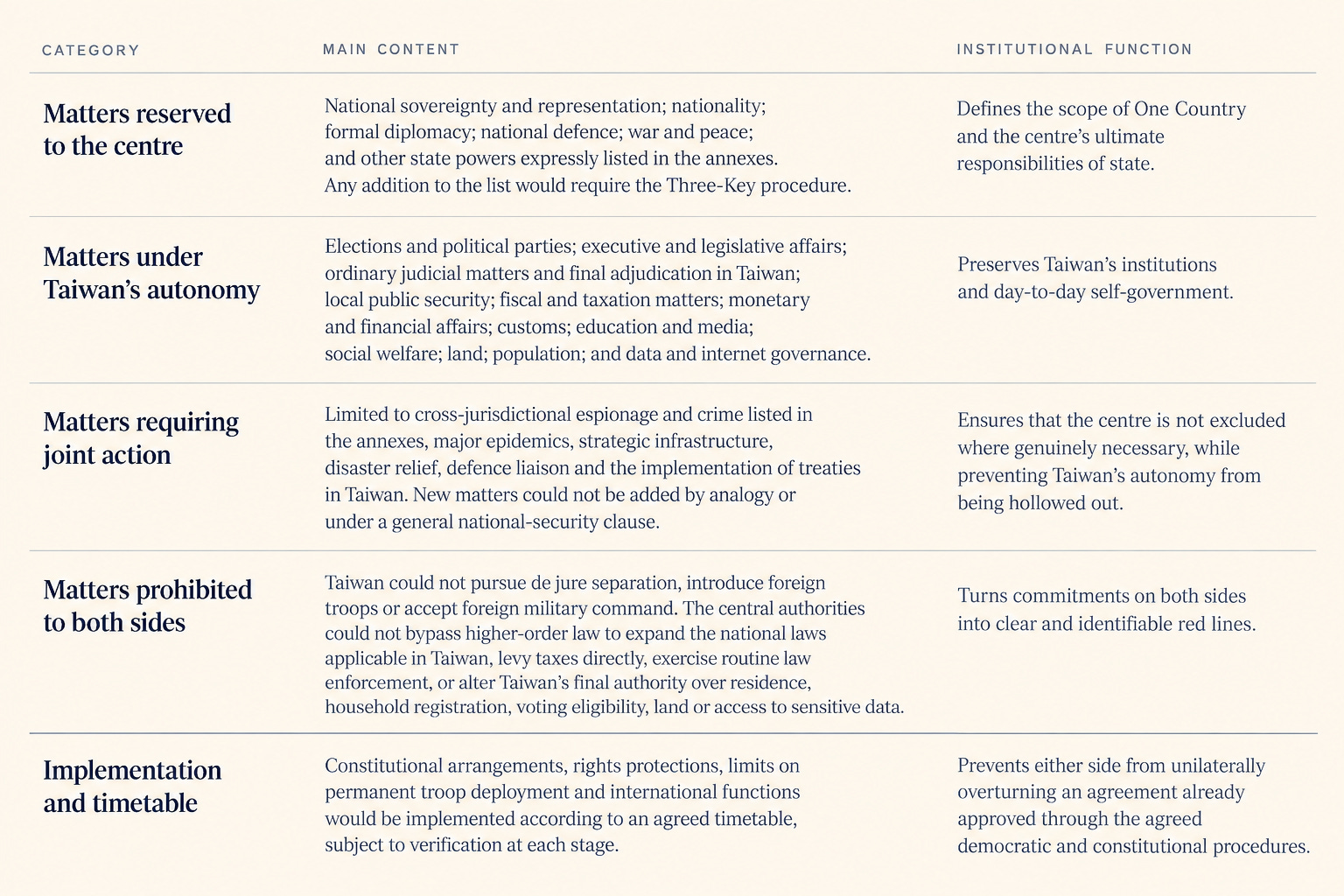
This framework would exclude, for Taiwan, a two-sovereign-state solution, confederate membership, a separate UN seat, formal diplomatic relations, foreign troop deployments, an independent right to wage war abroad and a unilateral right of withdrawal. At the same time, it would rule out using national security or unified sovereignty as blanket clauses through which central authority could enter fields outside the agreed lists at will.
The two sides would negotiate as procedural equals, while the outcome would be a single sovereignty; autonomy would derive from the state, but state organs would themselves remain bound by higher-order law. “One Country” would determine national belonging, formal diplomacy, and overall defence; “Two Systems” would determine how people in Taiwan live, who governs them, and whether the central authorities can arbitrarily alter Taiwan’s institutions.
Core Autonomy: Six Groups of Institutional Powers That Must Not Be Hollowed Out
The name and flag of a state carry dignity and historical meaning. But within the boundaries of what this article assumes Beijing might accept, the “Republic of China” could not continue as the name of a separate sovereign state.
Taiwan could nevertheless seek to preserve particular names, flags, calendar conventions, and holidays during a transition period, or retain them as symbols of local history and regional identity.
The issues that would most directly affect people’s daily lives, however, are the following six groups of institutional powers.
1. Democratic Institutions: Central Confirmation Must Not Become a Veto over Elections
Taiwan’s chief executive, legislature, and local leaders should continue to be chosen through periodic direct elections by residents of Taiwan. Space should also remain for multiparty competition, alternation in power, opposition parties and freely organised political activity.
Public officials could be required to swear allegiance to national reunification and Taiwan’s special constitutional order. The Basic Law of Taiwan could also prohibit organising, planning or carrying out separation, accepting foreign military command, engaging in espionage, or secretly receiving foreign funding to undermine the constitutional arrangement.
But such restrictions would have to be established by special legislation and differ substantially from Hong Kong’s 2021 candidate-eligibility review model. The grounds for disqualification would have to be exhaustively specified. Political bodies should not be allowed to add new requirements by invoking an abstract standard of being a “patriot”, and final judicial review should rest with Taiwan’s courts.
If Taiwan’s chief executive were formally appointed by the central authorities, that appointment should amount to a binding confirmation of a lawful election result. The central authorities should not be able to refuse appointment unless Taiwan’s court of final adjudication had found the candidate legally ineligible.
Peaceful criticism of the central authorities, academic discussion of alternative policies, or lawful advocacy of institutional reform that does not involve separation should not in itself constitute a crime or disqualify someone from standing for office. Otherwise, elections would merely confirm candidates already approved in advance. The democratic system might retain its name, but it would already have lost its function of conferring political authority.
Taiwan’s democracy does have problems, including partisan conflict, short-term policymaking, and political dysfunction. Those shortcomings are worth addressing, but they do not imply that people should lose the right to choose their government, replace those in power peacefully, and criticise authority openly.
The argument here need not prove in the abstract that one model of democracy is superior to all other systems. It need only recognise that elections, multiparty competition, freedom of the press, and judicial remedies have become part of Taiwan’s existing institutions and way of life.
Since Beijing says that it will “accommodate Taiwan’s actual conditions”, it cannot simultaneously promise to preserve Taiwan’s system while assuming from the outset that ruling parties will no longer alternate, candidates will be screened, and dissent will be restricted.
If people who oppose reunification are excluded first and only those who remain are allowed to express consent, the result is not democratic authorisation but filtered compliance.
2. The Judiciary and National Security: The Centre Cannot Be Excluded, Nor Can Taiwan Be Hollowed Out
The 1993 white paper explicitly proposed that Taiwan enjoy independent judicial power and final adjudication. That can serve as an important policy starting point for negotiations, but it is not itself a directly applicable legal source of jurisdiction.
The Basic Law of Taiwan would need to provide that ordinary civil, criminal, and administrative cases, together with cases involving Taiwan’s autonomous laws and basic rights, are heard by Taiwan’s courts and finally concluded there.
In principle, residents of Taiwan should not be transferred to the mainland for conduct occurring in Taiwan. Central public-security, state-security, prosecutorial, and military bodies should likewise not be able to independently carry out arrests, searches, surveillance, or other coercive measures in Taiwan.
Taiwan’s courts would review enforcement measures taken in Taiwan, as well as Taiwan laws and administrative acts. This would not amount to Taiwan’s courts invalidating decisions of the NPC.
A reunification solution could not allow Taiwan, in the name of autonomous legislation, to legalise organised armed separation, cross-jurisdictional espionage, acceptance of foreign military command, or violent attempts to undermine the reunification arrangement.
The central authorities would bear ultimate responsibility for national security, but that responsibility would not by itself confer unlimited law-enforcement powers on central national-security, public-security, or prosecutorial organs in Taiwan. The real issues must be separated: what conduct constitutes a crime, who legislates, who investigates, who adjudicates, and how exceptional jurisdiction can be triggered.
A more workable two-tier approach would be as follows.
At the national level, the core security threats would be exhaustively defined. Taiwan would then adopt its own detailed legislation and take responsibility for day-to-day investigation and adjudication.
Offences would have to be clearly defined and non-retroactive. Except where conduct has already caused serious actual harm, liability should at minimum require proof of a concrete, real, and imminent danger of serious harm. Mere expression of opinion should not be criminalised.
Joint jurisdiction should be triggered only in a very small number of cases involving foreign military command, organised armed separation, or major cross-jurisdictional espionage that Taiwan’s own authorities are demonstrably unable to handle effectively. Even then, arrest, search, and seizure in Taiwan should still be carried out by Taiwan authorities.
Defendants would be tried either by a joint court located in Taiwan or by a special panel of a Taiwan court, under procedures and rights protections specified in advance. They would not be transferred to the mainland.
3. Basic Rights: Non-Regression, Proportionality, and Judicial Remedies as the Floor
Taiwan’s existing rights concerning speech, the press, publication, the internet, academic activity, religion, assembly, association, privacy, labour, gender, family, Indigenous peoples, property, and due process should form a baseline of protection, defined by the Constitution, constitutional judgments, legislation implementing the two international human-rights covenants and other human-rights conventions, Indigenous legal frameworks, and other applicable law in force on the date reunification takes effect. The five legal instruments discussed below should then expressly establish a general principle of non-regression.
Any restriction in an individual case should require a clear legal basis, a legitimate purpose, necessity, proportionality, and an effective judicial remedy. A constitutional review body should be able to invalidate unlawful legal provisions, while administrative courts should be able to overturn unlawful administrative acts. Rights without an effective remedy are merely political declarations.
The institutional transition would also require provisions for political reconciliation across jurisdictions. Peaceful political advocacy, national identity, journalistic and academic activities, and ordinary military or public service before reunification should not become grounds for retrospective prosecution. This protection should be written simultaneously into the peace agreement, the Basic Law of Taiwan, and national reconciliation legislation.
For conduct that might fall within the scope of mainland criminal law, the NPC Standing Committee would also need to decide on an amnesty under Article 67 of the Constitution, followed by an amnesty order issued by the President under Article 80. This could not depend solely on decisions by Taiwan prosecutors not to prosecute. Amnesty and non-prosecution should exclude intentional homicide, torture, serious corruption, and other grave human-rights offences.
Education could include more material on shared history and the national constitutional order. But ideological screening, the elimination of political parties, or compelled identification should not replace public debate.
4. Finance, Population, and Data: Preventing the System from Being Quietly Rewritten
People often experience institutional change most directly through currency, housing, employment, taxation, health care, education, and population movement rather than through the name of the state.
Taiwan should retain the New Taiwan dollar, its central bank and foreign-exchange reserves, together with an independent tax system, budget, financial regulation, separate customs territory, land system, health insurance, pensions, and social-welfare arrangements. The central authorities should not directly levy taxes in Taiwan or force the adoption of the renminbi through administrative measures.
Hong Kong’s Basic Law already provides for fiscal autonomy, no central taxation in Hong Kong, a separate tax system, continued circulation of the Hong Kong dollar, local authority over currency issuance, and a separate customs territory. Allowing Taiwan to retain its own central bank and foreign-exchange reserves would go further. It should therefore be presented honestly as a new arrangement to be negotiated, rather than as a straightforward extension of the Hong Kong model.
Mainland residents’ settlement in Taiwan, acquisition of household registration and voting rights, purchase of land, and ownership or control of media, critical infrastructure, or large-scale personal data would have to be governed by Taiwan law and transparent quotas, with Taiwan retaining final legislative and approval authority.
Article 22(4) of Hong Kong’s Basic Law leaves the final decision on the number of mainland residents permitted to settle in Hong Kong to the relevant central authorities, requiring only consultation with the Hong Kong government. Between the handover in 1997 and 2019, more than one million people moved from the mainland to Hong Kong through the One-way Permit scheme, which allows eligible mainland residents to settle permanently in Hong Kong, primarily for family reunion. That cumulative total was equivalent to roughly one-seventh of Hong Kong’s population in 2019.
It should not, however, be taken as the proportion of Hong Kong’s population currently made up of migrants from the mainland; the precise demographic impact of those inflows would require separate analysis of age, place of birth, deaths, and outward migration.
Allowing Taiwan to retain final decision-making authority would not mean permanently excluding normal movement within a single country. Its purpose would be to prevent population, capital, and data flows from fundamentally reshaping the autonomous community within a generation while the formal rules remained unchanged.
5. Unified Diplomacy Does Not Mean Zero International Function
Accepting “One China” would mean that the central authorities would handle formal diplomatic recognition, the state’s UN seat, and international representation. But that would not mean that Taiwan must be cut off from the world.
The Basic Law of Taiwan could grant Taiwan prior general authorisation to establish overseas economic, trade and cultural offices under mutually agreed names, issue travel documents, and independently conclude agreements on functional matters such as trade, technology, aviation, shipping, public health, culture, taxation and judicial assistance.
Participation in organisations such as the WTO, APEC, the Olympic system, WHO and ICAO would continue to depend on the rules of each organisation and the decisions of its members. Beijing could commit to authorise and support such participation under domestic law, complete any necessary notifications, consultations, or applications, and refrain from unreasonable obstruction. It could not unilaterally guarantee the continuation of any particular international status for Taiwan.
The 2022 white paper already states that, “After reunification, foreign countries can continue to develop economic and cultural relations with Taiwan. With the approval of the central government of China, they may set up consulates or other official and quasi-official institutions in Taiwan” Hong Kong’s Basic Law likewise allows Hong Kong, under the name “Hong Kong, China”, to participate in international organisations not limited to states and to conclude functional agreements.
What Taiwan would need to negotiate is not a second system of formal diplomacy, but a clear division between two categories: Consulates and formal official institutions would remain matters for the central authorities; functional matters listed in the Basic Law of Taiwan, such as trade, technology, and civil aviation, would operate under prior general authorisation rather than case-by-case approval.
6. Military Transition: How National Command and Local Command Could Coexist
Military arrangements in the early stages after reunification would be crucial to building Taiwan’s confidence in the overall solution.
The 1993 white paper proposed that Taiwan could retain its own armed forces and that the mainland would not station troops or administrative personnel there. But that was only a policy proposal. It did not resolve the legal status of Taiwan’s armed forces within the state, the question of supreme command, or the operational chain of command.
The proposal here is not that Taiwan should permanently retain an independent national military capable of confronting the central government. Instead, a regional defence system for a transitional period could be established through constitutional amendments and special legislation.
Overall national defence, decisions of war and peace, and external military relations would belong to the central authorities. Taiwan would undertake not to join foreign military alliances, host foreign bases, accept foreign military command, deploy nuclear weapons, or maintain long-range strategic strike capabilities aimed at the mainland.
In return, Beijing would undertake not to establish a permanent PLA troop presence in Taiwan, Penghu, Kinmen, or Matsu, and not to allow mainland administrative or national security organs to take over the administration of Taiwan during the transition period.
Under Article 93 of the Constitution of the People’s Republic of China, the Central Military Commission leads the country’s armed forces. Therefore, the Taiwan chapter of the Constitution and the Basic Law of Taiwan would need to provide expressly that Taiwan’s regional defence forces fall under the unified leadership of the Central Military Commission as a matter of national law, while personnel, budgets, training, and peacetime operational command during the transition are exercised by Taiwan authorities under legally delegated authority.
The regional defence force would be limited to defence around Taiwan, maritime security, disaster relief, and local protection. It would have no independent authority to conduct military operations abroad. Any deployment outside Taiwan or participation in an overseas conflict during the transition period should require a joint activation procedure agreed in advance between the central authorities and Taiwan.
The guarantee against permanent PLA troop deployment, together with local defence arrangements, could be set for ten to twenty years or another minimum period sufficient to build confidence. Expiry of that period should not automatically trigger PLA deployment. Any subsequent change should still be subject to implementation review and the Three Keys procedure.
A reasonable negotiating formula would be: Taiwan’s military capabilities would not threaten the mainland, while mainland forces would not use troop deployment as a means of taking over Taiwan.
Turning Political Commitments into Constitutional Assurances: Five Legal Instruments, Three Keys, and Anti-Circumvention
If one party to an agreement simultaneously controls amendment, interpretation, and adjudication of breach, however detailed the text may be, it may still be rewritten unilaterally.
Article 31 of the Constitution of the People’s Republic of China provides that the systems instituted in special administrative regions be prescribed by laws enacted by the NPC; Article 67 gives the NPC Standing Committee the power to interpret the Constitution and laws; and Hong Kong’s Basic Law likewise vests the power of interpretation in the NPC Standing Committee and the power of amendment in the NPC. Therefore, under China’s current constitutional structure, no one can honestly guarantee that the NPC would be legally unable to alter Taiwan’s institutional arrangements in the future.
The “Three Keys” proposed in this article are not a mechanism that currently exists under China’s Constitution. For such a mechanism to be established, Article 64 — the constitutional-amendment procedure — would have to be amended, or a Taiwan-specific constitutional chapter would have to establish it as a special procedure under Article 64; any limits on the NPC Standing Committee’s power of interpretation would likewise need constitutional status.
Even then, without an independent adjudicator with authority over the NPC, this arrangement would remain a form of political-constitutional self-restraint rather than an absolutely irrevocable territorial veto. The realistic aim of such a system would be to make backtracking more difficult, slower, and more transparent, while making the costs of breach more predictable.
1. Anti-Circumvention: Formal Amendment Is Not the Only Path to Change
The most important lesson from Hong Kong is the asymmetry between formal amendment of the Basic Law and other routes through which the constitutional order can be materially altered.
Article 159 of Hong Kong’s Basic Law vests the power of amendment in the NPC, while amendment bills may be proposed by the NPC Standing Committee, the State Council, or the Hong Kong SAR. Only amendment bills originating from Hong Kong are expressly required to obtain the consent of two-thirds of Hong Kong’s NPC deputies, two-thirds of all members of the Legislative Council, and the Chief Executive.
In 2020, the NPC first adopted a decision establishing a national-security regime for Hong Kong. The NPC Standing Committee then enacted the Law of the People’s Republic of China on Safeguarding National Security in the Hong Kong SAR (Hong Kong National Security Law) and added it to Annex III of the Basic Law. Under specified circumstances and upon approval of the Central People’s Government, the law allows the Office for Safeguarding National Security of the Central People’s Government in the Hong Kong SAR to exercise jurisdiction over a case, with the Office conducting the investigation, the Supreme People’s Procuratorate designating a procuratorial body to prosecute it, and the Supreme People’s Court designating a court to adjudicate it.
In 2021, the NPC adopted a further decision authorising the NPC Standing Committee to amend Annexes I and II of Hong Kong’s Basic Law, after which Hong Kong enacted the corresponding local legislation. The Hong Kong Legislative Council was expanded from 70 to 90 seats, while the number of directly elected geographical constituency seats fell from 35 to 20, and a new candidate-eligibility review mechanism was established in which national-security authorities played a formal role.
In 2022, the NPC Standing Committee interpreted Articles 14 and 47 of the Hong Kong National Security Law pursuant to Article 65 of the law. [Article 14 sets out the powers of Hong Kong’s Committee for Safeguarding National Security and provides that its decisions are not subject to judicial review, while Article 47 requires Hong Kong courts to obtain a binding certificate from the Chief Executive on whether an act involves national security or evidence involves state secrets. Article 65 vests the power to interpret the law in the NPC Standing Committee.]
In 2024, Hong Kong enacted the Safeguarding National Security Ordinance.
Under Beijing’s constitutional account, each measure adopted through central state institutions had a formal legal basis in written law or an NPC decision. Whether the measures were compatible with the principle of a high degree of autonomy remains contested.
Taken together, however, they demonstrate that the boundaries of autonomy can be materially reshaped without amending the text of the Basic Law itself and without the direct consent of Hong Kong residents.
A solution to the Taiwan question therefore cannot merely raise the formal threshold for amending the text of a Basic Law of Taiwan. Any measure that permanently or structurally diminishes democratic elections, final judicial authority in Taiwan, basic rights, fiscal and economic autonomy, or the allocation of powers — whether through annexes, national laws to be applied in Taiwan, legal interpretation, implementing legislation, or subordinate regulations — should be treated as an amendment to a core provision and trigger the “Three Keys” procedure.
A genuine war, major disaster, or emergency that Taiwan’s authorities are objectively unable to control could justify temporary measures under exhaustively defined conditions. But such measures should be subject to requirements of necessity and proportionality, strict time limits, publicly stated reasons, periodic review, and sunset clauses. They should not permanently alter the structure of elections or the judiciary. Any emergency measure extended beyond its original term or converted into a permanent arrangement should again require the “Three Keys”.
2. Five Interdependent Legal Instruments
The arrangement would require five interdependent legal instruments.
First, the competent authorities on both sides would conclude an Agreement on Peaceful Reunification and a High Degree of Autonomy for Taiwan.
Second, the Constitution of the People’s Republic of China would be amended to add a Taiwan-specific chapter.
Third, the NPC would enact a Basic Law of Taiwan.
Fourth, under its existing constitutional-amendment procedure, the Republic of China would adopt constitutional transitional or conversion provisions authorising the Agreement and specifying the conditions and timing for transition from the existing constitutional order.
Fifth, the Basic Law of Taiwan would authorise Taiwan’s legislature to enact a Taiwan Autonomy Charter preserving its democratic, judicial, rights, and fiscal institutions, and would require ratification by Taiwan residents in a referendum. The Taiwan Autonomy Charter would be subordinate to the Constitution of the People’s Republic of China and the Basic Law of Taiwan, but within the authorised sphere, it would have the highest local legal force within Taiwan’s legal domain.
The five instruments would not have the same legal rank and could not literally be approved at the same time. Each should be drafted, deliberated, and approved in stages under the respective legal orders of the two sides, with the resulting instruments of approval deposited subject to agreed conditions.
Only after all requirements had been satisfied — including the amendment to the Constitution of the People’s Republic of China, enactment of the Basic Law of Taiwan, Taiwan’s legislative and constitutional amendments, ratification of the political agreement by referendum, and adoption of the Autonomy Charter — would all the instruments take effect on the same date agreed by both sides. If any one element remained incomplete, no irreversible transfer of sovereignty or powers should be triggered.
Mere cross-reference cannot create a hierarchy of law. The instruments would therefore also have to specify the order of application, conflict rules, adjudication mechanisms, and the manner in which existing laws continue in force.
3. The Three Keys and Constrained Interpretation
Any amendment that diminishes core provisions including democratic elections, final judicial authority in Taiwan, basic rights, fiscal and economic autonomy, the allocation-of-powers lists, the commitment against permanent troop deployment during the transition period, or population arrangements should require all “Three Keys”:
Passage by the NPC under a special constitutional procedure and the required statutory majority;
Approval by Taiwan’s legislature by a special majority;
Ratification by the people of Taiwan in a free referendum.
What constitutes a “substantial diminution” should itself be exhaustively defined in the Taiwan chapter and its annexes, with formal procedures giving Taiwan a role in proposing and consenting to changes. The central authorities should not retain unilateral power to define the term.
This would not give Taiwan an inherent power of constitutional amendment equal to that of the NPC. Rather, the Constitution of the People’s Republic of China would itself impose special validity requirements on amendments affecting Taiwan.
If the NPC Standing Committee retained final statutory authority to interpret the Basic Law of Taiwan, limits on that authority could not be set out only in ordinary legislation. They would also need to be incorporated into the Taiwan chapter of the Constitution, the Basic Law of Taiwan and the NPC Standing Committee’s rules of procedure.
Before issuing an interpretation, the NPC Standing Committee would have to notify the competent Taiwan authorities, consult a Basic Law committee composed of equal numbers of members from both sides, publish the committee’s views, and give full reasons for its decision. Interpretations should in principle have no retroactive effect, should not reopen cases already finally concluded by Taiwan courts, and should not create new central powers outside the agreed lists.
The legal consequences of procedural violations would also have to be clearly specified.
Even then, the residual risk of self-interpretation could not be eliminated entirely: the NPC Standing Committee would still retain the power to interpret the restrictions placed on its own interpretive authority.
4. Residual Risks That Would Remain
It must be acknowledged that, as long as ultimate sovereignty and constituent power are vested in a single state, no generation can, through law alone, bind every future exercise of constituent power. Unless foreign governments, the United Nations, or an international court were to serve as political guarantors, Taiwan would also lack a fully independent ultimate enforcer.
The proposed design could therefore only reduce the risk of breach, not eliminate it. It would do so through multiple layers of domestic legal entrenchment, local consent, procedural delay, publicly stated reasons, reciprocal implementation, and the political and economic costs of reversal.
If Beijing were unwilling even to accept mechanisms designed to raise the cost of reneging on its commitments, Taiwan would have even less reason to trust abstract promises.
5. Not a One-Way Guarantee: Reciprocal Obligations and Boundaries of Breach
Credible commitments are needed on both sides because each side has different means of breaching the agreement. The central authorities could withdraw or reduce Taiwan’s autonomy after reunification. Taiwan, for its part, could delay implementation during the transition, allow the introduction of external military forces, or use a change of ruling party to overturn the agreement unilaterally.
The obligations of both sides must therefore be concretely stated, so that political promises are translated into clear boundaries of breach.
Table One concerns powers and institutional red lines; Table Two below concerns conduct during implementation.
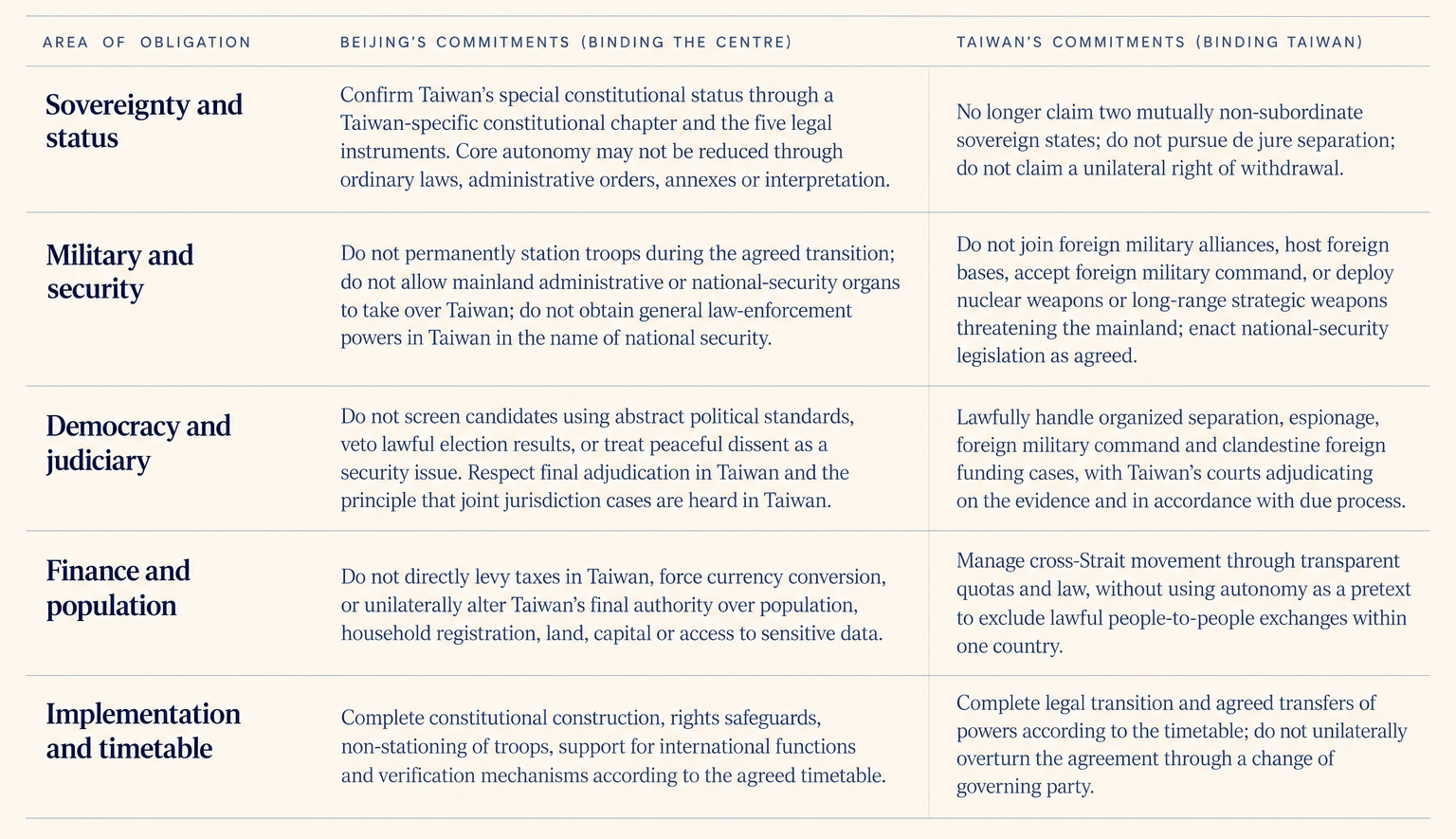
Political parties should remain free to compete over policy, criticise implementation of the agreement, and advocate changes through the agreed joint-amendment procedure. But a single election result should not be enough to unilaterally overturn an agreement that has already been democratically approved and incorporated into domestic law.
Likewise, the central authorities may discharge their national-security responsibilities, but should not acquire general law-enforcement powers in Taiwan under the banner of national security. Nor should they alter Taiwan’s final legislative and approval authority over residence, household registration, voting eligibility, land, or access to sensitive data.
The experience of Hong Kong need not be reduced to a simple argument over who was right or wrong. What Beijing sees in Hong Kong is the long-standing absence of national-security legislation, external intervention, and disorder in governance; what Taiwan sees is that national-security legislation, candidate-eligibility rules, annexes, and legal interpretation can be used to redefine the scope of autonomy.
These two fears can coexist and should therefore be translated into reciprocal obligations: Taiwan should not be able to use autonomy to evade national-security and anti-separation responsibilities, while Beijing should not be able to use national security to circumvent rights protections and local legal remedies. Any genuine solution to the Taiwan question would have to address both fears at the same time.
From Authorisation to Implementation: Taiwan Approval, Five Stages, and Breach Procedures
Under Taiwan’s current law, a “One Country, Two Systems” solution for the Taiwan question could not simply be negotiated and signed by the executive first and then submitted to the legislature or the public for approval afterwards.
Article 5-3 of the Act Governing Relations between the People of the Taiwan Area and the Mainland Area requires the Executive Yuan, ninety days prior to the commencement of negotiations on an agreement involving political issues, to submit to the Legislative Yuan a plan for entering into the agreement and an evaluation report on its constitutional or major political impact. Negotiations may not begin unless the plan is approved by an affirmative vote of three-quarters of the attending members of the Legislative Yuan at a session attended by three-quarters of all members. After negotiations are completed, the full text of the draft agreement must be made public and hearings held. The draft must then pass the same legislative threshold before being submitted to a national referendum. Only if the number of valid affirmative ballots exceeds one-half of all eligible voters may the agreement be signed and notes exchanged, after which it is submitted to the President for promulgation.
More importantly, paragraphs 9 and 10 of the same article provide that the destruction or change of the nation’s sovereign status or the free and democratic constitutional order shall not be the subject of a negotiation or an agreement involving political issues, and that any negotiation or agreement in violation of this Article shall be void.
The current government therefore could not directly begin negotiations on the institutional arrangement explored in this article. The statutory prohibition would first have to be amended. Whether constitutional authorisation would also have to be secured before negotiations could begin has not been settled by any existing precedent. The safer course would be to remove the statutory prohibition and obtain explicit constitutional authorisation before negotiations, rather than risk having a completed agreement later fail for lack of legal authority.
1. Constitutional Amendment, Constitutional Rupture and Dual Referendums
Article 12 of the Additional Articles of the Constitution of the Republic of China requires a constitutional amendment to be proposed by at least one-quarter of all members of the Legislative Yuan and passed by at least three-quarters of the members present at a meeting attended by at least three-quarters of all members. The proposal must then be sanctioned by electors in the free area of the Republic of China at a referendum held after a six-month period of public announcement, with valid votes in favour exceeding one-half of the total number of electors.
Whether a reunification arrangement would additionally trigger the territorial-change procedure under Article 4 would depend on whether the arrangement were legally characterised as a territorial change, a change in the structure of the state, or a constitutional replacement.
Judicial Interpretation No. 328 treated the delimitation of the nation’s existing territorial boundaries as a major political question, so there is currently no definitive judicial answer on how the territorial-change provisions would apply in this context.
Judicial Interpretation No. 499 established substantive limits on constitutional amendment by holding that amendments may not undermine the foundational principles of the free and democratic constitutional order. But the Constitutional Court has not yet ruled on how those limits would apply under the current procedure of popular ratification by referendum.
Therefore, placing Taiwan under another central constitutional order would raise major and unresolved constitutional questions. It could even amount to a constitutional rupture requiring a renewed basis of constituent legitimacy.
2. No-Coercion Clauses and Statutory Confirmation by Both Sides
Military coercion and the legal validity of a vote must be treated separately. Under Taiwan’s current Referendum Act, a blockade, military exercise, or information attack would still have to be linked to “the use of “violence, duress, or other unlawful means” against referendum participants or personnel “in a manner that could have affected the results of the referendum” before a court could invalidate the vote under Article 48. There is no direct precedent governing coercion by an external state.
But an irreversible constitutional choice should not rest merely on the minimum standard of “not yet declared invalid”. The agreement should therefore contain a separate no-coercion clause: If there were a blockade, live-fire exercises, missile threats, major cyber disruption, or an ultimatum of imminent military action, the Central Election Commission or another statutory body should be able to postpone the vote, and an expedited review procedure should be available before the Constitutional Court. After the coercion ended, there should still be a cooling-off period, full disclosure of relevant information, and a fair public debate.
Under the premise of this article, Taiwan residents would be voting on whether the negotiated agreement as a whole should replace Taiwan’s existing institutional arrangements and take legal effect within Taiwan’s jurisdiction, not on whether to create a sovereign status carrying a unilateral right of withdrawal at any time.
On the Beijing side, the NPC would have to complete the required constitutional amendment and enactment of the Basic Law of Taiwan.
On the Taiwan side, the political-agreement referendum and the constitutional-amendment referendum would remain legally distinct procedures and would, in principle, have to be completed separately. At most, they could be held on the same day, with the votes counted separately. Combining them into a single procedure would require an express statutory or constitutional amendment in advance.
The more precise description is therefore not “democratic confirmation on both sides”, but legal authorisation on both sides together with democratic confirmation in Taiwan.
3. Five Stages: Taiwan Cannot Hand Over All Its Leverage First
Taiwan could not realistically complete an irreversible transfer of power on Day 1 and then wait for Beijing to fulfil its commitments later. Research on civil-war peace agreements has repeatedly shown that one of the hardest problems is not reaching an agreement, but ensuring compliance after the weaker side has disarmed and lost much of its leverage.
Legal reunification could take effect on a common date, while governance, defence, and international arrangements could be implemented in stages according to agreed milestones. But at a minimum, the constitutional framework, rights safeguards, no-coercion provisions, arrangements against permanent troop deployment, and verification mechanisms would have to be in place before reunification took effect, or at least be legally ready for immediate implementation.
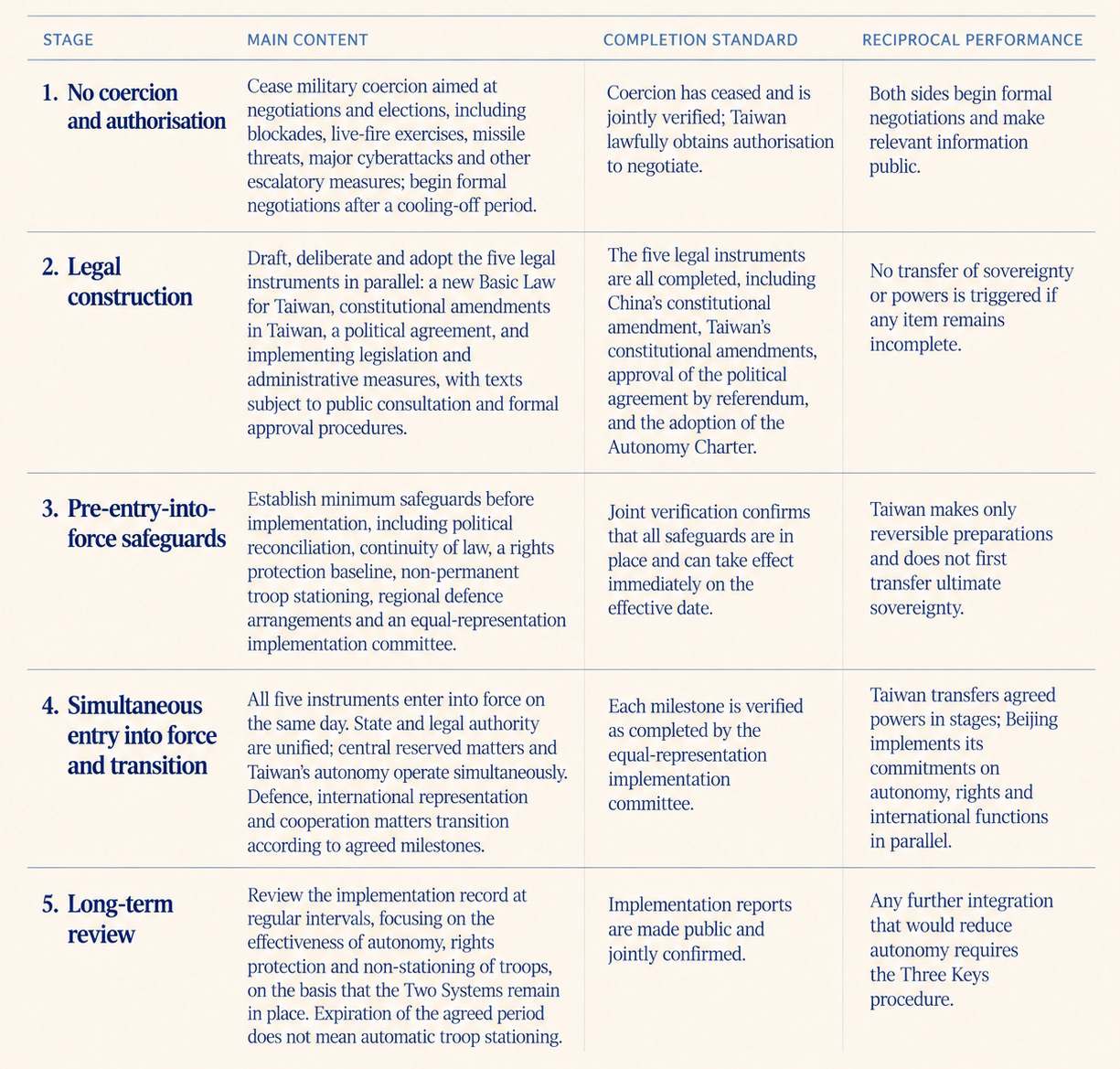
The overall sequence should be as follows.
Beijing would first cease military coercion aimed at influencing negotiations or voting. Both sides would then complete the five legal instruments under their respective legal systems and deposit their instruments of approval subject to agreed conditions.
Only after minimum safeguards concerning core rights, continuity of law, the commitment against permanent troop deployment, regional defence, and implementation verification had been jointly confirmed would reunification and Taiwan’s autonomy take effect on the same date. After that date, defence liaison, international representation, and areas of cooperation would be phased in according to agreed milestones.
It must be acknowledged that once the sovereignty arrangement takes effect, suspending a later stage cannot restore the previous status quo. That is precisely why the central authorities’ most important obligations must be fulfilled in advance.
4. A Contractual Deadline Is Not an Ultimatum
Article 7 of the Anti-Secession Law expressly recognises that cross-Strait consultations “may be conducted in steps and phases and with flexible and varied modalities.” Article 8 lists circumstances in which non-peaceful means and other necessary measures may be used, but does not prescribe a deadline for negotiations.
The proposal here for jointly agreed deadlines, milestones, objective completion criteria, reciprocal performance, cure periods, and anti-delay procedures is a new institutional design intended to create credible commitments on both sides. It is not a legal obligation imposed directly by Article 8.
A “ten-year timetable for implementation agreed by both sides” is fundamentally different from saying, “accept within ten years or force will be used”. The former is a contractual timetable; the latter is an ultimatum.
5. Implementation Committee and Breach Procedures
The two sides should establish an implementation committee and professional verification teams with equal representation. In the event of a material breach, written notice should first be given, followed by a cure period of 60 to 90 days. Until the dispute is resolved, the last lawful position should remain in effect, while any uncompleted next stage and the corresponding reciprocal obligations should be automatically suspended.
External experts could be invited to participate in technical verification concerning elections, finance, military deployments, and other matters, but they would not serve as final adjudicators of the sovereign relationship between the two sides.
The core of this mechanism is not to assume the existence of an authority superior to both sides, but to make each stage separable, verifiable, and capable of suspension.
After reunification takes effect, suspension would apply only to governance arrangements that had not yet been transferred or remained reversible. It would not amount to Taiwan unilaterally restoring a separate status.
Real-World Stress Test: Is Forced Reunification Really Less Costly Than Institutional Self-Constraint?
Any serious attempt to define the outer limits of negotiation must avoid turning into an open-ended wish list. Beijing could not realistically be expected to accept the two sides as separate sovereign states or members of a confederation; a separate UN seat and formal diplomatic relations for Taiwan; foreign troops in Taiwan or military alliances involving Taiwan; an independent Taiwanese right to wage war abroad; or a unilateral right of withdrawal for Taiwan. Nor would it be likely to accept foreign governments, the United Nations, or an international court as the ultimate political guarantors, still less to allow Taiwan’s courts to invalidate decisions of the NPC.
A more plausible negotiating position would be to limit outside involvement to invited technical verification and confine Taiwan’s consent rights to measures that directly diminish its core autonomy.
Opponents of a high-autonomy design often argue that the balance of power across the Strait has changed and that Beijing therefore has no reason to continue offering concessions made in earlier decades. Material power certainly changes the bargaining range. But it does not solve the problem of credible commitment.
The U.S. Department of Defense’s 2025 China Military Power Report assessed that Beijing may view coercion below the threshold of war as a lower-cost option, but that its success would still depend heavily on Taiwan’s resilience, willingness to resist, and external support. A full-scale amphibious landing, by contrast, would remain one of the most complex and highest-risk military operations.
This is not to suggest that Beijing lacks the ability to inflict severe damage on Taiwan, but rather that the ability to inflict harm does not automatically translate into political compliance or sustainable governance.
Quarantine, blockade, and coercion into negotiations carry different legal forms and different risks of escalation. CSIS describes a quarantine as a grey-zone operation led by the coast guard and other maritime law-enforcement forces, using selective controls over shipping and requiring commercial vessels to comply with Beijing’s jurisdiction. But if the aim were to impose enough pain to force Taiwan to accept final political terms, such an operation could move beyond the grey zone and develop into a more overt military blockade.
RAND has likewise argued that a quarantine could rapidly create shortages, compress decision-making time, and increase pressure on the United States and other actors to intervene directly. Forcing shipping companies to alter their routes is operational compliance. Forcing Taiwan’s government to accept terms of reunification is strategic compliance. The two should not be confused.
Taiwan’s energy vulnerability should not be underestimated. In CSIS’s 2025 blockade wargame, under a baseline scenario with no maritime resupply, stocks of liquefied natural gas, coal, and oil were estimated to run out after roughly ten days, seven weeks and twenty weeks, respectively. In two of the five iterations in which participants were allowed to make decisions freely, the scenario escalated to the highest level of violence.
These were outcomes generated under specific modelling assumptions and exploratory scenarios, not a “40 per cent chance of war” that could be extrapolated to the real world. What they actually show is that a blockade could generate pressure quickly while also carrying a significant risk of the crisis spiralling out of control and escalating into direct U.S.-China military conflict.
The costs would not fall on Taiwan alone. Using 2024 shipping data, CSIS estimated that more than US$2.4 trillion in goods transited the Taiwan Strait, equivalent to roughly 21 per cent of the value of global maritime trade, with nearly US$1.3 trillion involving China’s own trade.
These figures measure exposure to disruption, not inevitable losses. But they show that prolonged disruption could also damage China’s own supply chains, energy flows, and coastal shipping.
Under a severe scenario in which Taiwan’s external trade came to a complete halt, Rhodium estimated that over US$2 trillion in annual global economic activity would be at risk, excluding sanctions, military escalation, and second-order effects. This is a measure of annualised economic activity exposed to disruption, not a forecast of GDP loss.
Bloomberg Economics’ estimate of roughly US$10 trillion, by contrast, models the first-year impact of a war on global GDP. Its blockade scenario estimated that global GDP would fall by roughly 5 per cent in the first year. The two estimates measure different things and should not be conflated.
Political backlash is even harder to predict in linear terms. Survey research in Taiwan suggests that stronger perceptions of pressure from China are often associated with greater support for balancing China through closer ties with the United States and Japan. A 2026 comparative study by the Irregular Warfare Center argued, in a contingent scenario analysis, that if China were to take Taiwan through military conquest, wartime destruction and social trauma could fuel both violent and non-violent resistance, making occupation resemble a prolonged counterinsurgency more than smooth assimilation.
This is not a probability forecast. Sealing ports is not the same as securing political acceptance. Destroying organised resistance is not the same as eliminating the will to resist. If reunification could be sustained only through prolonged military control, political purges, and coercive security measures, it might achieve territorial control but not institutional integration.
1. Frankness about the Transitional Nature of “Two Systems” — and Its Costs
If the ultimate objective is to change Taiwan’s flag, station troops there, screen candidates, and reshape education, gradually moving Taiwan towards “One Country, One System” — as many readers have argued — then the arrangement should be described honestly as a “transitional plan towards One Country, One System”. In that case, Taiwan could not be expected to make irreversible concessions on sovereignty and defence in exchange for an autonomy that is already intended to be abolished. Nor could Beijing seek consent by invoking “long-term Two Systems” while simultaneously treating the abolition of Two Systems as the predetermined end point.
2. Minimum Tests for Alternative Proposals
Any of the provisions proposed above can, of course, be rejected. But any alternative would have to answer the same questions:
How would it secure acceptance from a majority of people in Taiwan? How would it reduce the risk of outside intervention and crisis escalation? How would it contain the costs of war, sanctions, financial disruption, and supply-chain damage? How would it restore administration, investment, and social cooperation after reunification? How would it avoid indefinite reliance on military control, political purges, and repressive security measures?
If the answer is simply “unify first and deal with the problems later”, or “use force if Taiwan does not accept the terms”, then that is not a better solution for peaceful reunification. It is an acknowledgement that the objective would instead be pursued through force.
The central question is not whether Beijing has the capacity to punish Taiwan, but whether that capacity can be converted into political compliance and long-term governance at a controllable cost.
Publicly available evidence does not establish that there is a coercive path to reunification that could be activated at will, at controllable cost, with predictable political results and smooth long-term governance.
Drawing red lines more rigidly may strengthen deterrence, but it does not necessarily bring reunification any closer. Removing all of Taiwan’s demands may simplify the text, but it cannot reduce the complexity or the enormous cost of public rejection and post-reunification governance.
The real comparison is between the cost of institutional self-restraint and the combined costs of war, coercion, and prolonged non-cooperation.
Conclusion: If “One Country” Is Hard Law, “Two Systems” Must Also Be Hard Law
After being tested by readers’ criticism, this article makes three necessary institutional revisions to the original argument.
First, it explicitly recognises that the legal basis of Taiwan’s autonomy would lie in the Constitution of the People’s Republic of China and authorisation by the NPC. It should not be framed as Taiwan transferring inherent sovereign powers to the central authorities.
Second, it recognises that the central authorities would bear ultimate responsibility for national security and national defence and could not be excluded entirely in the name of Taiwan’s autonomy.
Third, it adds corresponding obligations for Taiwan: opposition to separation and foreign military intervention, enactment of national-security legislation, and implementation in accordance with an agreed timetable.
But these three revisions do not support three further conclusions: that autonomy derives from the state does not mean that the central authorities may withdraw it whenever they choose; that national security is ultimately a central responsibility does not mean that ordinary political dissent can all be recast as matters of national security; that the mainland has greater material power does not mean that the free consent of Taiwan’s people is irrelevant.
Greater power affects only how much pressure one side can exert. It does not automatically create credible commitments, still less turn coerced compliance into freely given consent.
The result of this stress test is therefore neither a wish list under which Taiwan keeps everything after reunification nor a set of demands requiring unilateral concessions from Beijing. A sustainable solution would have to impose obligations on both “One Country” and “Two Systems”:
Taiwan would accept unified sovereignty, undertake obligations against separation and foreign military intervention, enact national-security legislation, and comply with the agreed timetable. Beijing, in turn, would place democratic elections, final judicial authority in Taiwan, basic rights, fiscal and population arrangements, and local defence during the transition under higher-order law that the central authorities could not unilaterally and structurally diminish.
The former prevents autonomy from hollowing out “One Country”. The latter prevents sovereignty from erasing “Two Systems”.
If Taiwan refused to accept obligations against separation and foreign military intervention within a one-China framework, that would not be “reunification”. If Beijing refused to constrain its own ability to unilaterally diminish Taiwan’s democracy, judicial autonomy, basic rights, and fiscal and economic autonomy, that would not be “Two Systems” either.
Institutionally, this would mean one sovereignty and two legal domains. The central government would grant Taiwan a general constitutional authorisation while exhaustively listing the matters reserved to the centre. The five legal instruments would be approved in sequence and take effect on the same date. Any diminution of core provisions would require all “Three Keys”: the NPC, Taiwan’s legislature, and the people of Taiwan. National reunification would take effect on a common date, while the transition in governance and defence would proceed reciprocally according to agreed milestones.
This would not amount to a confederation, nor would it simply rename the Hong Kong and Macao model or invoke a “Taiwan model”. The arrangement could not eliminate every risk, but it could turn a wager on goodwill into institutional costs that are observable, suspendable, remediable, and accountable.
The real test is not whether Beijing is willing to repeat the words “high degree of autonomy”, but whether it is willing to accept an institutional framework that constrains its own ability to renege on its commitments. Nor is the question simply whether Taiwan is willing to give up the option of separation, but whether it is willing to assume national obligations after reunification.
“Two Systems” in Hong Kong is not without a hard-law foundation: it is grounded in the Basic Law. The problem is that the central authorities also retain control over amendment, interpretation, additions to the annexes, and exceptional jurisdiction, leaving ultimate control over the autonomy asymmetric.
If a solution to the Taiwan question cannot change that structure, then “One Country” may be hard law while the hard-law protection of “Two Systems” remains incomplete. Such an arrangement could not command the long-term trust of Taiwanese society.
For peaceful reunification to work, both sides would have to change: Taiwan would have to change its position on where sovereignty lies, while Beijing would have to change the way it exercises sovereignty.
Equally important, peace cannot be merely a promise for after reunification. It must be sustained throughout the entire process of negotiation, approval, and implementation. Reunification without credible commitments is not genuine integration; peace without free consent is not genuine peace, but only temporary submission. Demonstrating the ability to punish Taiwan is not the same as demonstrating the ability to achieve peaceful integration; forcing one side to sign is not the same as securing the cooperation of 23 million people.
The only path that can genuinely avoid war, protect the people, and preserve differences is one of “peace through integration, and reunification through peace”: Institutional commitments must first become credible before political choice can become viable; the obligations of “One Country” to protect “Two Systems” must be first demonstrated in law before Taiwanese society has reason to discuss “One Country” politically. This is the central question that all advocates of peaceful reunification, reunification by force, and coercive reunification alike cannot avoid.


