

A weekend article by Yuyuantantian, a social-media commentary brand operated by China’s state broadcaster China Central Television (CCTV), is worth reading not as a conventional news report but as a policy-adjacent signal. Its style is unmistakably Chinese social-media commentary: part reporting, part interpretation, part rhetorical flourish, part warning, with facts and argument moving quickly into each other.
China does not usually signal through the familiar Western route of unnamed officials briefing mainstream outlets, which then turn those hints into “exclusive” stories. Signals like this are instead often embedded in domestic-facing commentary written for China’s own media ecosystem. That makes them easy for outside readers to overlook or misread — but also worth unpacking.
The timing is central to the message. On June 29, Chinese Commerce Minister Wang Wentao is expected to meet EU Trade Commissioner Maroš Šefčovič in Brussels. The meeting comes as European frustration over China’s trade surplus has become a major political issue. China’s goods trade surplus with the EU reached €360.6 billion in 2025, up 15 percent from 2024, and expanded by another 10 percent in the first four months of 2026. Europe has also been discussing a possible “China Shock 2.0,” including a widely cited estimate that Germany is losing roughly 10,000 manufacturing jobs a month amid intensifying industrial competition with China and other structural pressures. The June European Council conclusions did not name China, but under “competitiveness and global economic challenges,” EU leaders discussed strategic autonomy, economic security, industrial renewal, and reducing dependencies — language widely understood to include China. The Commission is also considering new tools, including supply-chain diversification requirements and tougher trade defenses. Dialogue has not stopped: Chinese and EU trade officials also met on June 9 and June 23.
The broader backdrop is the impasse since the July 2025 EU-China summit. Ursula von der Leyen said in Beijing that EU-China trade ties had reached a “clear inflection point,” citing trade imbalances and market access. Xi Jinping’s message was different: Europe’s challenges do not stem from China, and the EU should keep its trade and investment markets open and refrain from using restrictive trade measures.
Yuyuantantian says China came to the recent talks with two substantive concerns. First, Beijing wanted to continue work on a price-undertaking solution to the EU’s anti-subsidy case against Chinese electric vehicles. Second, China wanted Europe to address what Beijing sees as obstacles to expanding European exports to China, especially high-tech export controls. The article says European negotiators, by contrast, repeatedly asked China to respond to European concerns over rare earths supply. It then adds the harder message: China can withstand further deterioration in economic and trade ties, even a freeze.
The EV issue is where Beijing sees prior progress being neglected. In October 2024, the Commission finalized countervailing duties on Chinese-made battery EVs, ranging from 7.8 percent to 35.3 percent on top of the EU’s standard car tariff. The two sides later explored price undertakings — minimum-price arrangements that could offer an alternative to tariffs — and Brussels issued guidance in January 2026 on how Chinese exporters could individually submit such offers. That is probably what the commentary means by saying technical-level talks had “basically” reached a framework. More precisely, both sides had made procedural progress toward a possible negotiated solution: Beijing can present it as a near-consensus, while Brussels can still say the technical track remains unresolved.
China’s second ask — easing high-tech export controls — is larger. The EU’s export-control system is tied to non-proliferation, security, and human-rights considerations, and member states can add controls on public-security or human-rights grounds.
According to Yuyuantantian, Brussels showed little interest in addressing Beijing’s demands, and may have concluded from the EV case that it has found a working formula: create a trade-defense case, put pressure on China, and gain leverage.
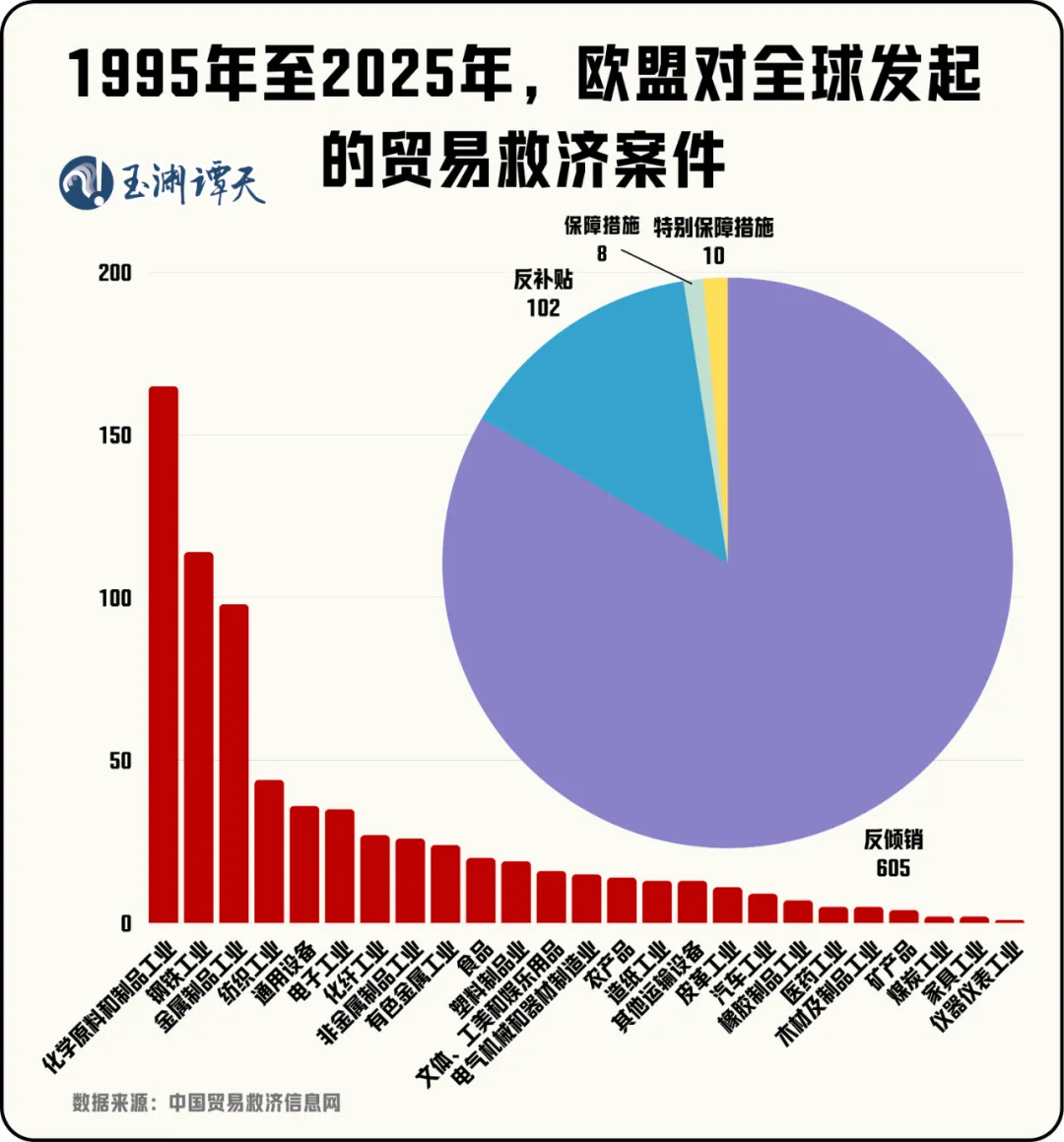
The key Chinese observation is that the EU’s trade-policy toolkit is shifting from relatively predictable WTO-embedded remedies — mainly anti-dumping and anti-subsidy cases — toward broader, more discretionary instruments outside or beyond the WTO framework. In this telling, Brussels is not only developing new tools, such as a possible U.S. Section 301-style “overcapacity” instrument, but also using them as bargaining chips even before formal adoption.
The state-broadcaster commentary then questions whether the EU has the power to repeat this strategy, citing weak manufacturing competitiveness, high energy costs, insufficient innovation, and the difficulty of coordinating 27 member states. Its language is polemical, but the underlying issue is real. The 2024 Draghi competitiveness report, referred to by Yuyuantantian, warned that Europe needs a more coordinated industrial policy, faster decision-making, and €750-800 billion in additional annual investment to keep pace with the United States and China. The Chinese reading is that Europe’s industrial difficulties should make it more open to cooperation with Chinese companies, not more protectionist.
The article’s anecdotes point in the same direction. It cites a French regional official welcoming Chinese industrial investment and a Polish local-government representative studying Chinese smart-vehicle technology. These examples should not be dismissed automatically. They reflect a real gap between local actors seeking factories, jobs, batteries, and Chinese manufacturing know-how, and EU-level institutions prioritizing economic security, dependency reduction, and enforceability. But anecdote is not policy.
This is also where Beijing’s member-state diplomacy matters. Recent visits by European leaders and ministers give Beijing diplomatic material, though it is difficult to know whether they have emboldened China’s judgment that member-state needs create leverage over Brussels. Turning such interests into EU-level trade movement remains structurally and institutionally demanding.
Another reason the article sounds confident is that it does not present Europe as indispensable. Yuyuantantian says many Chinese firms no longer see any single country or region as a necessary market. Southeast Asia, the Middle East, and Latin America are portrayed as lower-cost, easier-entry alternatives. China’s own trade data partly explain why this argument has become more plausible. China’s exports to ASEAN reached about $665 billion, larger than exports to the EU at about $560 billion; its surplus with ASEAN was about $276 billion, not far below its roughly $292 billion surplus with the EU. Exports to Latin America were about $297 billion, around half the EU level. In clean technology, the pattern is also broadening: Chinese EV exports reached $69.6 billion in 2025, spanning more than 150 markets, with the Middle East posting a 92 percent increase and Africa 189 percent.
While many would like to believe the European market matters significantly to Beijing, as it remains a high-income, standards-setting market and one of the largest sources of China’s goods surplus, the Chinese state broadcaster’s account appears to say that marginal allocation of Chinese corporate attention, capital, and supply-chain planning is more flexible than before. From Beijing’s perspective, that weakens Europe’s ability to assume that China will accept any conditions for the sake of market access - or at least that’s the bargaining message here.
The most interesting signal concerns Chinese investment in Europe. Many observers see Chinese investment in EVs, batteries, and manufacturing as partly compensatory: factories in Europe can create jobs, local value added, and political reassurance. Yuyuantantian frames it differently. It presents Chinese investment less as a concession to Europe than as a form of leverage: if barriers keep rising, Chinese projects that European regions want may slow down.
Yet the leverage is uneven. Some European governments and regions want Chinese factories. Others worry that Chinese investment in strategic sectors may create dependence, lead to limited technology transfer and few jobs, or primarily preserve Chinese market access. For them, less Chinese investment may not be a loss; it may look like de-risking.
The larger obstacle, which receives little attention in the state-broadcaster message and in China’s trade-focused official readouts, is political. Beijing tends to argue that EVs, rare earths, export controls, and investment should be handled on their own economic merits between China and Europe. Brussels finds that harder. At the 2025 summit, the EU explicitly tied the broader relationship with China to Russia’s war against Ukraine and called on Beijing to distance itself from Moscow.
There is also an American factor that the Yuyuantantian article does not spell out but may sit behind Beijing’s confidence. From Beijing’s perspective, Trump has reduced U.S. support for Ukraine, weakened transatlantic cohesion, and adopted a more transactional approach toward China. It is possible that Beijing reads this as creating more room to press Europe: if Washington can be pragmatic with China, why should Europe, facing its own industrial and growth pressures, insist on a harder line?
High-tech export controls illustrate the difficulty. In Beijing’s view, European exports are constrained not only by Brussels or national capitals but also by American extraterritorial pressure. The latest example came from a Bloomberg scoop that the U.S. Commerce Secretary had raised concerns with ASML executives that one of the company’s high-end chipmaking tools might have reached China in violation of U.S.-led export restrictions. ASML denied ever shipping the machines or related components to China. For China, such episodes reinforce the argument that Europe should not let Washington define the limits of China-Europe trade. For Europe, however, the issue is not only American pressure; it is also its own security judgment about technology, dependency, and Russia’s war in Ukraine.
That is the tension the Yuyuantantian article leaves unresolved. Beijing appears to believe that Europe’s industrial needs, member-state interests, Chinese market alternatives, and transatlantic strain give China more room to resist pressure than Brussels assumes. Brussels, meanwhile, is operating in a political environment where trade, security, Ukraine, and dependency can no longer be neatly separated. The article is therefore less a prediction of where EU-China trade talks will go than a revealing statement of Beijing’s working assumption: Europe may have more tools, but China believes Europe has fewer easy choices. (Enditem)

OECD's Subsidy-Centric Narrative of China’s Emerging Industries Is Increasingly Flawed and Outdated: CF40 research

On June 1, 2026, the OECD released a report titled OECD MAGIC Database of Industrial Subsidies. Its central argument is that Chinese firms receive far larger industrial subsidies than those in other economies, concentrated in emerging strategic industries such as solar, semiconductors and wind power.

A sharp read of the signal. The confidence you decode is real, and it has a method with a track record. From 2012 Beijing built the "16+1," sitting down with Europe's smaller states one at a time, outside Brussels, precisely because a bloc that negotiates as twenty-seven can be dealt with as twenty-seven. For a decade it worked. Then Lithuania walked out in 2021, the Baltics followed, and the format quietly hollowed. The lesson Beijing surely drew is not that divide-and-deal fails, but that it has a shelf life: leverage over a fragmented partner lasts exactly until the fragments notice they are being counted one by one. The three-hundred-and-sixty-billion surplus and the ten thousand German jobs a month are real pressure. The open question is whether Brussels has learned to answer as one before the next signal lands, or whether it will be read, again, as twenty-seven.
It’s very simple- if the west wants to tame inflation, it will buy more from China. To fix domestic employment it needs 20 years of investment in infrastructure and resources and then we’ll see