


Last Sunday, we published a transcript of a Chinese video on Bilibili, China’s equivalent of YouTube, and invited readers to decipher its “true” intent. Now, we are here to reveal the answer.

The “real” version of the video was uploaded to YouTube by the same creator presenting his name as Zhang Beihai, just a day before its domestic debut to his over 1.9 million followers on Bilibili.
This YouTube version is a direct, unapologetic assault on China’s official rejection of the “1644 view of history”—a view that treats the Manchu-led Qing conquest of the Han-led Ming dynasty as a catastrophic civilisational rupture.
The transcripts of the two videos are very similar, save for one major, calculated change: “China,” in the YouTube video, is replaced by “America” in the domestic Bilibili version. This trick allows Zhang to bypass the censors by using an American allegory to address sensitive topics related to Chinese ethnic and political realities.
Zhang argues that the “1644 view” has evolved beyond historical debate into a vessel for modern Han Chinese resentment. He claims, as you will read below, that the Han, despite making up over 90% of the population, have been “sacrificed” by state policies that favour ethnic minorities in education, law, and the economy.
Yet this narrative of Han victimhood is as intellectually thin as it is politically incendiary. It mirrors the “Great Replacement” anxieties of right-wing populists in the West, conveniently ignoring the structural dominance a 90% majority inherently enjoys. What Mr Zhang decries as systematic discrimination is, in reality, a form of Chinese state-led affirmative action to integrate a vast, diverse periphery into the modern nation-state.
Moreover, in the eyes of a party determined to forge a modern, rationalised nation, the customs of the “Old Society” are viewed as inefficiencies to be streamlined rather than heritages to be preserved. Take, for instance, the cases of the grave-levelling campaign cited in the domestic Bilibili video. The often impatient, and at times heavy-handed, push for land-use efficiency and secular reform stems not from ethnic malice against the Han, but from a vision of progress where traditional sentiments are expected to yield to the broader demands of developmentalism. In this framework, the cultural preservation of the Han remains a secondary priority to the pragmatic needs of a developing state. What Zhang frames as a targeted “betrayal” of the Han is less an ethnic vendetta than a byproduct of a relentless drive toward modernisation, not an orchestrated preference for minorities—and they certainly do not justify his stoking of ethnic division.
But if there is a point of narrow concurrence with Zhang, it’s in his warning to authorities that exploit nationalism for political gains while attempting to micromanage where such sentiments should stop. Nationalism is rarely so obedient. Once stirred, it sets off a chain of events that cannot easily be reversed. The power to define the boundaries of “us” and “them” will not remain a monopoly of the state forever; the fire lit to warm the halls of power has a habit of burning it down.
—Yuxuan Jia
The pictures in this post are all sourced from Zhang’s video.
华夷之辨再起,团结史观为何惨败?
The Debate Between Han and Non-Han Peoples Reignites: Why Has the Unity-first View of History Failed So Miserably?
Over the past few days, official media has collectively stepped in to criticise the “1644 view of history”. For example, Xinhua published a commentary saying this traffic-driven business of dressing up history and force-fitting it onto the present should stop. Zhejiang Publicity, the official WeChat blog of the Zhejiang Provincial Party Committee’s publicity department, published an article warning people to stay alert to the “1644 view of history,” warning it could throw public discussion off track. There are plenty of other pieces, but I won’t list them all.
The level of the official platforms stepping in, and the breadth of the actions taken, are striking. At this point, it looks very much like an unspoken collective will shared by publicity departments and cyberspace regulators.
Coming out at a moment like this to talk about it, to touch a nerve like this, means preparing yourself ready for a serious hit. I am ready for it. When they can’t win the argument, they silence it. That playbook isn’t new.
But let’s flip the question for a moment. Are you really prepared to answer the questions of the people?
Because the so-called “1644 view of history” that the state media is attacking is, in substance, an accusation that the Qing dynasty imposed restrictions on China, ran policies that kept people ignorant, and even carried out open massacres against the Han people.
At this point, you’ve got people stepping in to smooth things over. They say that China follows a unity-first narrative of history, which emphasizes reasoning backward from the present. The present says that the 56 ethnic groups are one family, so in the past, the 56 ethnic groups must also be presented as one family.
As for what happened within that family? Well, that’s nothing more than friction between brothers. It doesn’t count, and it’s not something that can be taken out and discussed on its own.
There’s a Hegelian three-step structure buried in this view of history.
Thesis: the Ming dynasty.
Antithesis: the Qing dynasty, which wiped out the Ming.
The current view of history traces back to the theory of “the Chinese nation” invented by Liang Qichao. In the late Qing, when China was surrounded by encroaching foreign powers and the old system was crumbling, this concept tried to rise above concrete ethnic boundaries, Han, Manchu, Mongol, Tibetan, and Hui, and build a modern nation-state community to survive the competition.
The idea of the Chinese nation as the synthesis has persisted into the present day, becoming the dominant historical perspective. At the heart of this view is the principle of unity.
That’s the thesis-antithesis-synthesis dialectic in philosophical form.
Dialectics sounds so grand, doesn’t it? The “negation of the negation.” Both sides of the contradiction are lifted up and preserved within a higher synthesis. Every conflict gets reconciled. History moves toward a complete, final ending, as if no new propositions are needed ever again. But that’s actually a vulgar dialectic.
Slavoj Žižek points out that this neat triad is a serious oversimplification of Hegel, because any synthesis is necessarily incomplete and provisional, and the very production of a synthesis generates new internal contradictions. Real dialectics isn’t a magic button. It’s not like you press “synthesis” and everything is over. That kind of “middle way” is basically a color-changing chameleon.
The synthesis always contains fractures inside it. It is already breeding new negativity, opening up a new dialectical cycle. That is where the victory of dialectics lies.
So, many of the problems in Chinese historiography today, from adjustments in ethnic policies, to the fierce online debates about Hanfu vs. Huafu [whether traditional Chinese clothing should be called Hanfu (Han ethnic clothing) that explicitly excludes other ethnic groups, especially Manchus, or Huafu (Chinese clothing), which aims to be more inclusive], to whether the Yuan and Qing dynasties were part of China, and whether 1840 or 1644 holds more significance, can all be seen as the flickering shadow of a “fourth step,” constantly flashing into view.
That sounds a bit abstract. So let’s go back to the triad just laid out. Since Liang Qichao introduced the idea of the “Chinese nation,” more than a hundred years have passed. The Ming-Qing transition, an era marked by bloodshed, conquest, and cultural rupture, has been redefined as an internal conflict. It has covered up the real historical facts and violence for one purpose only: serving the construction of a modern multi-ethnic nation-state.
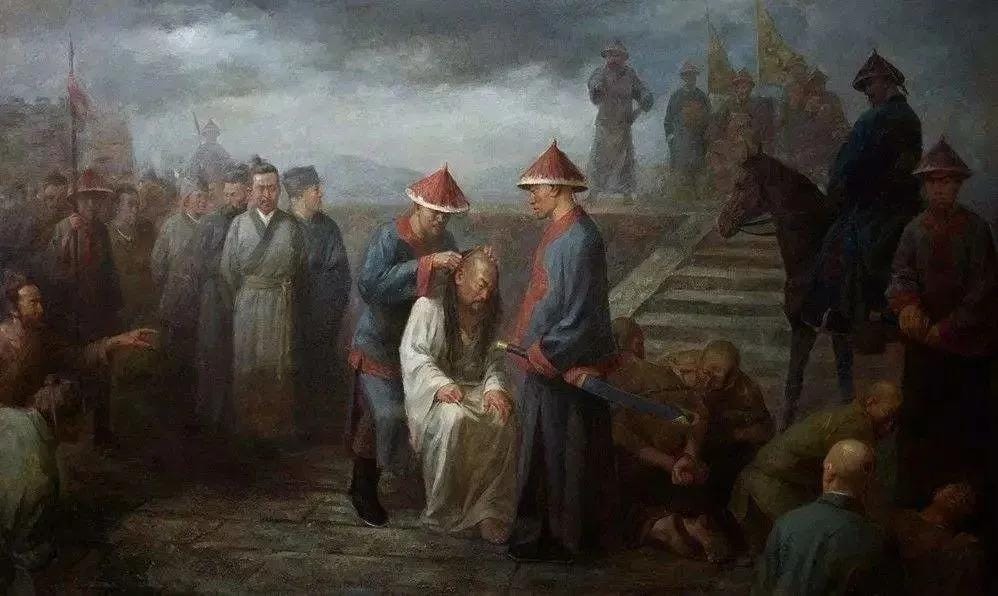
It has to be admitted that Liang Qichao’s concept was highly progressive when it was introduced. During the 100 years of China’s struggle for survival, this concept played a crucial role. But in the process of building it, for the sake of political realities or theoretical convenience, it inevitably ended up somewhat unfair in practice.
The main ethnic majority loses its own distinct character and is forced to become a kind of transparent backdrop. For example, the Han Chinese tradition of burial was historically earth burial, with death by strangulation considered more merciful than decapitation because it preserved the body, which was seen as more dignified. In the name of historical reform, the Han people was pressured to give up their community traditions and adopt cremation.
In March 2012, a large-scale grave leveling campaign was launched in Zhoukou, Henan, where 350 graves were destroyed within six months. Yet when it comes to the burial traditions of ethnic minority groups, those are something that must be protected.

In 2019, Xu Guang, then Party Secretary of Zhoukou, was investigated and removed from office. The investigation revealed that Xu had lost his ideals and beliefs, abandoned his original mission, and was disloyal and dishonest to the Party, resisting organizational scrutiny and indulging in superstitious activities. In 2023, Yue Wenhai, then Mayor and Deputy Party Secretary of Zhoukou, was also investigated and sentenced to 12 years in prison for multiple crimes.
One man demolishes others’ ancestral graves while indulging in superstition himself. Is it funny? I don’t think it’s funny at all. It’s a massive ethnic trauma.
That leads to a question: are the Han people who make up more than 90% of China’s population even considered “people”? Don’t their traditional feelings deserve equal protection?
And it’s not only emotional. The ordinary Han people have paid enormous economic costs as well. The fees for cremation, urns, and public cemeteries have become a new economic growth sector, with people having to spend money even after they die.
Looking at China’s modern history, grand narratives are often built on the erosion of the identity of the dominant ethnic group. The term “Han” itself is so politically charged that even the word Hanfu is avoided in favor of Huafu.
Sure, some people will point the finger and say, “Zhang, you are a leftist. What you’re saying is Han nationalism. It shouldn’t be said. It’s not good for national unity.”
But here’s the point. In modern Chinese history, this kind of sacrifice by the majority is not exactly rare.
It’s not just about the grave leveling I mentioned earlier, but also about policies like halal meat subsidies, extra points for ethnic minority students, family planning, and the “Two Less, One Lenient” policy [less arrest (fewer criminal detentions and arrests), less execution (fewer death sentences and death penalties with reprieve), and lenient handling (offering more lenient punishments or clemency) for ethnic minority offenders], all of which involve differential treatment. A community that, in theory, promises equality for all ethnic groups, exhibits obvious policy tilts in practice.
Friends, fairness. The pursuit of fairness is one of the fundamental reasons the left exists. If someone refuses to acknowledge the fractures and contradictions here, then I refuse to recognize that person as left-wing, because what they’re defending isn’t equality, it’s power.
Giving benefits is not the problem. The problem is giving too many extra benefits. If the benefits being handed out are ones the majority can’t actually share in, then all you do is let minorities repeatedly “confirm” the value of a two-track system, and realize just how valuable their current identity is.
And that prevalent two-track system does not eliminate barriers and differences between groups. It does the opposite. It intensifies division and confrontation between ethnic communities by emphasizing identity differences. I genuinely want to know: on what grounds would a leftist endorse a policy like that?
Some people say that the current criticism is undermining national unity. I would argue the opposite. The ongoing debates about the distinction between Han and non-Han peoples, and the intense discussions on Ming-Qing history, are actually a major step forward in maintaining true national unity. The contradictions that have always been smoothed over by grand national narratives will inevitably resurface in various forms, until Chinese society acknowledges their existence.
Back to the “1644 view of history,” there are many, including Zhejiang Publicity, who have stepped forward to oppose it. They have ten thousand reasons to denounce this view as stupid, crude, and divisive. But it’s worth asking: what kind of real-world environment makes a “stupid, crude, and divisive” narrative like this spread so widely in the first place?
You are smarter than I am. It’s impossible that you haven’t thought of this. You’ve simply closed your eyes, and, on this issue, maintained a shameful silence, exactly as expected. Worse, you turn around and brand the people who suffer from it as the ones causing national division. And that’s exactly how, by late 2025, you’ve created such a huge rift. It’s arrogance, arrogance so extreme it borders on cruelty.
I’ve said this twice in past videos, but I’m going to say it again, and I know I’ll keep repeating it in the future.
Why is Han nationalism rising today? Because under the big umbrella of nationalist storytelling, some people are actively using nationalism to separate “us” from “them,” to split the East from the West, to mobilize society, to boost social cohesion. And once the “us versus them” mindset hardens into a habit, it naturally spreads. It migrates. Someone will always take that “us versus them” logic one step further, and use it to think through other relationships. The power to define “us” and “them” will not stay in the hands of a minority forever.
The basic principle of nationalism is distinction and exclusion. It starts from your needs, but the endpoint is not yours to decide. Nationalism will not be judged only on the boundary you choose. That’s not up to you people who lit the fire.
If you try to play with nationalism in a historically complex, multi-ethnic country, you’re going to get the full package of nationalism. You don’t get to say, “nationalism only outward.” Whoever created the current situation should be responsible for the current situation.
Looking at this year’s controversies surrounding Ming: Wuchang – Fallen Feathers [a game set in the 1640s that sparked debate for depicting Ming loyalists as enemies while omitting Qing forces] and the Battle of the Penghu Islands [a state‑backed film framing the battle with slogans like “Unifying Taiwan is unstoppable,” which drew criticism for celebrating the Qing conquest of a Ming-loyalist Taiwan administration], although some people are very dissatisfied with the “imperial Han (皇汉 Huang Han)” group [an online label for extreme Han‑centred ethnic nationalist sentiment], imperial Han is a direct byproduct of nationalist propoganda: you can’t exterminate your own shadow.
As a leftist, I don’t support nationalism. But when someone is pushing this half-baked nationalism, shouting on the one hand, “Anyone who offends China will be punished no matter how far away,” while on the other hand smoothing internal contradictions over at home, then I have to say a few words for the sake of justice.
The current public discourse has now moved beyond historical evaluation. I fully agree. Whether people mourn the Ming dynasty or oppose the Qing, this public sentiment is, in fact, a retrospective construction, a symbolic tool. Its purpose is never to revisit the past but to serve certain demands in the present. The glorious image of the Ming dynasty retroactively constructed by the 1644 narrative is, in fact, a projection of today’s emotions.
You can reject these kinds of historical conspiracies as anti-intellectual. And I agree: these claims are often strained and intellectually thin. But there’s only one real difference between you and me. Do you acknowledge the underlying demand of the ethnic majority for equality? Because in this world, no great nation ends up as a great nation if, in the end, it can’t even protect its own ancestors’ graves, or its own corpse.
As for those people accusing the 1644 view of “dressing up history,” fine, well said, fully agreed. China has an old anecdote called “not eating horse liver.” Back in the Han dynasty, two scholars were debating in front of Emperor Jing of Han (r. 157–141 BCE). They were arguing over how to interpret the Zhou dynasty (c. 1046-256 BCE)’s overthrow of the Shang (c. 1600-1046BCE): was it “the Mandate of Heaven,” or was it simply a case of a minister rising up and killing his sovereign? Emperor Jing cut them off with a single line that shut the whole discussion down. He said: when people eat meat, they don’t eat horse liver. It’s not that they don’t know it tastes good, it’s that it’s poisonous. And scholars keeping silent on whether Tang and Wu “received the Mandate” doesn’t make them foolish.
So why did Emperor Jing dodge the question like that? Because it went straight to the ultimate question of legitimacy for a feudal dynasty.
And think about where that debate leads. If you say the overthrow was illegitimate, then was Han Gaozu, the founder and first emperor of the Han dynasty, also just an illegitimate rebel? But if you say it was legitimate, then doesn’t that imply that one day, if the Han house loses the Mandate, someone else can overthrow the Han? Either way you get trapped. There’s no safe answer. So Emperor Jing simply brushed it aside, and that became the story: “not eating horse liver.”
The opposition to “dressing up history” is a classic “not eating horse liver” problem. It’s a question you’re not even allowed to oppose. You say history shouldn’t be dressed up. Fine. Then everyone should ask: who is the biggest dresser-up of history?
Truth seeps out of wounds. What leaks out of the cracks, what cannot be absorbed, what has been suppressed, forgotten, and pushed to the margins, one day will rise up from the abyss of history and strike back at today’s sophistry. I don’t know what form it will take, or how it will arrive. But if China were to prevent the risk of the social fabric coming undone, it has to face the problem. The best time was ten years ago. The second-best time is now.
Although everything I’ve said here is common sense and objectively true, saying it in today’s public discourse is taboo. It’s highly risky. And yet, in Chinese tradition, historians and remonstrating officials have always had the spirit of recording the truth as it is. High Minister Cui Zhu (died 546 BCE) murdered his Duke, but successive court historiographers were killed for insisting on the blunt record “Cui Zhu murdered his Duke,” the truth still held, because someone would always write it down.
If you won’t let people speak, then I will speak. And if I can’t speak, someone else will stand up and speak for me and for those who came before. That is the spirit of the Chinese nation, and I’m proud to have upheld it.
If you made it this far, follow the channel, and hit the like, comment, and subscribe. The script will be posted on my WeChat blog, Zhang Beihai’s Natural Selection 章北海的自然选择. This video will also be up on YouTube. This is Beihai, and I’ll see you in the next one.
