

Some reports invite rebuttal. Others invite correction. Heartland for Hire, a recent report by an anonymous contractor for Strategy Risks on Missouri State University’s China-linked MBA programmes, invites neither. It is not wrong in any simple empirical sense that can be cleanly overturned. It is more revealing: a document that converts ordinary institutional life into strategic suspicion, then mistakes the conversion for analysis.

The subject is ordinary. For two decades, Missouri State University ran MBA and EMBA programmes enrolling Chinese officials, state-enterprise managers and university-affiliated cohorts. Some graduates later entered state-owned enterprises, including firms now considered sensitive. Administrators met foreign counterparts. Fees were paid. Degrees awarded. Revenue earned.
From this, the report constructs something darker: a Chinese state pipeline embedded in an American public university, allegedly financed by American taxpayers and directed toward strengthening China’s defence-industrial ecosystem. The distance between description and interpretation is not a gap in the argument. It is the argument.
The most conspicuous claim—“American taxpayer money”—is the report’s method in miniature. It appears in the subtitle as though it were established. Yet the estimate rests, by the report’s own admission, on “a single recruiting account.” Other materials “describe the funding differently”; “no public U.S. record confirms that taxpayer money was paid”; “no total can be confirmed.” These qualifications go to the core of the charge.
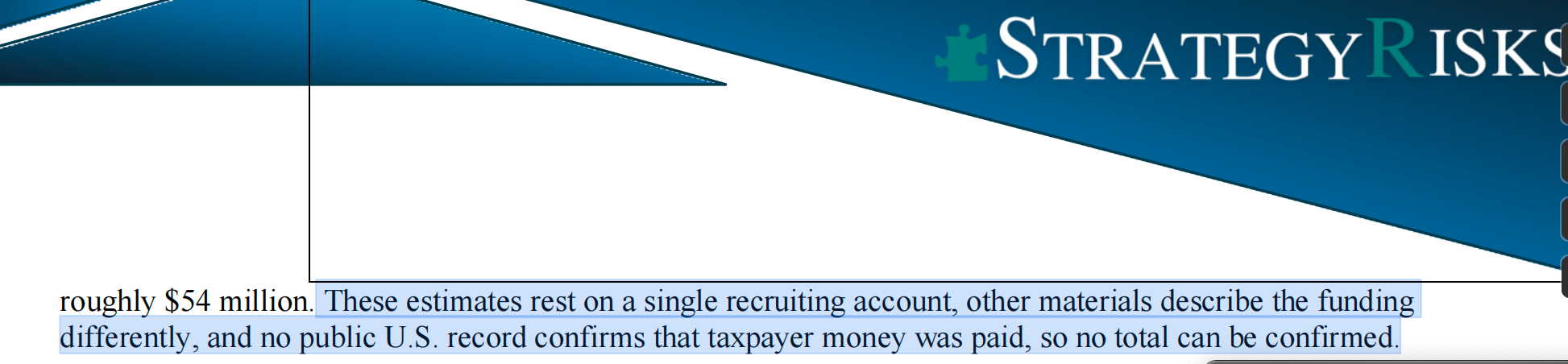
The source is a 2014 sales material connected to China Agricultural University’s promotion of the programme, to make the programme appear attractive and subsidised. Yet this fragile material undergoes a remarkable transformation. A recruiter-facing claim about affordability becomes an estimate of U.S. taxpayer exposure; that estimate is scaled across more than 1,500 participants; the possible tens-of-millions figure is elevated into the subtitle. A caveated possibility becomes a headline claim and then moral atmosphere. The body whispers uncertainty. The title shouts taxpayer money.
The same technique appears in the treatment of misconduct. The report acknowledges that “standard markers of wrongdoing are absent in this case. No intellectual property appears to have been stolen. Strategy Risks found no evidence of false affiliations, espionage, or complaints of Chinese students harassing others on campus.”

In an older analytical tradition, this would narrow suspicion. Here it expands it. If nothing was stolen, perhaps the problem lies in what was learned; if no secrets were transferred, perhaps education itself is the transfer.
At that point, the MBA ceases to be a degree and becomes a metaphor. Accounting, logistics, organisational behaviour and strategy are reclassified as latent instruments of state power. The category “education” quietly disappears.
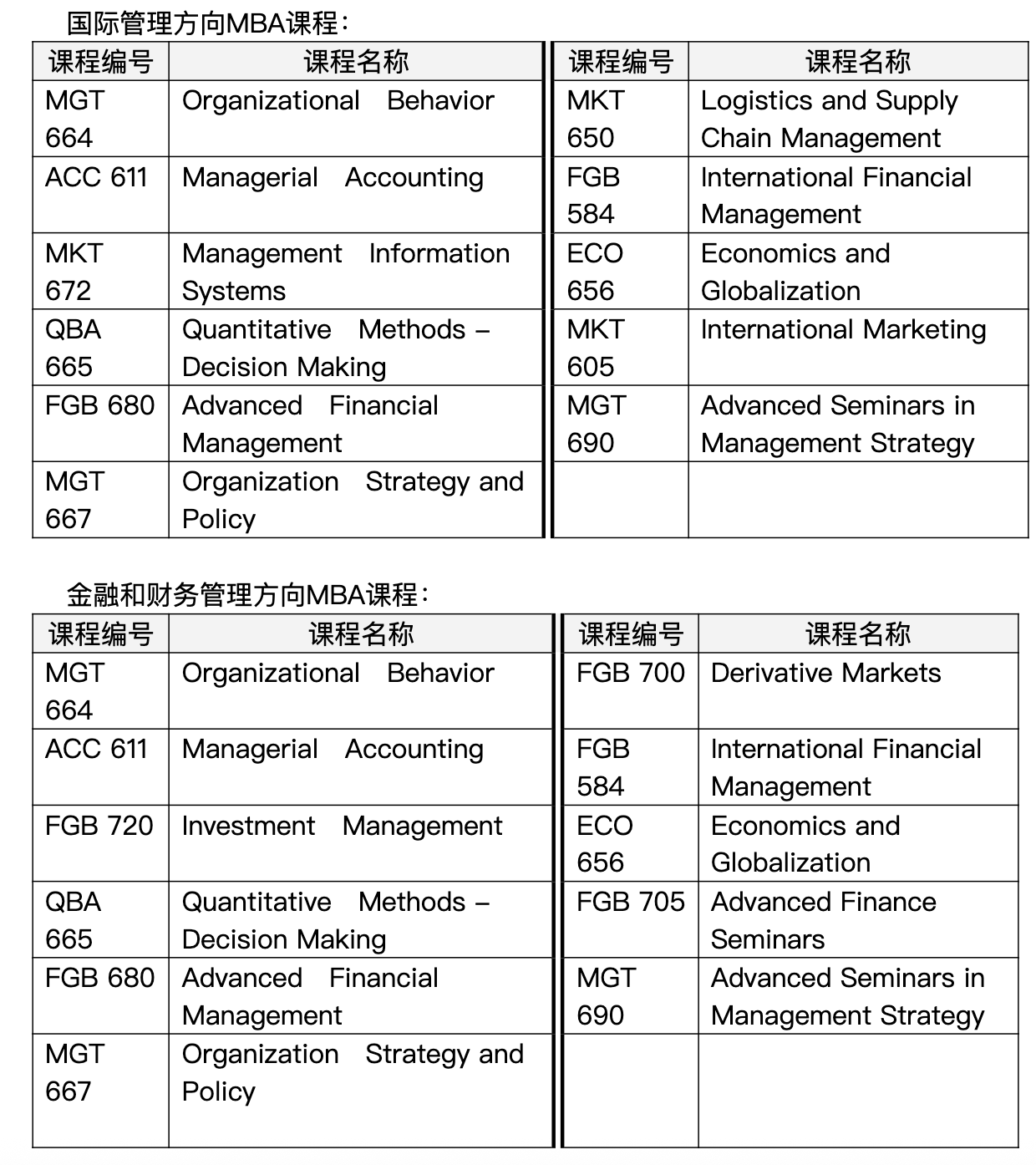
The report’s own evidence is thinner than its language suggests. Its opening “Key Facts” section relies on a small number of selected alumni cases, repeated until they appear to form a pattern. The programme is said to have trained more than 1,500 Chinese officials, state-enterprise managers and related personnel by 2018. But the report does not show that the handful of named defence-linked alumni are statistically representative of that universe. It offers no full alumni list, no denominator for defence-linked participants and no evidence that the programme as a whole was, meaningfully, a defence-industrial training pipeline.
Instead, a few individuals are named; their later employers are described in the most strategically charged terms available, to stand in for the whole programme. A small number of cases become “China’s defence executives.” A management degree becomes a pipeline. Association becomes function.
The slippage is clearest in the treatment of AVIC. AVIC is indeed a major Chinese aviation and defence conglomerate. It is also a vast industrial, commercial and financial system with civilian operations, leasing arms, logistics functions, finance units and commercial aerospace activities. To treat any AVIC affiliation as weapons work is to collapse a complex corporate structure into a single military identity.
One of the report’s own details should have encouraged caution: 107 finance personnel from AVIC system entities had completed the MSU programme. Finance personnel. That points naturally to corporate financial management, budgeting, accounting and administration. Yet the report repeatedly places such personnel near the “J-20 stealth fighter, Y-20 military transport, H-6 bomber, attack helicopters and military drones.” The proximity is rhetorical, not evidentiary. The report provides no evidence that the individuals it identifies were involved in the design, production, deployment or operational development of those systems. It places them inside large institutions that also contain such programmes, then lets the institution do the work of proof.

This is category drift. The report slides from individual to employer, from employer to conglomerate, from conglomerate to weapons platform, from weapons platform to national-security threat. The chapter title “China’s Weapons Makers in Springfield” captures the move. What is documented are people with varying roles in large state-owned enterprises passing through a business programme. The report supplies the weapons. The evidence supplies the office workers.
Even this transformation rests on a more basic omission: what kind of educational programme this actually was. Participants who had not reached TOEFL 79 or IELTS 6.0 could still take part. GMAT was not required. Standard graduate admissions procedures were bypassed in favour of cohort-based selection. These are not signs of an elite training pipeline. They are signs of a programme designed for participation rather than academic competition.
Anyone who has experienced graduate instruction in a second language understands the difference between exposure and mastery. If participants did not meet normal language thresholds, how much subtle strategic knowledge were they supposed to extract from a one-year management curriculum in Missouri? The report treats this gap as irrelevant. It is central to what the programme could plausibly do—and what it could not.
Business education has its uses. For an economy moving from central planning towards markets, exposure to Western accounting, corporate finance, marketing, logistics and management theory was not trivial. Chinese officials, state-enterprise managers and university administrators wanted a vocabulary of modern business that China did not yet fully possess. But it is a long way from that to the claim that a one-year management course in Springfield materially strengthened China’s defence-industrial base.
The more plausible description is less theatrical. This was an experiential programme: a year in America, a foreign degree, some business administration, and the prestige of touching a world that early twenty-first-century China still regarded as richer and more modern. For many participants, the value was probably American campuses, English, a foreign credential and institutional gloss.
There is something melancholy in that history. China was still looking outward with hunger, insecurity and admiration. Its officials and state-enterprise managers were sent abroad not because China had mastered the world, but because it had not. An American MBA, from Missouri State, carried an aura. To many Chinese organisations, it was less a weapon than a talisman.
That talisman now returns in American discourse as evidence of threat. What was once a poorer country’s attempt to learn from the United States is retrospectively recast as an operation against it. The old asymmetry is forgotten. The aspiration is criminalised. A Chinese manager who went to Missouri to acquire the vocabulary of American business now reappears as proof that America trained its adversary.
This is not simply wrong. It is sad. The United States once believed, perhaps too confidently, that exposure to American institutions would change China; China once believed, perhaps too earnestly, that learning from America was part of becoming modern. Both beliefs now lie in ruins. But to rummage through those ruins and declare every exchange a security failure is retrospective bitterness, not wisdom.
The report gestures at this history, acknowledging that the programme began in an earlier phase of U.S.–China engagement, when universities and policymakers encouraged such exchanges. Yet it repeatedly smuggles later anxieties back into earlier moments. A 2012 Chinese Government Friendship Award given to an MSU official is discussed through policy frameworks that did not yet exist or had not yet been articulated in their later form. References to the Belt and Road Initiative and Made in China 2025 are placed near the 2012 award, creating suggestive continuity across discontinuous periods. The report need not say the official’s work was connected to later policies. It merely places later policies near earlier actions, allowing chronology to soften into insinuation.
This is not historical analysis. It is temporal blending: distinct policy eras are allowed to bleed into one another until the past appears to anticipate the present.
The same problem appears in its treatment of Chinese public-sector selection. China is a party-state. Its state-owned enterprises, universities and local governments sponsor and screen personnel. To present this as revelation is to mistake bureaucracy for conspiracy.
Nor was this a secret file pulled from a vault. The Chinese-side material came from open notices, public university pages and recruitment materials. If the programme “evaded scrutiny,” it did so because, at the time, few people considered such a programme a national-security object. That is not concealment. It is a change in American perception.
The report is less interested in reconstructing what these programmes were than in showing what they can look like under contemporary security assumptions. A revenue-seeking international programme becomes a national-security node. A language-light MBA cohort becomes a training pipeline. A few named cases become representative of an unexplored population.
Seen in that light, Heartland for Hire is not a discovery of hidden structures. It is a document of interpretive transformation: what happens when an MBA programme, a university partnership and an educational exchange are passed through a security grammar that permits no non-strategic meanings to survive.
The tragedy is not that everything turns out to have been strategic. It is that so little is allowed to remain ordinary. (Enditem)
The State of Taste

Xie Na may or may not be a good singer. That is not the issue. Nor is it especially important whether her concert would have been elegant, moving, embarrassing or merely loud. A society that allows markets to function must also allow people to spend money on things others consider foolish. Bad taste is not a public emergency. A disappointing concert sho…
The category drift observation is the structural contribution and it applies far beyond Missouri State. The same analytical method, sliding from individual to employer to conglomerate to weapons platform to national security threat, is being applied across every domain of US-China interaction right now. Semiconductor engineers who worked at TSMC and later joined SMIC. Researchers who published with Chinese co-authors. Universities that accepted Chinese PhD students. The method treats proximity to a Chinese institution as evidence of strategic intent regardless of the individual's actual function, knowledge, or access. A finance clerk at AVIC becomes a "weapons maker" through the same slippage that turns an MBA student into a pipeline.
The method has no floor, which is what makes it so dangerous as a policy input. It can't distinguish between a genuine security concern and an ordinary educational exchange because it wasn't designed to distinguish. It was designed to generate volume, and volume creates the appearance of a pattern that justifies the method's own existence. The tragedy you named at the end, that so little is allowed to remain ordinary, is also the structural description of how analytical frameworks calcify into institutions that can't afford to find nothing, because finding nothing would mean the framework wasn't needed.
Wang's diagnosis of Heartland for Hire is correct, but too narrow: this is not a new pathology of the American security state, it is the oldest reflex in the book, simply re-tooled for the language of "strategic risk." The same country that once wrote alarmed dispatches about the Qing court's stubborn indifference to British trade demands, treating Chinese self-sufficiency itself as an affront requiring correction, ultimately by force in the Opium Wars, has a long institutional memory of converting Chinese competence into Chinese threat. When Chinese labor rather than Chinese sovereignty became the irritant, the reflex turned domestic and physical. The 1871 Chinese Massacre in Los Angeles, in which a mob killed roughly twenty Chinese residents after a dispute spiraled out of control, the 1885 Rock Springs Massacre in Wyoming Territory, where white miners killed dozens of Chinese coworkers whose diligence and lower strike rate had made them targets of resentment, that same year's forcible expulsion of the entire Chinese population of Tacoma, Washington, marched to the train depot in the rain and put out of the city by organized vigilance committees, and the Chinese Exclusion Act of 1882 and the Page Act of 1875 before it, which built exclusion into federal statute, together these form less a series of isolated incidents than a pattern. When Chinese individuals or communities demonstrated ordinary competence, thrift, and industry, the response was not admiration but violence, and when violence proved politically inconvenient, the response was law. Heartland for Hire belongs to the same lineage, dressed in the vocabulary of due diligence rather than nativism, but performing the identical function: converting a Chinese population's unremarkable success into evidence of danger.
The transcontinental railroad supplies the clearest early template for this pattern. Central Pacific Railroad's roughly 12,000 Chinese laborers, most recruited from Guangdong, performed the most lethal portion of the entire project, blasting and hand-drilling through the granite of the Sierra Nevada, wintering in snow tunnels at elevation, working with nitroglycerin under conditions that killed workers by the hundreds, and did so at lower wages than their white counterparts, without the provisioned board given to Euro-American crews, while organizing one of the earliest coordinated labor strikes in American railroad history, the June 1867 work stoppage demanding wage parity and shorter hours. Contemporary accounts and later labor histories consistently record that Chinese crews outpaced Irish and other Euro-American work gangs in output and reliability, with lower rates of the drinking-related absenteeism and disorder that regularly slowed Irish-dominated crews on the Union Pacific side of the line. The railroad could not have been finished on schedule without them. That performance bought the Chinese laborers of the 1860s no durable goodwill; it bought their descendants and countrymen the Exclusion Act fifteen years later. Effectiveness, once again, was not rewarded. It was punished, because it disrupted a racial hierarchy that depended on Chinese workers being seen as expendable rather than exceptional.
Applied to Missouri State, this history sharpens rather than softens Wang's critique, because it exposes a second and more embarrassing irony sitting underneath the first. Not only was the MSU programme ordinary rather than strategic, it was, by any serious academic standard, thin. A cohort-based MBA that waived TOEFL and GMAT thresholds, admitted participants without competitive screening, and existed principally to sell an American credential and a year of exposure to a still-developing administrative culture is not a training pipeline for a sophisticated adversary. It is a remedial finishing school for officials and managers from an economy that, well into the 2000s and 2010s, was still substantially organized around opaque state-enterprise balance sheets, politically directed lending, and the accounting habits of a command system only partially reformed. A curriculum built for institutions still learning to keep honest books and manage basic organizational hierarchy is structurally inapplicable to the kind of tightly disciplined, technically literate planning that a genuine defense-industrial pipeline would require. The programme's low bar of entry is not incidental to the security question, it is dispositive of it. The report wants the MSU cohort to be simultaneously unqualified enough to require no real admissions standard and sophisticated enough to extract usable strategic knowledge from a business-school syllabus. Those two claims cannot both be true, and the report needs both.