

This week, the United States marked the 25th anniversary of the September 11 terrorist attacks through memorial ceremonies, readings of victims’ names, moments of silence, acts of service, exhibitions and other forms of remembrance across the country. Nearly 3,000 innocent people were murdered that day. A quarter-century later, the horror of the attacks deserves neither qualification nor abstraction: terrorism against civilians must be condemned, and the victims and their families remembered.
A few days ago, Julian Gewirtz deftly revisited another part of the history of those days: how China’s leadership reacted to the attacks, and how that response affected a U.S.-China relationship that had been under considerable strain in the months before 9/11. He recounts how Beijing quickly condemned the attacks and expressed sympathy to the United States, and how that response helped alter the atmosphere between the two countries. Toward the end of his note, Gewirtz cites the late senior Chinese diplomat Wu Jianmin, who described Jiang Zemin’s rapid outreach as “a very brilliant diplomatic move,” adding that sometimes “a phone call is more powerful than a million soldiers.”
Wu Jianmin (1939–2016) was one of the best-known Chinese diplomats of his generation. Over a diplomatic career spanning several decades, he served as a Chinese Foreign Ministry spokesman and director-general of its Information Department, ambassador to the Netherlands and France, and China’s permanent representative to the United Nations Office at Geneva and other international organizations in Switzerland. After leaving his ambassadorial post in Paris, he served from 2003 to 2008 as president of China Foreign Affairs University.
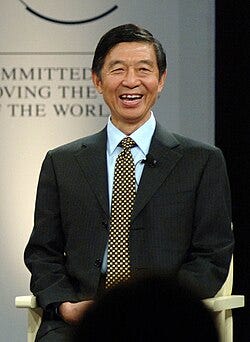
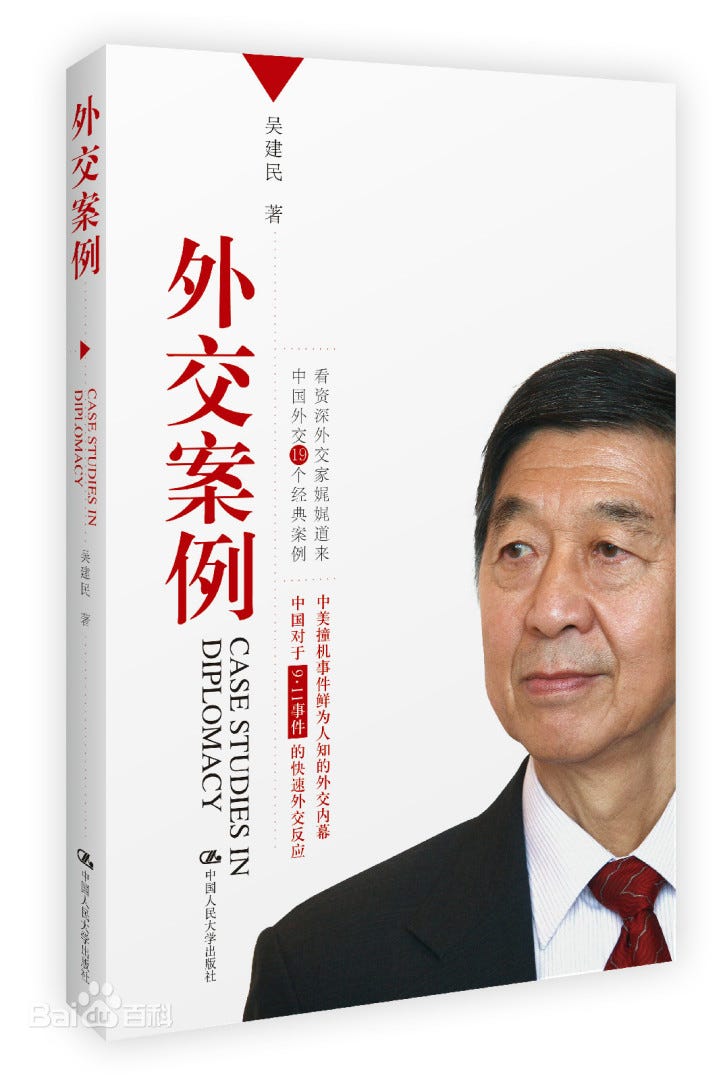
In 2007, Wu published 外交案例 (Case Studies in Diplomacy), a book developed from a course he taught at China Foreign Affairs University. Rather than offering a conventional diplomatic history, Wu organized 19 episodes around a simple structure: the background to an event, the choices facing Chinese diplomacy, what China actually did, and the lessons he drew from the experience. Among the cases was China’s response to the September 11 attacks. It is translated in full below.
I should add one qualification. In online fact-checking Wu’s account against contemporaneous Chinese and American public records, I found several details that do not appear to line up with the documentary record — most notably his repeated recollection that Jiang Zemin spoke with George W. Bush by telephone only five hours after the attacks. I have not silently corrected Wu’s text. The translation follows the Chinese original, while I have flagged the discrepancies in footnotes so readers can distinguish Wu’s own account from what the available records show.
In September 2001, China and the United States had serious disagreements and ample reasons to distrust each other. Yet when Americans were attacked and thousands of innocent people were killed, Beijing’s immediate response was not to view the tragedy simply through the prism of geopolitical rivalry. It expressed sympathy, condemned terrorism and offered cooperation.
There is something worth remembering in that today. China and the United States will continue to have profound differences, and neither country should pretend otherwise. But rivalry does not have to extinguish empathy, and strategic competition should not make it difficult to recognize the suffering of ordinary people on the other side. At some of the darkest moments in international affairs, basic humanity can itself become good diplomacy. A relationship as consequential as that between China and the United States surely needs more of it, not less.
中国对“9·11事件”的快速反应[上][下]
China’s Swift Response to 9/11
By Wu Jianmin
The September 11 attacks took place in 2001. They marked an important turning point in the international situation. What is worth noting is that only five hours after the attacks, President Jiang Zemin took the initiative to call President Bush.1 On behalf of the Chinese government and people, he condemned terrorism and expressed sympathy and condolences to the U.S. government and people. This action had an impact on the subsequent development of China-U.S. relations that should not be overlooked. Diplomatically, it was a highly successful move.
I. Background
After George W. Bush took office as U.S. president in January 2001, some new changes emerged in China-U.S. relations. Even during the presidential campaign, Bush had openly criticized the Clinton administration’s China policy, arguing that it was too soft and that a tougher element should be added. He characterized China-U.S. relations as one between “strategic competitors.”
After taking office, Bush not only abandoned the Clinton-era formulation of establishing a U.S.-China “constructive strategic partnership,” but also stopped mentioning the Clinton administration’s “Three Noes” commitment on the “Taiwan issue” — namely, no support for Taiwan independence, no support for “two Chinas” or “one China, one Taiwan,” and no support for Taiwan’s membership in international organizations for which statehood is a requirement. Clinton’s original formulation was: “we don’t support independence for Taiwan, or two Chinas, or one Taiwan-one China. And we don’t believe that Taiwan should be a member in any organization for which statehood is a requirement.”
The Bush administration suggested that the United States would not abandon its obligation to help defend Taiwan, while suspending China-U.S. military exchanges, vigorously advancing missile-defense plans, and exploring the construction of an Asia-Pacific security system. Its tough posture cast a new shadow over the development of China-U.S. relations.
Under these circumstances, on March 19, 2001, the Chinese government sent Vice Premier Qian Qichen to visit the United States, with the aim of exchanging information, increasing mutual trust, and preserving the healthy and stable development of China-U.S. relations. Vice Premier Qian Qichen’s visit was a complete success.
After this visit, with regard to the strategic positioning of China-U.S. relations, the U.S. side abandoned the formulation of “strategic competitor” and stated: “A strategic partner China is not, but neither is China our inevitable and implacable foe. China is a competitor, a potential regional rival, but also a trading partner willing to cooperate in areas where our strategic interests overlap.” It said that developing friendly relations with China was “in our nation’s best interests,” and the U.S. side agreed to “handle bilateral relations from a strategic perspective.” President Bush himself said during Qian’s visit: “It is in our nation’s best interests that we have good relations with China.”2
On the Taiwan issue, U.S. political leaders repeatedly reaffirmed that the United States would continue to adhere to the one-China policy and abide by the three China-U.S. Joint Communiqués, and they suggested that the United States would not sell Taiwan Aegis-class destroyers or Patriot III missiles. President Bush also said that he was “particularly eager to visit China.” Tensions between China and the United States eased somewhat.
However, on April 1, 2001, a U.S. reconnaissance aircraft collided with a Chinese military aircraft over China’s exclusive economic zone east of Hainan Island, and China-U.S. relations once again became tense. On April 24, in response to a question from an ABC reporter, Bush said that if Taiwan faced an attack from the mainland, the United States would defend Taiwan at any cost. His actual words, when asked whether this meant using the full force of the U.S. military, were: “Whatever it took to help Taiwan defend herself.” In April, the Bush administration decided to sell advanced weapons to Taiwan, including new weaponry that China was closely watching, such as missile destroyers equipped with Aegis radar systems.3
Through the Chinese government’s struggle, conducted on justified grounds, to China’s advantage, and with restraint, the U.S. government was compelled to say that it was “very sorry,” and the incident was ultimately properly resolved.
The circumstances described above show that, right up until the September 11 attacks, China-U.S. relations remained subject to a considerable degree of uncertainty.
II. The Choices Facing the Chinese Government
After the September 11 attacks, the Chinese government at the time faced the following choices:
Wait and observe, without taking a position;
Wait and observe the reactions and moves of various parties before taking a position;
Condemn terrorism as quickly as possible.
The Chinese government chose the third option.
III. The Specific Process
On the evening of the September 11 attacks, President Jiang Zemin watched almost the entire course of the events unfold on television and immediately decided to convene a meeting of the Politburo Standing Committee. After the meeting, at 1:47 a.m. Beijing time on September 12, President Jiang Zemin spoke by telephone with President Bush, condemned the terrorist attacks, expressed deep sympathy to the U.S. government and people, and offered condolences to the families of the victims. This was only five hours after the first terrorist attack.4
On the evening of September 12, President Jiang Zemin again spoke by telephone with U.S. President Bush at the latter’s request. President Bush first thanked President Jiang for calling him to express sympathy and condolences over the terrorist attacks. He said that he looked forward to strengthening cooperation with President Jiang and other leaders of the international community in jointly combating international terrorism. Bush hoped that the United States and China would strengthen cooperation in this regard at the United Nations Security Council. President Jiang said that China was very concerned about the progress of the rescue effort and was willing to provide the United States with all necessary support and assistance.
On September 12, Foreign Ministry spokesman Zhu Bangzao issued a statement on behalf of the Chinese government: “We are deeply shocked by the serious attacks on a number of locations in New York and Washington, which have caused heavy casualties.” “The Chinese government has consistently condemned and opposed all acts of terrorist violence.”
After the September 11 attacks, the Chinese government’s response was swift, timely and correct. In particular, the telephone exchanges between the two heads of state had a positive and far-reaching impact on stabilizing and advancing the development of China-U.S. relations. On September 25, 2001, White House Press Secretary Ari Fleischer disclosed that President Bush would still attend, as originally planned, the Asia-Pacific Economic Cooperation informal leaders’ meeting in Shanghai on October 20–21, but would postpone his visits to Tokyo, Seoul and Beijing. For the United States to make such a decision when the country had suffered an enormous disaster demonstrated the importance it attached to China and reflected an improvement in bilateral relations.
At the APEC joint ministerial press conference on October 18, 2001, U.S. Secretary of State Colin Powell said that “since the 11th of September, we have been encouraged by the response that we have had from China on support of the campaign against terrorism.” He also said that “our relationship is thriving in a number of different areas.” Although China and the United States still had differences over the handling of the aircraft collision incident, both sides should look forward.
From October 18 to 20, 2001, U.S. President George W. Bush made his first trip abroad after the September 11 attacks to attend the APEC meeting in Shanghai.
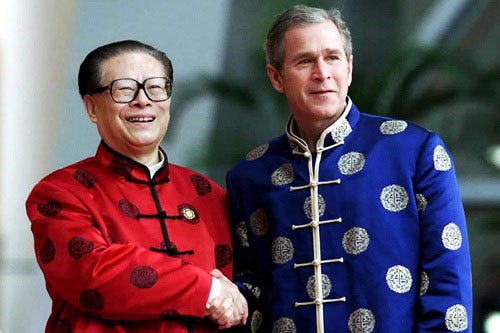
During the meeting, President Jiang and Bush held three hours of talks on China-U.S. relations, Taiwan and other issues. Bush made clear that “China is a great power. And America wants a constructive relationship with China,” and that “We seek a relationship that is candid, constructive and cooperative.” The two heads of state unanimously agreed to define China-U.S. relations as one in which the two sides were committed to developing a “constructive and cooperative relationship.” This established a positive direction for the future development of bilateral relations.
The September 11 attacks marked a turning point in U.S. foreign policy. After the collapse of the former Soviet Union, the United States suddenly lost the opponent against which it had competed. Who was America’s enemy? This was a major question in U.S. strategic thinking. The September 11 attacks and China’s rapid response made the United States realize that China was not America’s enemy; terrorism was the principal threat to U.S. national security, and the United States needed China’s cooperation and support. If, before September 11, the emphasis of U.S. policy toward China had been on containing China and guarding against its becoming a future adversary of the United States, after the attacks the emphasis shifted toward seeking cooperation with China and developing the relationship.
In February 2002, President Bush again made a working visit to China. During the visit, President Jiang Zemin put forward four proposals for maintaining and developing the positive momentum in bilateral relations and enriching the constructive and cooperative relationship: strengthening dialogue, deepening cooperation, properly handling differences, and jointly safeguarding world peace. Bush expressed agreement and said that, after 30 years of development, “Our ties are mature, respectful and important to both our nations and to the world.”
In April 2002, Vice President Hu Jintao visited the United States, and the visit was successful. From October 22 to 25, 2002, President Jiang Zemin visited the United States at President Bush’s invitation and was a guest at Bush’s private ranch, the Crawford Ranch in Texas. Only one year after the September 11 attacks, the Chinese and U.S. presidents held three meetings, and relations between the two countries tended toward stability.
During the 2004 U.S. presidential election, unlike “in the past,” China-U.S. relations were no longer a focus of contention between the Democratic and Republican parties. All of this reflected the fact that China-U.S. relations had entered a period of relatively stable development.
IV. Lessons
(1) Diplomacy Must Focus on the People
Diplomacy must focus on the people. This is a principle that China’s diplomacy has consistently upheld. Premier Zhou Enlai once said: “The ultimate purpose of diplomatic work is still to influence and win over the people.” I once had an opportunity to ask President Jiang in person why he had decided to call President Bush only five hours after the September 11 attacks. President Jiang said: “The foundation of diplomatic work is the people. The Chinese and American peoples are friendly toward each other. The September 11 attacks killed so many innocent Americans. Of course we Chinese should express our sympathy and condolences. People’s hearts are made of flesh.”5
President Jiang did not say much, but his words clarified an important principle of diplomacy and provided powerful guidance. The Chinese nation is a nation with a strong sense of compassion. When others suffer danger or hardship, the Chinese nation always expresses sympathy and offers comfort. This is a tradition of the Chinese nation. The September 11 attacks brought suffering to the American people. Seeing so many people die amid the raging flames, President Jiang decided immediately to call President Bush and express sympathy and condolences to the American people, thereby also expressing the feelings of the Chinese people.
The facts proved that this action had a very good effect. In the early days after George W. Bush took office, uncertainties in China-U.S. relations increased. During the campaign, he called China “not a strategic partner of the United States, but a competitor.” At the critical moment of September 11, President Jiang Zemin’s telephone call played an important role in bringing China-U.S. relations back onto a normal track.
(2) At Critical Moments, One Must Act Decisively
The facts are quite clear: making the call five hours after the attacks and making it three days later would have had completely different effects. The basis for acting decisively was a judgment about the nature of the event. The September 11 attacks were naked acts of terrorism that resulted in the deaths of large numbers of innocent people, while opposition to terrorism had always been a consistent position of the Chinese government.
Acting decisively must also be based on ordinary human feelings. Five hours after the attacks, 7 World Trade Center in New York had not yet collapsed, and smoke was still rising from the ruins. At that moment, the American people were experiencing their deepest grief. When people are grieving, what they need most is sympathy, support and comfort. This is human nature. When someone is in the most difficult circumstances and you express sympathy and offer comfort, it is something they are unlikely to forget. “People’s hearts are made of flesh.” This is simply human nature. It can therefore be seen that diplomacy not only cannot exclude ordinary human feelings; at times, ordinary human feelings are themselves a crucial factor leading to the right diplomatic decision.
Zichen’s note: Official records do not support the claim that Jiang Zemin and George W. Bush spoke by telephone only five hours after the first attack. The Chinese Foreign Ministry’s official English account says that Jiang “sent a telegram” to Bush on the night of September 11. The White House records an approximately ten-minute telephone conversation between Bush and Jiang on September 12.
Zichen’s note: The chronology in this paragraph is problematic. The quoted formulation beginning “A strategic partner China is not” was made by Colin Powell at his Senate confirmation hearing on January 17, 2001, two months before Qian Qichen’s March visit. Moreover, on April 5, after Qian’s visit, President Bush himself still said, “China is a strategic partner, a strategic competitor.” It is therefore too categorical to say that the U.S. side had abandoned the “strategic competitor” formulation as a result of Qian’s visit.
Zichen’s note: The April 2001 U.S. arms package did not approve the sale of Aegis-equipped destroyers to Taiwan. President Bush approved, among other items, four older Kidd-class destroyers, eight diesel-electric submarines and twelve P-3C aircraft, while deferring a decision on Aegis-equipped destroyers. The administration also approved a technical briefing on the PAC-3 system, rather than the sale of PAC-3 missiles themselves.
Zichen’s note: As noted above, official records do not support the claim that Jiang Zemin and George W. Bush spoke by telephone only five hours after the first attack. The Chinese Foreign Ministry’s official English account says that Jiang “sent a telegram” to Bush on the night of September 11. The White House records an approximately ten-minute telephone conversation between Bush and Jiang on September 12.
Zichen’s note: Again, as noted above, official records do not support the claim that Jiang Zemin and George W. Bush spoke by telephone only five hours after the first attack. The Chinese Foreign Ministry’s official English account says that Jiang “sent a telegram” to Bush on the night of September 11. The White House records an approximately ten-minute telephone conversation between Bush and Jiang on September 12.