


Zhao Shukai argues that the decisive breakthroughs in China’s rural reform of the 1980s were not designed in advance. Household contracting and other major changes emerged through initiatives from farmers, grassroots cadres and local governments, while the central leadership was often divided over how to respond. What made these breakthroughs possible, in his account, was a relatively pluralistic political environment that gave local actors considerable room to act and allowed competing policy approaches to coexist.
Zhao draws a broader lesson from this history: good public policy cannot simply be engineered from the top. Effective policies and institutions are often discovered through competition, experimentation and decentralised initiative. The role of higher authorities, he argues, should therefore be less to prescribe solutions than to preserve the political space in which alternative solutions can emerge.
Zhao Shukai (赵树凯; b. 1959) is a Chinese official of rural policy and governance. From 1982 to 1989, he worked at the Rural Policy Research Office of the Communist Party of China Central Committee’s Secretariat (later reorganised as the State Council’s Rural Development Research Centre and subsequently the Research Centre of Rural Economy under the Ministry of Agriculture and Rural Affairs). Starting in 1990, he served at the Development Research Centre of the State Council, China’s government cabinet, holding roles including Director General of the Rural Department’s Organisation Research Office and Director General of the Information Centre.
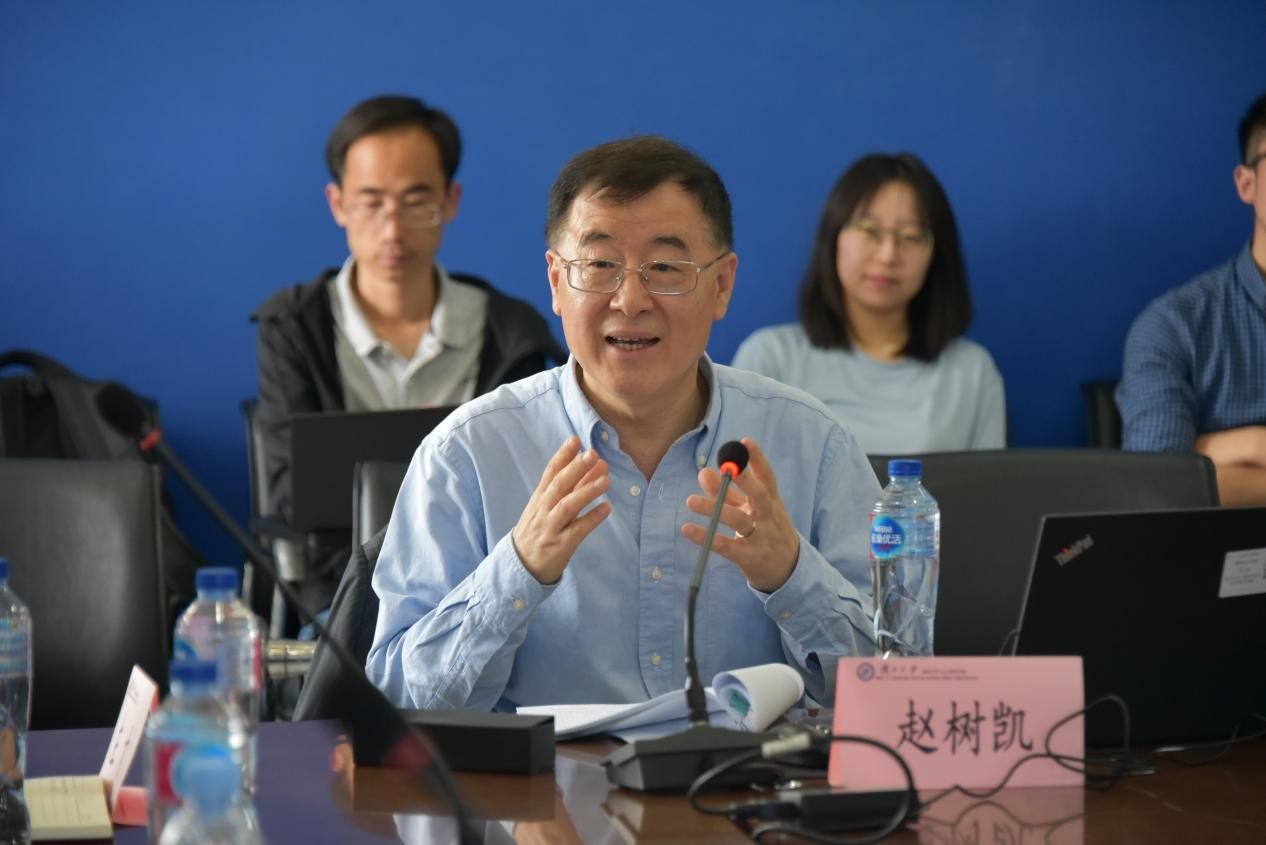
赵树凯:农村改革没有“设计师”
Zhao Shukai: Rural Reform Had No “Designer”
Rural reform in the 1980s unfolded through a series of groundbreaking departures from established policy. These upended conventional policymaking and marked a politically significant shift in policy direction.
The rural reforms of the 1980s represented an epoch-making policy shift. Household contracting reshaped the rural economic system, while the abolition of the people’s communes transformed governance at the grassroots. These changes paved the way for private ownership of large-scale means of production, the hiring of labour, and the freedom to leave one’s hometown for work or business, thereby laying the foundations of a market economy. No change in rural Chinese society since the founding of the People’s Republic has been more profound.
The profound significance of rural reform lay above all in the major political and ideological breakthroughs. The establishment of household contracting was not simply a change in how production was organised; it marked a far-reaching social and political turning point and the collapse of an old ideology.
In December 1958, the Sixth Plenary Session of the Eighth CPC Central Committee adopted the Resolution on Certain Questions Concerning the People’s Communes. The resolution stated that the people’s commune would “become the best form for our country’s transition from socialist to communist society” and that “in the future communist society, the people’s commune will remain the basic unit of the social structure.”1 In this sense, household contracting dismantled not only the people’s communes, but also the entire theoretical logic underpinning revolutionary development. It marked the collapse of a generation’s political ideals.
How did decisions on rural reform come about? As Du Runsheng put it: “There was no blueprint for rural reform drawn up in advance. It took shape through interactions at every level and on every front among farmers, grassroots cadres, local governments, and the central leadership.”2 By emphasising this multifaceted “interactions,” Du effectively rejected the idea that reform was driven by any single force. But this raises a further question: how exactly did these “interactions” unfold and reach fruition?
For these “interactions” to unfold, a particular political space was needed, and it was opened up by a pluralistic power structure at the centre. The rural policy process of the 1980s shows that this structure provided both a political arena for policy innovation and a political opening for reform. Reform occurred not simply because committed reformers emerged, but also because changes in the political structure created a more permissive environment — one enabled and sustained by multiple centres of power at the top. History has never lacked reformers; successful reforms, however, have been much rarer, because they depend on particular political conditions. The autonomy local governments enjoyed in policymaking within this pluralistic structure was the fundamental reason for the success of rural reform in the 1980s.
One school of thought attributes China’s reforms to guidance and planning by the country’s top leaders. Yet the course of rural reform in the 1980s shows that none of its major policy innovations originated in top-level design. Rural reform had already begun when the Third Plenary Session of the Eleventh CPC Central Committee was convened. More importantly, the documents adopted at that meeting explicitly prohibited household contracting. The same was true of the policy on hiring labour. When innovations and breakthroughs emerged at the grassroots level, the central leadership itself was divided over how to respond. Even among those who supported reform, some moved faster than others — a divergence later explained by saying that “understanding takes time.” Nor was there any shortage of people who opposed reform to the very end.
Another school of thought characterises decision-making in China’s reforms as “experimentation under hierarchy”: “key political goals are defined centrally; the policy instruments, however, are regularly developed and tested locally, and they are only later applied on a national scale.” Yet the pivotal breakthroughs in rural reform did not occur in this way. There was no centrally designed policy of “experimentation under hierarchy” among the top leadership. If anything resembling such experimentation did take place, it was only after reform had already achieved its decisive breakthroughs.
The decision-making process behind rural reform shows that top leaders should not hold a monopoly on policy decisions or serve as the sole source of policy. Higher levels of government should not monopolise policymaking; localities should have ample autonomy to formulate their own policies. Nor should the top-level policymaking apparatus be a closed, single-centre system. Lower levels of government and other social organisations should do more than merely supply information and offer policy recommendations: different parts of the system should have an independent voice and the right to participate.
Put differently, a power structure that allows and encourages competing policy proposals is an essential institutional safeguard for sound public policy. Such a structure must necessarily be pluralistic. Policymaking cannot depend excessively on political authority at the top. Such a political order must be reformed and a polycentric policymaking system established.
The decision-making process behind rural reform also shows that public policy cannot be scientifically engineered. Unlike in the natural sciences, mathematical models cannot be used to predict outcomes precisely and design every arrangement in advance. However capable leaders and experts may be, they cannot readily foresee which policies or institutional arrangements will prove effective.
In the case of particular rural policies, even farmers themselves often found it difficult at the time to judge what would work best for them. They needed sufficient freedom to compare alternatives and choose for themselves. Consider household contracting. Initially, some farmers in more developed rural areas did not believe it suited their circumstances and even preferred to retain the production-team system. Yet once household contracting was introduced, they had no wish to return to the old system.
Sound policymaking, therefore, depends on an open environment in which alternatives can compete. Competition is the fundamental means through which effective policies and sound institutions are discovered. In policymaking, polycentrism requires the highest decision-making authorities to redefine their role, moving away from issuing directives and towards respecting grassroots and the people.
Good policies and sound institutions can emerge only through robust and effective competition. The fundamental advantage of a pluralistic distribution of power, or a polycentric system, is that it preserves competition in the policymaking process and gives full play to the autonomy and creativity of the whole society.

Zhao Shukai: From National Policy to Local Politics

Regional stereotypes are a staple of Chinese humour: Shandong is associated with bureaucracy and protocol, Sichuan and Chongqing with bluntness, Beijing with political savvy and grand talk, and Shanghai with commercial pragmatism.
Zhao Shukai: China’s Rural Reform Began with Political Change

China’s rural reform is commonly recounted as a series of policy breakthroughs, above all the shift from collective to household farming. Zhao Shukai, however, argues that the political changes that preceded — and made possible — policy shifts should not be overlooked. A less monolithic distribution of power at the top, together with growing disagreemen…
Zhao Shukai: where Ezra Vogel got it wrong

Zhao Shukai (赵树凯; b. 1959) is a Chinese official of rural policy and governance. From 1982 to 1989, he worked at the Rural Policy Research Office of the Communist Party of China Central Committee’s Secretariat (later reorganised as the State Council’s Rural Development Research Centre and subsequently the
General Office of the State Agricultural Commission, ed., Nongye jitihua zhongyao wenjian huibian 农业集体化重要文件汇编 [A Compilation of Important Documents on Agricultural Collectivization], vol. 2 (Beijing: Central Party School Press, 1981), 112.
Du Runsheng 杜润生, ed., Zhongguo nongcun gaige juece jishi 中国农村改革决策纪事 [A Chronicle of Decision-Making in China’s Rural Reform] (Beijing: Central Party Literature Press, 1999), 1.


Good to have this in English.
What strikes me is who is saying it. A man who sat inside the rural policy apparatus in the 1980s is arguing that the reform era's founding success came from below, from competition between approaches, not from design at the top. That reads differently today, when top-level design is the official vocabulary.
My question is practical. The experimentation Zhao describes rode on real local room, including fiscal room. Land sales revenue has roughly halved from its 2021 peak. Where does a province now find the space to try something different?
I think we need to get away from thinking that progress either occurs top down through central planning or bottom up through competitive markets. It occurs through a process of “coordinated adaptation”, where central authorities engage with independent agents to coordinate public and private investments. We need both top down coordination and bottom up adaptation.